
用产热稳定肠毒素的产肠毒素性菌株TW11681对人类志愿者进行实验性感染。
Experimental Infection of Human Volunteers with the Heat-Stable Enterotoxin-Producing Enterotoxigenic Strain TW11681.
作者信息
Todnem Sakkestad Sunniva, Steinsland Hans, Skrede Steinar, Kleppa Elisabeth, Lillebø Kristine, Sævik Marianne, Søyland Hanne, Rykkje Heien Astrid, Gjerde Tellevik Marit, Barry Eileen M, Sommerfelt Halvor, Hanevik Kurt
机构信息
Department of Clinical Science, Faculty of Medicine, University of Bergen, Postbox 7804, 5020 Bergen, Norway.
Centre for International Health, Department of Global Public Health and Primary Care, Faculty of Medicine, University of Bergen, Postbox 7894, 5020 Bergen, Norway.
出版信息
Pathogens. 2019 Jun 22;8(2):84. doi: 10.3390/pathogens8020084.
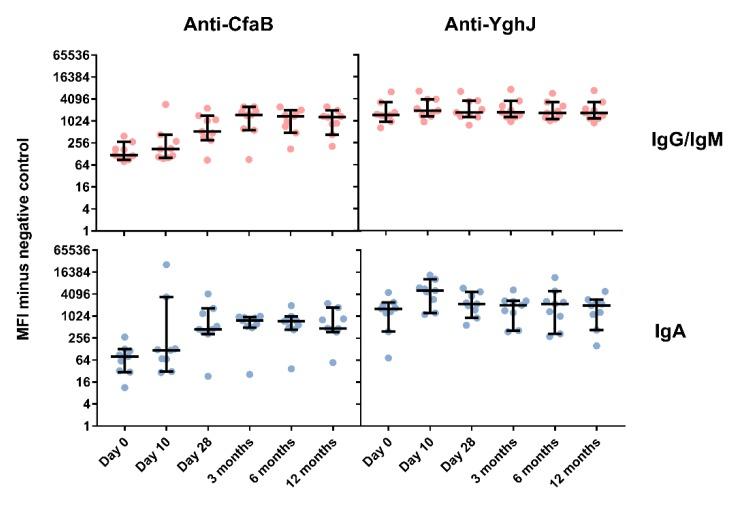
Infection with enterotoxigenic (ETEC) producing the heat-stable enterotoxin (ST) is one of the most important causes of childhood diarrhoea in low- and middle-income countries. Here, we undertook a controlled human infection model (CHIM) study to investigate whether ST-producing ETEC strain TW11681 would be suitable for testing the protective efficacy of new ST-based vaccine candidates in vaccine challenge models. In groups of three, nine volunteers ingested 1 × 10, 1 × 10, or 1 × 10 colony-forming units (CFU) of TW11681. Flow cytometry-based assays were used to measure CD4+ T cell responses and antibody levels targeting virulence factors expressed by the strain. We found that infection with TW11681 elicited few and mild symptoms, including mild diarrhoea in two volunteers, both of whom ingested 1 × 10 CFU. Averaged across all volunteers, the CD4+ T cell responses specific for YghJ mucinase peaked 10 days after infection (3.2-fold (p = 0.016)), while the CD4+ T cell responses specific for Colonization Factor Antigen I (CFA/I) major fimbrial subunit (CfaB) peaked after 28 days (3.6-fold (p = 0.063)). The serum CfaB-specific anti-IgA and anti-IgG/IgM levels were significantly increased and peaked 3 months after infection. Both remained elevated for the duration of the 12-month follow-up. The corresponding anti-YghJ serological response was strongest after 10 days, although a significant increase was seen only for IgA levels (3.2-fold (p = 0.008)). In conclusion, due to its low diarrhoea attack risk, TW11681 is probably not suitable for testing the efficacy of new vaccines in human challenge studies at doses 1 × 10 to 1 × 10. However, the strain may still be useful in CHIMs for studying ETEC host-pathogen interactions.
感染产生热稳定肠毒素(ST)的产肠毒素大肠杆菌(ETEC)是低收入和中等收入国家儿童腹泻的最重要原因之一。在此,我们进行了一项人体感染对照模型(CHIM)研究,以调查产ST的ETEC菌株TW11681是否适合在疫苗攻毒模型中测试新型基于ST的候选疫苗的保护效力。9名志愿者分成3组,每组3人,分别摄入1×10、1×10或1×10个TW11681的菌落形成单位(CFU)。基于流式细胞术的检测方法用于测量CD4 + T细胞反应以及针对该菌株表达的毒力因子的抗体水平。我们发现,感染TW11681引发的症状较少且较轻,包括两名摄入1×10 CFU的志愿者出现轻度腹泻。在所有志愿者中,针对YghJ粘蛋白酶的CD4 + T细胞反应在感染后10天达到峰值(3.2倍(p = 0.016)),而针对定居因子抗原I(CFA/I)主要菌毛亚基(CfaB)的CD4 + T细胞反应在28天后达到峰值(3.6倍(p = 0.063))。血清中CfaB特异性抗IgA和抗IgG/IgM水平显著升高,并在感染后3个月达到峰值。在12个月的随访期内两者均持续升高。相应的抗YghJ血清学反应在10天后最强,尽管仅IgA水平有显著升高(3.2倍(p = 0.008))。总之,由于其导致腹泻的风险较低,TW11681可能不适合在人体攻毒研究中以1×10至1×10的剂量测试新型疫苗的效力。然而,该菌株在CHIM中对于研究ETEC宿主-病原体相互作用可能仍有用处。


 Zotero 插件