
理想与现实:关于随机对照试验中协变量处理的系统评价。
Ideal vs. real: a systematic review on handling covariates in randomized controlled trials.
机构信息
Department of Preventive Medicine, Biostatistics Collaboration Center, Feinberg School of Medicine, Northwestern University, 680 N Lake Shore Drive, Suite 1400, Chicago, IL, 60611-4402, USA.
AbbVie Inc, North Chicago, IL, USA.
出版信息
BMC Med Res Methodol. 2019 Jul 3;19(1):136. doi: 10.1186/s12874-019-0787-8.
BACKGROUND
In theory, efficient design of randomized controlled trials (RCTs) involves randomization algorithms that control baseline variable imbalance efficiently, and corresponding analysis involves pre-specified adjustment for baseline covariates. This review sought to explore techniques for handling potentially influential baseline variables in both the design and analysis phase of RCTs.
METHODS
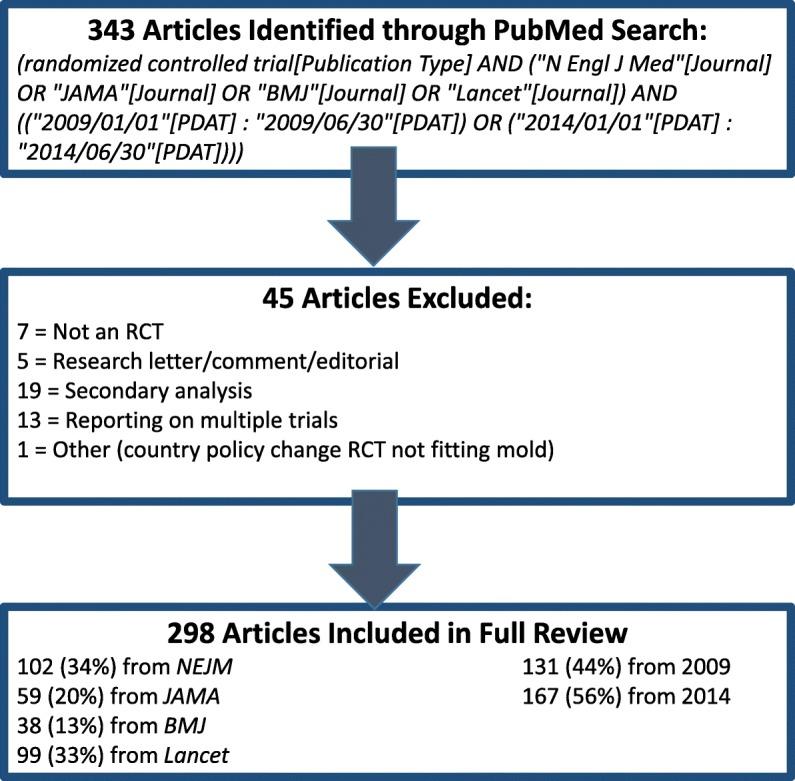
We searched PubMed for articles indexed "randomized controlled trial", published in the NEJM, JAMA, BMJ, or Lancet for two time periods: 2009 and 2014 (before and after updated CONSORT guidelines). Upon screening (343), 298 articles underwent full review and data abstraction.
RESULTS
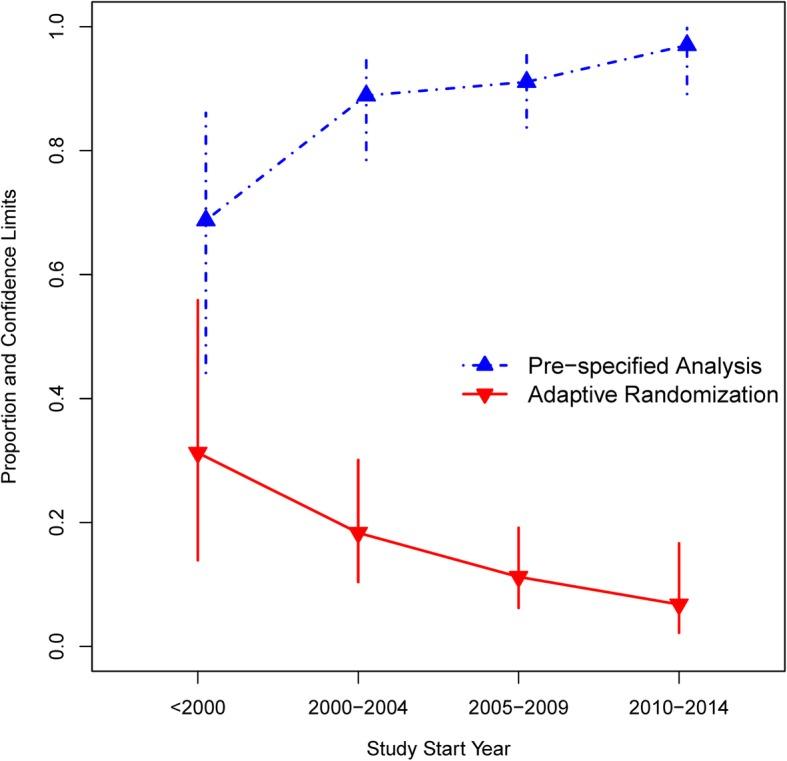
Typical articles reported on superiority (86%), multicenter (92%), two-armed (79%) trials; 81% of trials involved covariates in the allocation and 84% presented adjusted analysis results. The majority reported a stratified block method (69%) of allocation, and of the trials reporting adjusted analyses, 91% were pre-specified. Trials published in 2014 were more likely to report adjusted analyses (87% vs. 79%, p = 0.0100) and more likely to pre-specify adjustment in analyses (95% vs. 85%, p = 0.0045). Studies initiated in later years (2010 or later) were less likely to use an adaptive method of randomization (p = 0.0066; 7% of those beginning in 2010 or later vs. 31% of those starting before 2000) but more likely to report a pre-specified adjusted analysis (p = 0.0029; 97% for those initiated in 2010 or later vs. 69% of those started before 2000).
CONCLUSION
While optimal reporting procedures and pre-specification of adjusted analyses for RCTs tend to be progressively more prevalent over time, we see the opposite effect on reported use of covariate-adaptive randomization methods.
背景
从理论上讲,高效的随机对照试验(RCT)设计涉及到能够有效控制基线变量不均衡的随机化算法,相应的分析则需要针对基线协变量进行预设调整。本综述旨在探讨在 RCT 的设计和分析阶段处理潜在有影响的基线变量的技术。
方法
我们在 PubMed 上检索了在 NEJM、JAMA、BMJ 或 Lancet 上发表的 2009 年和 2014 年两个时间段的索引为“随机对照试验”的文章。经过筛选(343 篇),298 篇文章进行了全面审查和数据提取。
结果
典型的文章报道了优越性(86%)、多中心(92%)、双臂(79%)试验;81%的试验涉及分配中的协变量,84%呈现了调整后的分析结果。大多数报告采用分层块方法(69%)进行分配,且报告调整分析的试验中,91%是预设的。2014 年发表的试验更有可能报告调整分析(87%比 79%,p=0.0100),更有可能在分析中预设调整(95%比 85%,p=0.0045)。在较晚年份(2010 年或之后)开始的研究更不可能采用自适应随机化方法(p=0.0066;2010 年或之后开始的研究中,7%采用该方法,而 2000 年之前开始的研究中,31%采用该方法),但更有可能报告预设的调整分析(p=0.0029;2010 年或之后开始的研究中,97%采用该方法,而 2000 年之前开始的研究中,69%采用该方法)。
结论
尽管 RCT 的最佳报告程序和针对调整分析的预设分析在时间上趋于更加普遍,但我们看到报告中使用协变量适应性随机化方法的情况却出现了相反的效果。
 Zotero 插件