
饮食在 2 型糖尿病发病中的作用:对前瞻性观察研究荟萃分析的伞状评价。
Role of diet in type 2 diabetes incidence: umbrella review of meta-analyses of prospective observational studies.
机构信息
Institute for Biometrics and Epidemiology, German Diabetes Centre, Leibniz Centre for Diabetes Research at Heinrich Heine University Düsseldorf, Auf'm Hennekamp 65, D-40225 Düsseldorf, Germany.
Institute for Clinical Diabetology, German Diabetes Centre, Leibniz Centre for Diabetes Research at Heinrich Heine University Düsseldorf, Düsseldorf, Germany.
出版信息
BMJ. 2019 Jul 3;366:l2368. doi: 10.1136/bmj.l2368.
OBJECTIVE
To summarise the evidence of associations between dietary factors and incidence of type 2 diabetes and to evaluate the strength and validity of these associations.
DESIGN
Umbrella review of systematic reviews with meta-analyses of prospective observational studies.
DATA SOURCES
PubMed, Web of Science, and Embase, searched up to August 2018.
ELIGIBILITY CRITERIA
Systematic reviews with meta-analyses reporting summary risk estimates for the associations between incidence of type 2 diabetes and dietary behaviours or diet quality indices, food groups, foods, beverages, alcoholic beverages, macronutrients, and micronutrients.
RESULTS
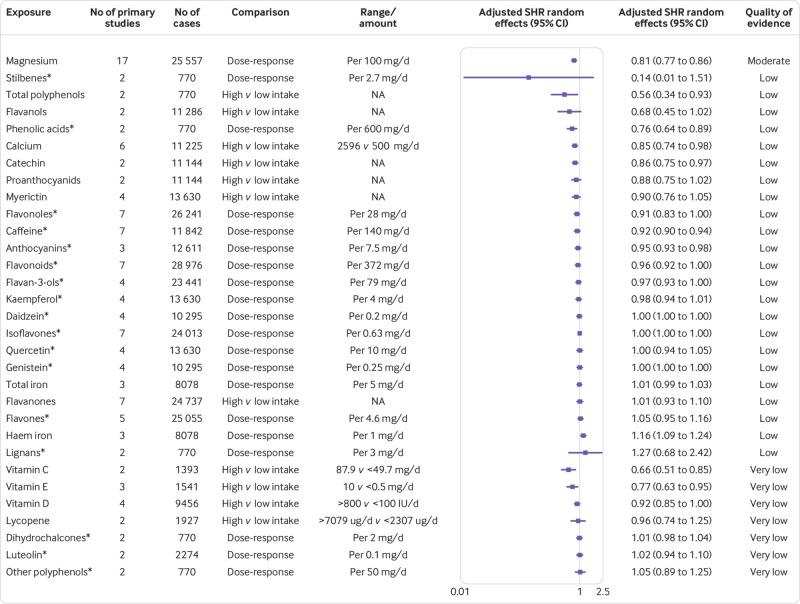
53 publications were included, with 153 adjusted summary hazard ratios on dietary behaviours or diet quality indices (n=12), food groups and foods (n=56), beverages (n=10), alcoholic beverages (n=12), macronutrients (n=32), and micronutrients (n=31), regarding incidence of type 2 diabetes. Methodological quality was high for 75% (n=115) of meta-analyses, moderate for 23% (n=35), and low for 2% (n=3). Quality of evidence was rated high for an inverse association for type 2 diabetes incidence with increased intake of whole grains (for an increment of 30 g/day, adjusted summary hazard ratio 0.87 (95% confidence interval 0.82 to 0.93)) and cereal fibre (for an increment of 10 g/day, 0.75 (0.65 to 0.86)), as well as for moderate intake of total alcohol (for an intake of 12-24 g/day no consumption, 0.75 (0.67 to 0.83)). Quality of evidence was also high for the association for increased incidence of type 2 diabetes with higher intake of red meat (for an increment of 100 g/day, 1.17 (1.08 to 1.26)), processed meat (for an increment of 50 g/day, 1.37 (1.22 to 1.54)), bacon (per two slices/day, 2.07 (1.40 to 3.05)), and sugar sweetened beverages (for an increase of one serving/day, 1.26 (1.11 to 1.43)).
CONCLUSIONS
Overall, the association between dietary factors and type 2 diabetes has been extensively studied, but few of the associations were graded as high quality of evidence. Further factors are likely to be important in type 2 diabetes prevention; thus, more well conducted research, with more detailed assessment of diet, is needed.
SYSTEMATIC REVIEW REGISTRATION
PROSPERO CRD42018088106.
目的
总结饮食因素与 2 型糖尿病发病率之间关联的证据,并评估这些关联的强度和有效性。
设计
对前瞻性观察研究的系统评价进行伞式综述,并进行荟萃分析。
数据来源
PubMed、Web of Science 和 Embase,检索截至 2018 年 8 月。
入选标准
系统评价,其中包括了与 2 型糖尿病发病率相关的饮食行为或饮食质量指数、食物组、食物、饮料、酒精饮料、宏量营养素和微量营养素的汇总风险估计,并进行了荟萃分析。
结果
纳入了 53 篇文献,其中有 153 项关于饮食行为或饮食质量指数(n=12)、食物组和食物(n=56)、饮料(n=10)、酒精饮料(n=12)、宏量营养素(n=32)和微量营养素(n=31)与 2 型糖尿病发病率之间关联的调整后的综合危险比。75%(n=115)的荟萃分析具有较高的方法学质量,23%(n=35)为中等质量,2%(n=3)为低质量。对于摄入全谷物(每天增加 30 克,调整后的综合危险比 0.87(95%置信区间 0.82 至 0.93))和谷物纤维(每天增加 10 克,0.75(0.65 至 0.86))与 2 型糖尿病发病率呈负相关,以及摄入适量的总酒精(每天摄入 12-24 克与不饮酒相比,0.75(0.67 至 0.83)),证据质量被评为高。对于摄入更多的红肉(每天增加 100 克,1.17(1.08 至 1.26))、加工肉类(每天增加 50 克,1.37(1.22 至 1.54))、熏肉(每天两片,2.07(1.40 至 3.05))和含糖饮料(每天增加一份,1.26(1.11 至 1.43))与 2 型糖尿病发病率增加之间的关联,证据质量也很高。
结论
总的来说,饮食因素与 2 型糖尿病之间的关联已经得到了广泛的研究,但很少有研究被评为高质量证据。可能还有其他因素对 2 型糖尿病的预防很重要;因此,需要进行更多精心设计的研究,并对饮食进行更详细的评估。
系统评价注册
PROSPERO CRD42018088106。


 Zotero 插件