
乳糜泻和难治性乳糜泻的最新进展
Recent advances in celiac disease and refractory celiac disease.
作者信息
Malamut Georgia, Cording Sascha, Cerf-Bensussan Nadine
机构信息
Gastroenterology, Hôpital Cochin APHP, Paris, France.
Université Paris Descartes, Paris, France.
出版信息
F1000Res. 2019 Jun 26;8. doi: 10.12688/f1000research.18701.1. eCollection 2019.
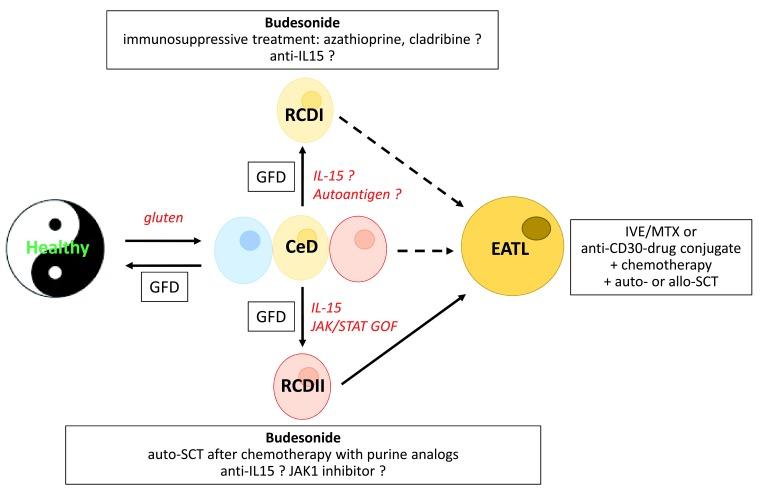
Celiac disease (CeD), defined as gluten-induced enteropathy, is a frequent and largely underdiagnosed disease. Diagnosis relies on the detection of highly specific serum IgA anti-transglutaminase auto-antibodies and on the demonstration of duodenal villous atrophy. Treatment necessitates a strict gluten-free diet, which resolves symptoms and enables histological recovery. However, regular follow-up is necessary to assess mucosal healing, which emerges as an important prognostic factor. Recent work on CeD pathogenesis has highlighted how the cross-talk between gluten-specific CD4 T cells and interleukin-15 can activate cytotoxic intraepithelial lymphocytes and trigger epithelial lesions. Moreover, acquisition by a subset of intraepithelial lymphocytes of somatic gain-of-function mutations in the JAK-STAT pathway was shown to be a decisive step in the progression toward lymphomas complicating CeD, thus opening new therapeutic perspectives for these rare but life-threatening complications.
乳糜泻(CeD),定义为麸质诱导的肠病,是一种常见但大多未被诊断的疾病。诊断依赖于检测高度特异性的血清IgA抗转谷氨酰胺酶自身抗体以及十二指肠绒毛萎缩的证实。治疗需要严格的无麸质饮食,这可以缓解症状并实现组织学恢复。然而,定期随访对于评估黏膜愈合是必要的,黏膜愈合已成为一个重要的预后因素。最近关于CeD发病机制的研究突出了麸质特异性CD4 T细胞与白细胞介素-15之间的相互作用如何激活细胞毒性上皮内淋巴细胞并引发上皮病变。此外,上皮内淋巴细胞亚群获得JAK-STAT途径中的体细胞功能获得性突变被证明是CeD并发淋巴瘤进展中的决定性步骤,从而为这些罕见但危及生命的并发症开辟了新的治疗前景。

 Zotero 插件