
阿达木单抗治疗甲银屑病:来自一项 3 期、随机、安慰剂对照试验的 52 周疗效和安全性。
Adalimumab for nail psoriasis: efficacy and safety over 52 weeks from a phase-3, randomized, placebo-controlled trial.
机构信息
School of Medicine, University of Alabama at Birmingham, Birmingham, AL, USA.
Skin & Cancer Foundation Inc and Probity Medical Research, Carlton, Vic., Australia.
出版信息
J Eur Acad Dermatol Venereol. 2019 Nov;33(11):2168-2178. doi: 10.1111/jdv.15793. Epub 2019 Sep 4.
BACKGROUND
Few clinical trials have evaluated long-term treatment of nail psoriasis with biologics.
OBJECTIVE
Safety and efficacy of adalimumab [ADA; Humira AbbVie Inc, North Chicago, IL, USA)] long-term treatment (52 weeks) was evaluated in a phase-3, randomized trial in patients with moderate-to-severe plaque psoriasis and concomitant moderate-to-severe fingernail psoriasis. Results from the first 26 weeks (Period A) have been reported.
METHODS
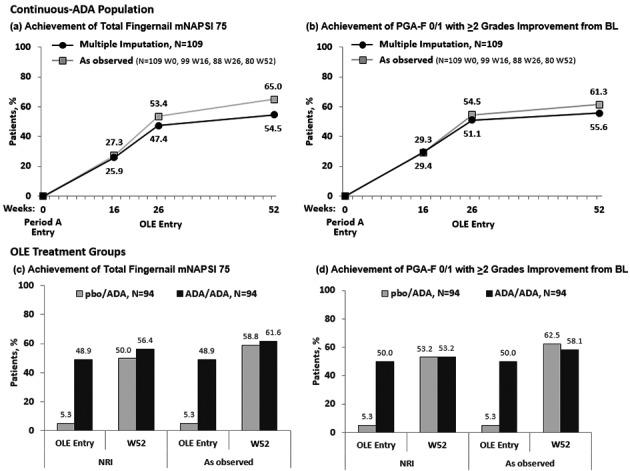
Patients receiving 40 mg ADA every other week or placebo in Period A, continued with or switched to 40 mg ADA every-other-week treatment in the subsequent 26-week open-label extension (OLE) period. Main efficacy evaluations were ≥75% improvement in total-fingernail modified Nail Psoriasis Severity Index (mNAPSI 75) and achievement of Physician's Global Assessment for Fingernail Psoriasis of clear or minimal disease (PGA-F 0/1) with a ≥2-grade improvement from baseline, across the trial for patients who continued ADA from Period A through the OLE (Continuous-ADA Population). Safety was evaluated during the OLE and for patients receiving ADA at any time during the study (All-ADA Population).
RESULTS
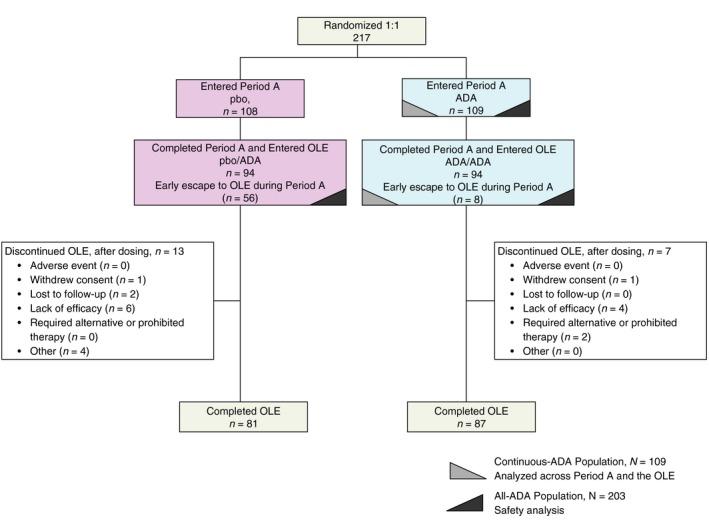
Of the 217 patients initially randomized in Period A, 188 (86.6%; 94 in each treatment group) entered the OLE after completion of or early escape from Period A. For the Continuous-ADA Population (N = 109), endpoint achievement rates improved from OLE entry (Week 26) to Week 52, including total-fingernail mNAPSI 75 (47.4-54.5%); PGA-F 0/1 (51.1-55.6%) and total-fingernail mNAPSI = 0 (6.6-17.9%). Serious adverse event and serious infection rates for the All-ADA Population (N = 203) were 6.9% and 3.4%, respectively.
CONCLUSIONS
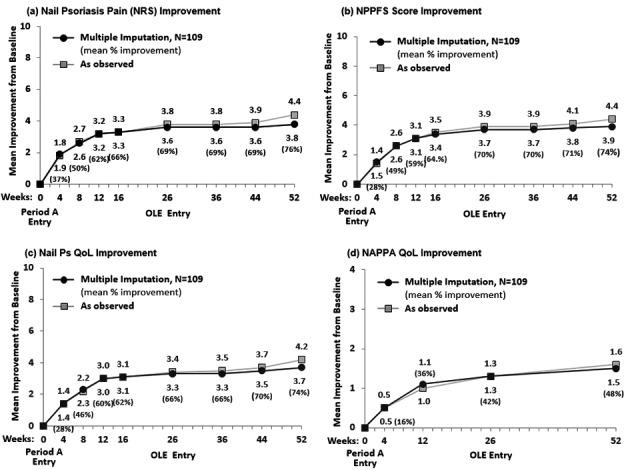
In this population of psoriasis patients with concomitant, moderate-to-severe nail psoriasis, long-term efficacy and improvement in signs and symptoms of nail disease were demonstrated after every-other-week ADA treatment, including incremental improvements in rate of total clearance of nail disease. No new safety risks were identified for patients receiving at least one ADA dose across 52 weeks.
背景
很少有临床试验评估生物制剂长期治疗指甲银屑病的效果。
目的
评估阿达木单抗(ADA;美国雅培公司,芝加哥,伊利诺伊州,美国))长期治疗(52 周)的安全性和疗效,这项 3 期随机试验纳入了中重度斑块型银屑病和中重度指甲银屑病的患者。本研究报告了前 26 周(A 期)的结果。
方法
A 期接受 ADA 40mg 每 2 周 1 次或安慰剂治疗的患者,在随后的 26 周开放标签扩展(OLE)期继续接受或转换为 ADA 40mg 每 2 周 1 次治疗。主要疗效评估是在整个试验中,继续 ADA 治疗的患者(从 A 期到 OLE 期的连续 ADA 人群)的指甲总评分(mNAPSI75)改善≥75%和指甲银屑病医师总体评估(PGA-F)为清除或轻度疾病(PGA-F0/1),与基线相比改善≥2 级,同时评估安全性和研究期间任何时间接受 ADA 治疗的患者(所有 ADA 人群)。
结果
在 A 期最初随机分组的 217 名患者中,188 名(86.6%;每组 94 名)在完成 A 期或提前退出后进入 OLE。对于连续 ADA 人群(N=109),终点达标率从 OLE 进入(第 26 周)到第 52 周有所提高,包括指甲总评分(mNAPSI75)(47.4-54.5%);PGA-F0/1(51.1-55.6%)和指甲总评分 mNAPSI=0(6.6-17.9%)。所有 ADA 人群(N=203)的严重不良事件和严重感染发生率分别为 6.9%和 3.4%。
结论
在伴有中重度指甲银屑病的银屑病患者中,每 2 周接受 ADA 治疗后,可长期观察到疗效和指甲疾病体征和症状的改善,包括指甲疾病总清除率的逐渐提高。在 52 周内至少接受一次 ADA 治疗的患者未发现新的安全性风险。

 Zotero 插件