
美国住院患者急性肾损伤的简单实时预测模型:描述性建模研究。
A simple real-time model for predicting acute kidney injury in hospitalized patients in the US: A descriptive modeling study.
机构信息
Program of Applied Translational Research, Yale School of Medicine, New Haven, Connecticut, United States of America.
Joint Data Analytics Team, Yale School of Medicine, New Haven, Connecticut, United States of America.
出版信息
PLoS Med. 2019 Jul 15;16(7):e1002861. doi: 10.1371/journal.pmed.1002861. eCollection 2019 Jul.
BACKGROUND
Acute kidney injury (AKI) is an adverse event that carries significant morbidity. Given that interventions after AKI occurrence have poor performance, there is substantial interest in prediction of AKI prior to its diagnosis. However, integration of real-time prognostic modeling into the electronic health record (EHR) has been challenging, as complex models increase the risk of error and complicate deployment. Our goal in this study was to create an implementable predictive model to accurately predict AKI in hospitalized patients and could be easily integrated within an existing EHR system.
METHODS AND FINDINGS
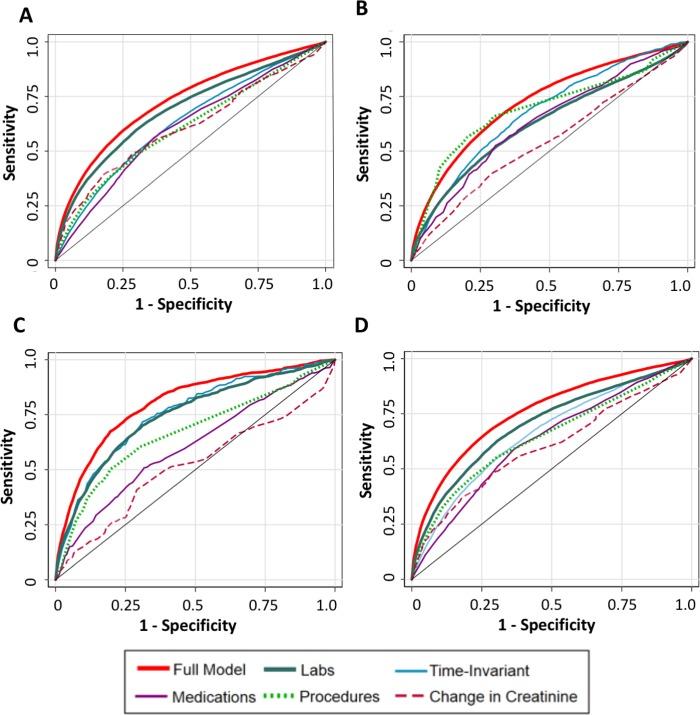
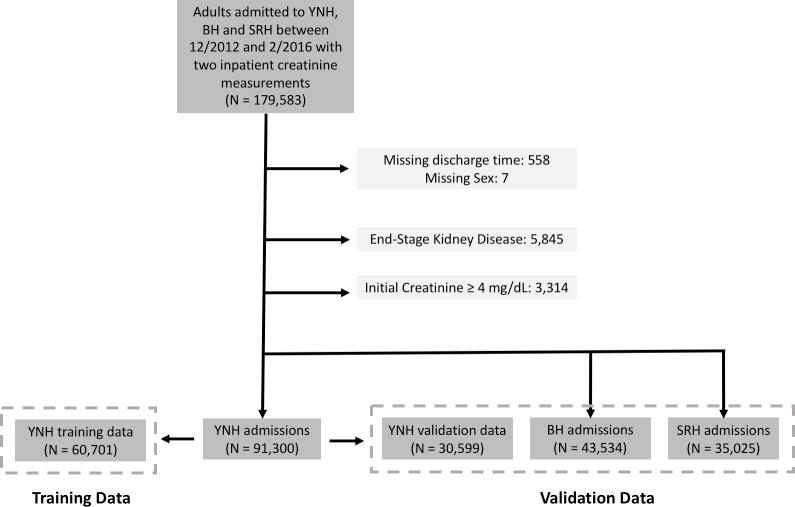
We performed a retrospective analysis looking at data of 169,859 hospitalized adults admitted to one of three study hospitals in the United States (in New Haven and Bridgeport, Connecticut) from December 2012 to February 2016. Demographics, medical comorbidities, hospital procedures, medications, and laboratory data were used to develop a model to predict AKI within 24 hours of a given observation. Outcomes of AKI severity, requirement for renal replacement therapy, and mortality were also measured and predicted. Models were trained using discrete-time logistic regression in a subset of Hospital 1, internally validated in the remainder of Hospital 1, and externally validated in Hospital 2 and Hospital 3. Model performance was assessed via the area under the receiver-operator characteristic (ROC) curve (AUC). The training set cohort contained 60,701 patients, and the internal validation set contained 30,599 patients. External validation data sets contained 43,534 and 35,025 patients. Patients in the overall cohort were generally older (median age ranging from 61 to 68 across hospitals); 44%-49% were male, 16%-20% were black, and 23%-29% were admitted to surgical wards. In the training set and external validation set, 19.1% and 18.9% of patients, respectively, developed AKI. The full model, including all covariates, had good ability to predict imminent AKI for the validation set, sustained AKI, dialysis, and death with AUCs of 0.74 (95% CI 0.73-0.74), 0.77 (95% CI 0.76-0.78), 0.79 (95% CI 0.73-0.85), and 0.69 (95% CI 0.67-0.72), respectively. A simple model using only readily available, time-updated laboratory values had very similar predictive performance to the complete model. The main limitation of this study is that it is observational in nature; thus, we are unable to conclude a causal relationship between covariates and AKI and do not provide an optimal treatment strategy for those predicted to develop AKI.
CONCLUSIONS
In this study, we observed that a simple model using readily available laboratory data could be developed to predict imminent AKI with good discrimination. This model may lend itself well to integration into the EHR without sacrificing the performance seen in more complex models.
背景
急性肾损伤(AKI)是一种会导致严重发病率的不良事件。鉴于 AKI 发生后的干预措施效果不佳,因此人们非常关注在 AKI 诊断之前对其进行预测。然而,将实时预后模型集成到电子健康记录(EHR)中具有挑战性,因为复杂的模型会增加出错的风险并使部署变得复杂。我们的研究目标是创建一个可实施的预测模型,以准确预测住院患者的 AKI,并可轻松集成到现有的 EHR 系统中。
方法和发现
我们进行了一项回顾性分析,观察了来自美国三个研究医院(康涅狄格州纽黑文和布里奇波特)的 169859 名住院成年患者的数据,这些患者于 2012 年 12 月至 2016 年 2 月入院。使用人口统计学、合并症、医院程序、药物和实验室数据来开发一种模型,以便在给定观察结果后 24 小时内预测 AKI。还测量和预测了 AKI 严重程度、需要肾脏替代治疗和死亡率的结果。模型在医院 1 的一个子集中使用离散时间逻辑回归进行训练,在医院 1 的其余部分进行内部验证,并在医院 2 和医院 3 进行外部验证。通过接受者操作特征(ROC)曲线下面积(AUC)评估模型性能。训练集队列包含 60701 名患者,内部验证集包含 30599 名患者。外部验证数据集包含 43534 名和 35025 名患者。总体队列中的患者年龄通常较大(各医院中位数范围为 61 至 68 岁);44%-49%为男性,16%-20%为黑人,23%-29%入住外科病房。在训练集和外部验证集中,分别有 19.1%和 18.9%的患者发生 AKI。完整模型(包括所有协变量)在验证集、持续性 AKI、透析和死亡率方面具有良好的预测即将发生 AKI 的能力,AUC 分别为 0.74(95%CI 0.73-0.74)、0.77(95%CI 0.76-0.78)、0.79(95%CI 0.73-0.85)和 0.69(95%CI 0.67-0.72)。一个仅使用现成的、随时间更新的实验室值的简单模型具有与完整模型非常相似的预测性能。本研究的主要限制是它本质上是观察性的;因此,我们无法得出协变量与 AKI 之间存在因果关系的结论,也不能为那些预计会发生 AKI 的患者提供最佳治疗策略。
结论
在这项研究中,我们观察到,使用现成的实验室数据可以开发出一种简单的模型来很好地预测即将发生的 AKI。该模型可能非常适合集成到 EHR 中,而不会牺牲更复杂模型中的性能。
 Zotero 插件