
Par 蛋白控制下的 DNA 分离。
DNA segregation under Par protein control.
机构信息
Physics Department, Simon Fraser University, Burnaby, British Columbia, V5A 1S6, Canada.
出版信息
PLoS One. 2019 Jul 18;14(7):e0218520. doi: 10.1371/journal.pone.0218520. eCollection 2019.
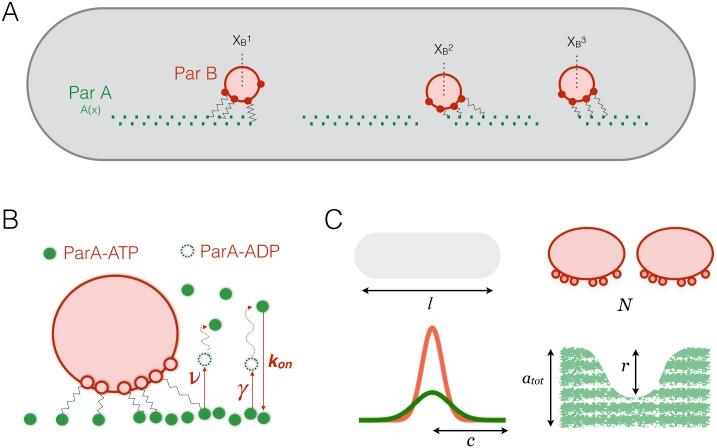
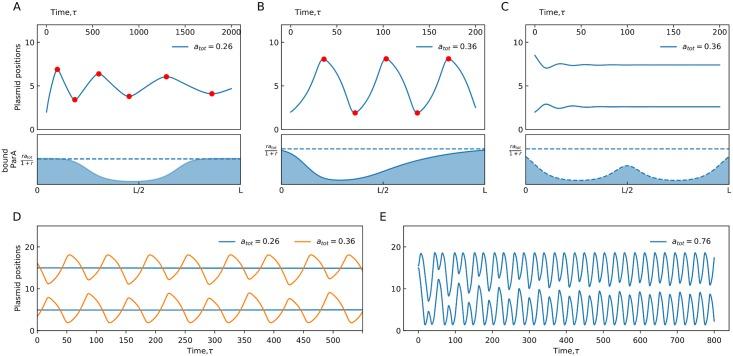
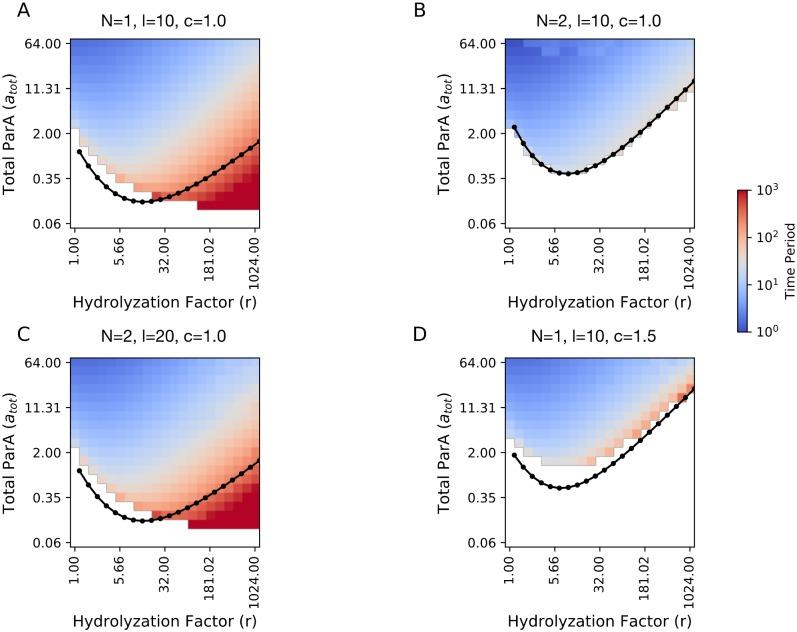
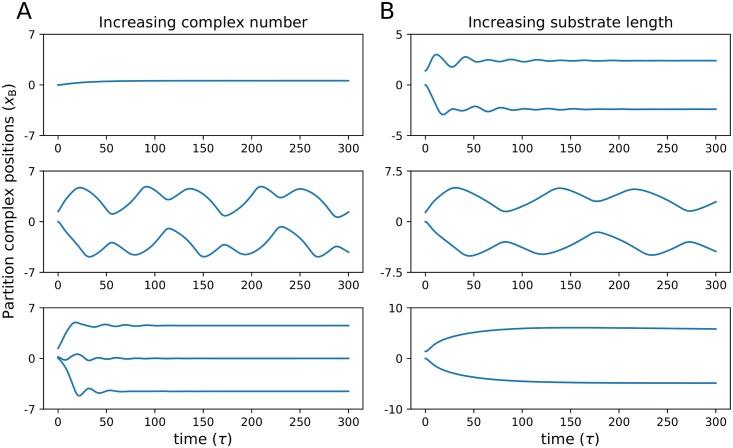
The spatial organization of DNA is mediated by the Par protein system in some bacteria. ParB binds specifically to the parS sequence on DNA and orchestrates its motion by interacting with ParA bound to the nucleoid. In the case of plasmids, a single ParB bound plasmid is observed to execute oscillations between cell poles while multiple plasmids eventually settle at equal distances from each other along the cell's length. While the potential mechanism underlying the ParA-ParB interaction has been discussed, it remains unclear whether ParB-complex oscillations are stable limit cycles or merely decaying transients to a fixed point. How are dynamics affected by substrate length and the number of complexes? We present a deterministic model for ParA-ParB driven DNA segregation where the transition between stable arrangements and oscillatory behaviour depends only on five parameters: ParB-complex number, substrate length, ParA concentration, ParA hydrolysis rate and the ratio of the lengthscale over which the ParB complex stimulates ParA hydrolysis to the lengthscale over which ParA interacts with the ParB complex. When the system is buffered and the ParA rebinding rate is constant we find that ParB-complex dynamics is independent of substrate length and complex number above a minimum system size. Conversely, when ParA resources are limited, we find that changing substrate length and increasing complex number leads to counteracting mechanisms that can both generate or subdue oscillatory dynamics. We argue that cells may be poised near a critical level of ParA so that they can transition from oscillatory to fixed point dynamics as the cell cycle progresses so that they can both measure their size and faithfully partition their genetic material. Lastly, we show that by modifying the availability of ParA or depletion zone size, we can capture some of the observed differences in ParB-complex positioning between replicating chromosomes in B. subtilis cells and low-copy plasmids in E. coli cells.
在一些细菌中,DNA 的空间组织是由 Par 蛋白系统介导的。ParB 特异性地结合到 DNA 上的 parS 序列,并通过与结合在核区的 ParA 相互作用来协调其运动。在质粒的情况下,观察到单个 ParB 结合的质粒在细胞两极之间执行振荡,而多个质粒最终沿着细胞的长度以彼此相等的距离稳定下来。虽然已经讨论了 ParA-ParB 相互作用的潜在机制,但仍然不清楚 ParB-复合物的振荡是稳定的极限环还是仅仅是到固定点的衰减瞬态。动力学如何受到底物长度和复合物数量的影响?我们提出了一个 ParA-ParB 驱动的 DNA 分离的确定性模型,其中稳定排列和振荡行为之间的转变仅取决于五个参数:ParB 复合物数量、底物长度、ParA 浓度、ParA 水解速率以及 ParB 复合物刺激 ParA 水解的长度尺度与 ParA 与 ParB 复合物相互作用的长度尺度之比。当系统被缓冲且 ParA 再结合速率恒定时,我们发现 ParB 复合物动力学独立于底物长度和复合物数量,超过最小系统尺寸。相反,当 ParA 资源有限时,我们发现改变底物长度和增加复合物数量会导致相互抵消的机制,这些机制既可以产生也可以抑制振荡动力学。我们认为,细胞可能处于 ParA 的临界水平附近,以便随着细胞周期的进展,它们可以从振荡动力学过渡到固定点动力学,从而既能测量其大小又能忠实地分配其遗传物质。最后,我们表明,通过改变 ParA 的可用性或耗尽区的大小,我们可以捕捉到枯草芽孢杆菌细胞中复制染色体和大肠杆菌细胞中低拷贝质粒之间 ParB 复合物定位的一些观察到的差异。


 Zotero 插件