
中国河流中营养物污染的多尺度建模。
Multi-scale Modeling of Nutrient Pollution in the Rivers of China.
机构信息
Key Laboratory of Agricultural Water Resources, Hebei Key Laboratory of Soil Ecology, Center for Agricultural Resources Research , Institute of Genetics and Developmental Biology, Chinese Academy of Sciences , 286 Huaizhong Road , Shijiazhuang 050021 , China.
Water Systems and Global Change Group , Wageningen University & Research , Droevendaalsesteeg 4 , Wageningen 6708 PB , The Netherlands.
出版信息
Environ Sci Technol. 2019 Aug 20;53(16):9614-9625. doi: 10.1021/acs.est.8b07352. Epub 2019 Aug 1.
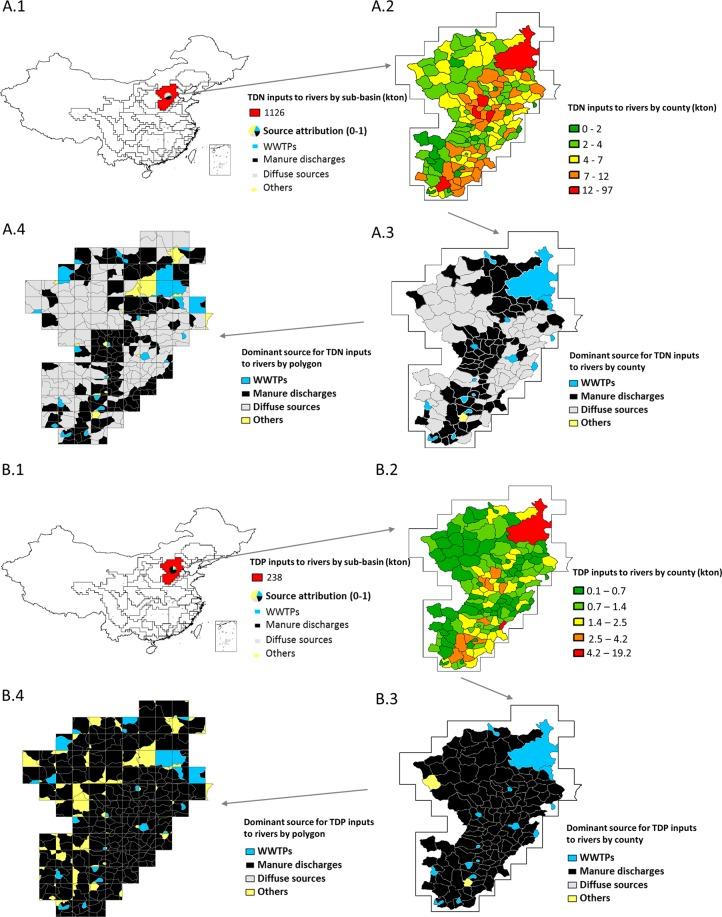
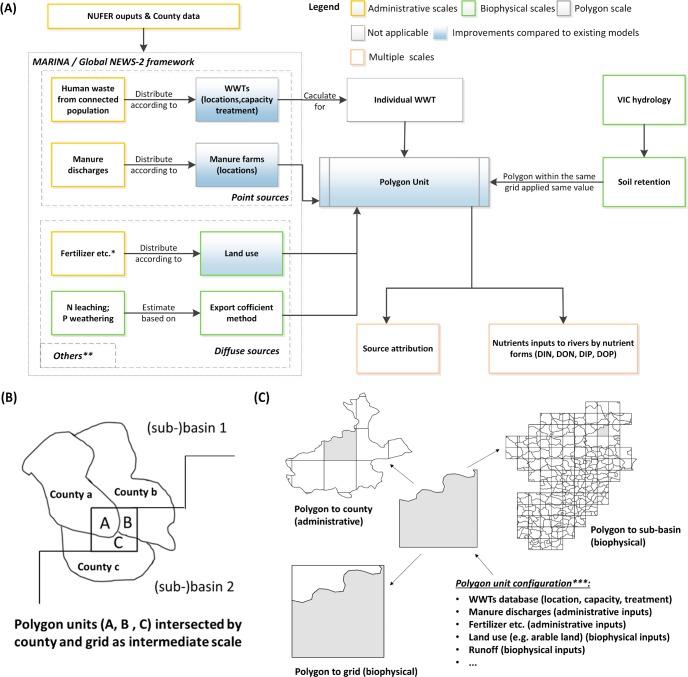
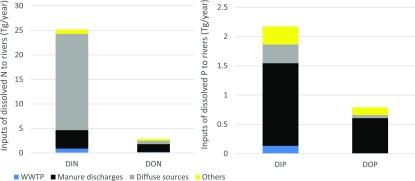
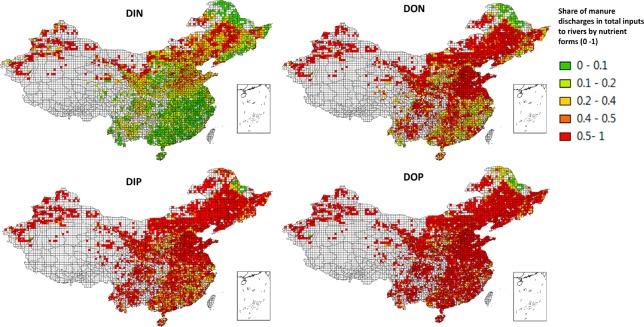
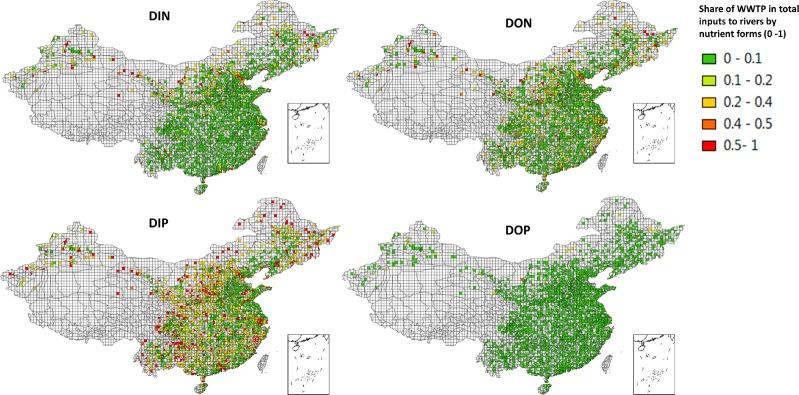
Chinese surface waters are severely polluted by nutrients. This study addresses three challenges in nutrient modeling for rivers in China: (1) difficulties in transferring modeling results across biophysical and administrative scales, (2) poor representation of the locations of point sources, and (3) limited incorporation of the direct discharge of manure to rivers. The objective of this study is, therefore, to quantify inputs of nitrogen (N) and phosphorus (P) to Chinese rivers from different sources at multiple scales. We developed a novel multi-scale modeling approach including a detailed, state-of-the-art representation of point sources of nutrients in rivers. The model results show that the river pollution and source attributions differ among spatial scales. Point sources accounted for 75% of the total dissolved phosphorus (TDP) inputs to rivers in China in 2012, and diffuse sources accounted for 72% of the total dissolved nitrogen (TDN) inputs. One-third of the sub-basins accounted for more than half of the pollution. Downscaling to the smallest scale (polygons) reveals that 14% and 9% of the area contribute to more than half of the calculated TDN and TDP pollution, respectively. Sources of pollution vary considerably among and within counties. Clearly, multi-scale modeling may help to develop effective policies for water pollution.
中国地表水受到营养物的严重污染。本研究针对中国河流养分建模的三个挑战:(1)在生物物理和行政区划尺度之间转移建模结果的困难;(2)点源位置表示不佳;(3)直接向河流排放粪肥的限制。因此,本研究的目的是量化不同来源和多种尺度下中国河流中氮(N)和磷(P)的输入。我们开发了一种新的多尺度建模方法,包括河流中营养物点源的详细、最先进的表示。模型结果表明,河流污染和污染源归属在不同的空间尺度上有所不同。点源占 2012 年中国河流总溶解磷(TDP)输入的 75%,而分散源占总溶解氮(TDN)输入的 72%。三分之一的子流域占污染的一半以上。向下细化到最小尺度(多边形)揭示,分别有 14%和 9%的区域对计算出的 TDN 和 TDP 污染贡献了一半以上。各县之间和内部的污染来源差异很大。显然,多尺度建模可能有助于制定水污染的有效政策。


 Zotero 插件