
由羟基磷灰石/纤维蛋白复合材料构成的3D微流控骨肿瘤微环境
3D Microfluidic Bone Tumor Microenvironment Comprised of Hydroxyapatite/Fibrin Composite.
作者信息
Ahn Jungho, Lim Jungeun, Jusoh Norhana, Lee Jungseub, Park Tae-Eun, Kim YongTae, Kim Jangho, Jeon Noo Li
机构信息
Department of Mechanical and Aerospace Engineering, Seoul National University, Seoul, South Korea.
George W. Woodruff School of Mechanical Engineering, Georgia Institute of Technology, Atlanta, GA, United States.
出版信息
Front Bioeng Biotechnol. 2019 Jul 17;7:168. doi: 10.3389/fbioe.2019.00168. eCollection 2019.
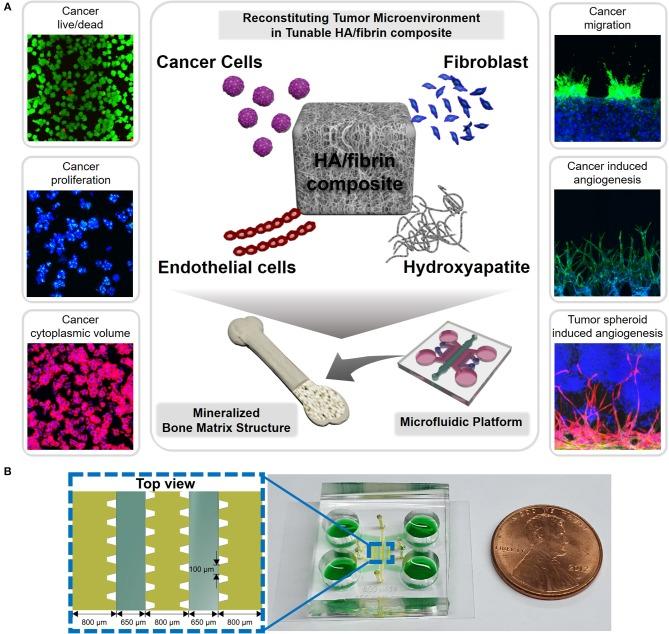
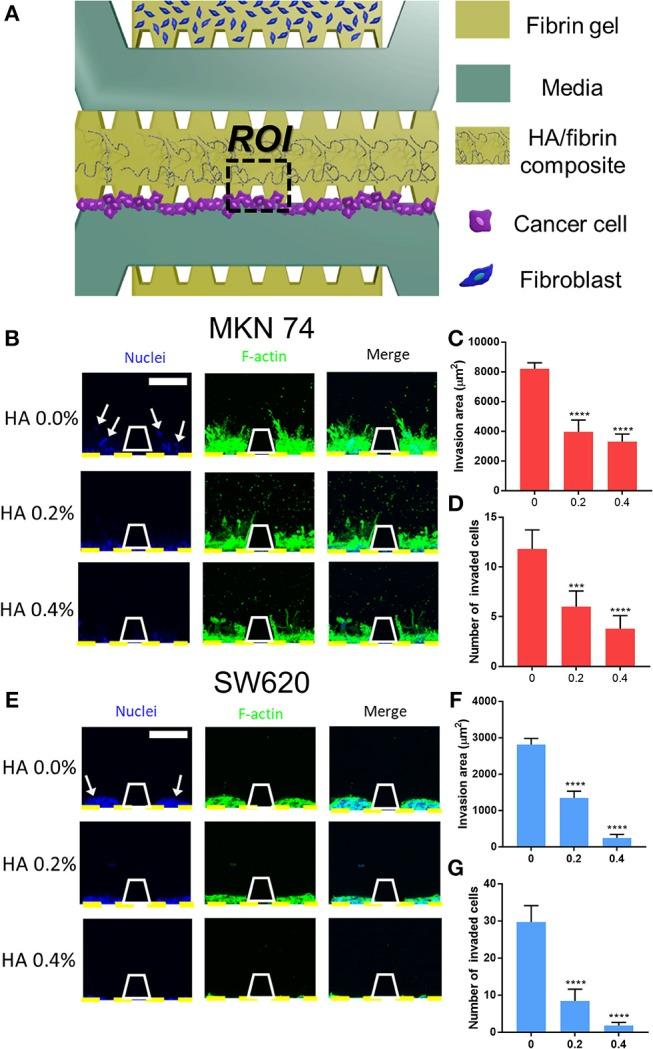
Bone is one of the most common sites of cancer metastasis, as its fertile microenvironment attracts tumor cells. The unique mechanical properties of bone extracellular matrix (ECM), mainly composed of hydroxyapatite (HA) affect a number of cellular responses in the tumor microenvironment (TME) such as proliferation, migration, viability, and morphology, as well as angiogenic activity, which is related to bone metastasis. In this study, we engineered a bone-mimetic microenvironment to investigate the interactions between the TME and HA using a microfluidic platform designed for culturing tumor cells in 3D bone-mimetic composite of HA and fibrin. We developed a bone metastasis TME model from colorectal cancer (SW620) and gastric cancer (MKN74) cells, which has very poor prognosis but rarely been investigated. The microfluidic platform enabled straightforward formation of 3D TME composed the hydrogel and multiple cell types. This facilitated monitoring of the effect of HA concentration and culture time on the TME. In 3D bone mimicking culture, we found that HA rich microenvironment affects cell viability, proliferation and cancer cell cytoplasmic volume in a manner dependent on the different metastatic cancer cell types and culture duration indicating the spatial heterogeneity (different origin of metastatic cancer) and temporal heterogeneity (growth time of cancer) of TME. We also found that both SW620 and MKN72 cells exhibited significantly reduced migration at higher HA concentration in our platform indicating inhibitory effect of HA in both cancer cells migration. Next, we quantitatively analyzed angiogenic sprouts induced by paracrine factors that secreted by TME and showed paracrine signals from tumor and stromal cell with a high HA concentration resulted in the formation of fewer sprouts. Finally we reconstituted vascularized TME allowing direct interaction between angiogenic sprouts and tumor-stroma microspheroids in a bone-mimicking microenvironment composing a tunable HA/fibrin composite. Our multifarious approach could be applied to drug screening and mechanistic studies of the metastasis, growth, and progression of bone tumors.
骨骼是癌症转移最常见的部位之一,因为其丰富的微环境会吸引肿瘤细胞。骨细胞外基质(ECM)主要由羟基磷灰石(HA)组成,其独特的力学性能会影响肿瘤微环境(TME)中的许多细胞反应,如增殖、迁移、活力和形态,以及与骨转移相关的血管生成活性。在本研究中,我们构建了一个仿生骨微环境,以使用为在HA和纤维蛋白的3D仿生骨复合材料中培养肿瘤细胞而设计的微流控平台,研究TME与HA之间的相互作用。我们从结直肠癌(SW620)和胃癌(MKN74)细胞中建立了一个骨转移TME模型,该模型预后很差,但很少被研究。该微流控平台能够直接形成由水凝胶和多种细胞类型组成的3D TME。这便于监测HA浓度和培养时间对TME的影响。在3D仿生骨培养中,我们发现富含HA的微环境以依赖于不同转移性癌细胞类型和培养持续时间的方式影响细胞活力、增殖和癌细胞胞质体积,表明TME的空间异质性(转移性癌症的不同起源)和时间异质性(癌症的生长时间)。我们还发现,在我们的平台中,SW620和MKN72细胞在较高HA浓度下迁移均显著减少,表明HA对两种癌细胞迁移均有抑制作用。接下来,我们定量分析了TME分泌的旁分泌因子诱导的血管生成芽,并表明来自肿瘤和基质细胞的高HA浓度旁分泌信号导致形成的芽较少。最后,我们在由可调节的HA/纤维蛋白复合材料组成的仿生骨微环境中重建了血管化TME,使血管生成芽与肿瘤-基质微球体之间能够直接相互作用。我们的多种方法可应用于骨肿瘤转移、生长和进展的药物筛选和机制研究。



 Zotero 插件