
微小 RNA-134 通过 PLXNA1 介导的 MAPK 信号通路抑制食管鳞癌细胞的进展。
MicroRNA-134 prevents the progression of esophageal squamous cell carcinoma via the PLXNA1-mediated MAPK signalling pathway.
机构信息
Department of Pathology, The First Affiliated Hospital of Zhengzhou University, Zhengzhou 450052, China; Department of Pathology, School of Basic Medicine, Zhengzhou University, Zhengzhou 450002, China; Henan Key Laboratory for Tumor Pathology, Zhengzhou 450052, China.
Institute of Medical and Pharmaceutical Sciences, Zhengzhou University, Zhengzhou 450052, China.
出版信息
EBioMedicine. 2019 Aug;46:66-78. doi: 10.1016/j.ebiom.2019.07.050. Epub 2019 Aug 2.
BACKGROUND
MicroRNAs (miRNAs) are involved in oncogenesis of esophageal squamous cell carcinoma (ESCC). miR-134 is reported to have a tumour-suppressive role but its role in ESCC is not known. The present study was designed to examine whether miR-134 inhibits ESCC development and further explored relevant underlying mechanisms.
METHODS
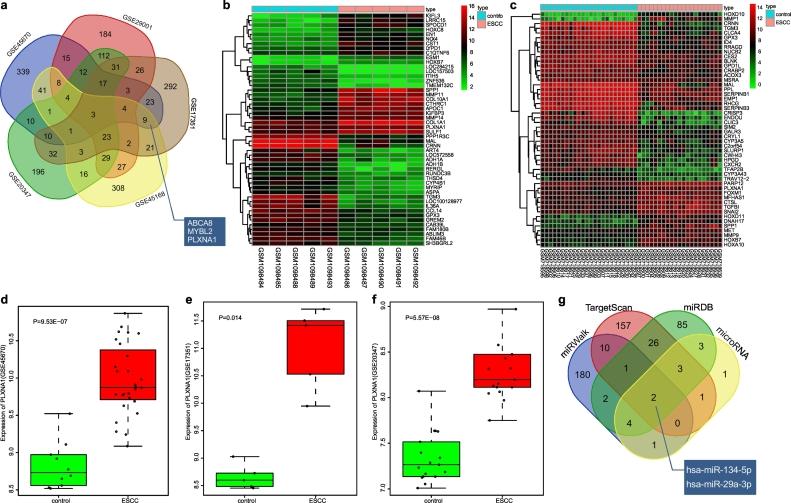
Differentially expressed genes related to ESCC were identified from microarray gene expression profiles. Immunohistochemical staining and RT-qRCR assays identified elevated PLXNA1 expression levels and low miR-134. The relationship between miR-134 and PLXNA1 was predicted and further verified by a dual-luciferase reporter assay. The expression levels of miR-134 and PLXNA1 in ESCC cells were modified by miR-134 mimic/inhibitor and siRNA against PLXNA1, respectively. Thereafter, the expression of MAPK signalling pathway-related proteins, as well as the viability, migration, invasion, cell cycle and cell apoptosis of ESCC cells was investigated.
FINDINGS
The results showed that miR-134 could block the MAPK signalling pathway by downregulating PLXNA1. When miR-134 was overexpressed or PLXNA1 was silenced, cell apoptosis was enhanced, the cell cycle was retarded, and the cell proliferation, migration and invasion were suppressed. In vivo experiments confirmed that miR-134 overexpression or PLXNA1 silencing restrained tumour growth and lymph node metastasis.
INTERPRETATION
These findings demonstrate that cancer cell proliferation, migration, invasion, and tumour metastasis of ESCC can be suppressed by overexpression of miR-134 through downregulating PLXNA1, which subsequently blocks the MAPK signalling pathway. These results provide new potential targets and strategies for the treatment of ESCC.
背景
微小 RNA(miRNA)参与食管鳞状细胞癌(ESCC)的发生。miR-134 具有抑癌作用,但在 ESCC 中的作用尚不清楚。本研究旨在探讨 miR-134 是否抑制 ESCC 发展,并进一步探讨相关的潜在机制。
方法
从微阵列基因表达谱中鉴定与 ESCC 相关的差异表达基因。免疫组织化学染色和 RT-qRCR 检测鉴定出 PLXNA1 表达水平升高和 miR-134 表达水平降低。通过双荧光素酶报告基因实验预测并进一步验证了 miR-134 与 PLXNA1 的关系。通过 miR-134 模拟物/抑制剂和针对 PLXNA1 的 siRNA 分别修饰 ESCC 细胞中 miR-134 和 PLXNA1 的表达水平。然后,研究了 MAPK 信号通路相关蛋白的表达水平,以及 ESCC 细胞的活力、迁移、侵袭、细胞周期和细胞凋亡。
结果
结果表明,miR-134 可以通过下调 PLXNA1 阻断 MAPK 信号通路。当 miR-134 过表达或 PLXNA1 沉默时,细胞凋亡增强,细胞周期阻滞,细胞增殖、迁移和侵袭受到抑制。体内实验证实,miR-134 过表达或 PLXNA1 沉默抑制肿瘤生长和淋巴结转移。
结论
这些发现表明,通过下调 PLXNA1 可增强 miR-134 的表达,从而抑制 ESCC 癌细胞的增殖、迁移、侵袭和肿瘤转移,进而阻断 MAPK 信号通路。这些结果为 ESCC 的治疗提供了新的潜在靶点和策略。



 Zotero 插件