
甘油磷酸穿梭酶 GPD2 调节巨噬细胞炎症反应。
Glycerol phosphate shuttle enzyme GPD2 regulates macrophage inflammatory responses.
机构信息
Department of Genetics & Complex Diseases, Harvard T.H. Chan School of Public Health, Boston, MA, USA.
School of Medicine, University of Glasgow, Glasgow, UK.
出版信息
Nat Immunol. 2019 Sep;20(9):1186-1195. doi: 10.1038/s41590-019-0453-7. Epub 2019 Aug 5.
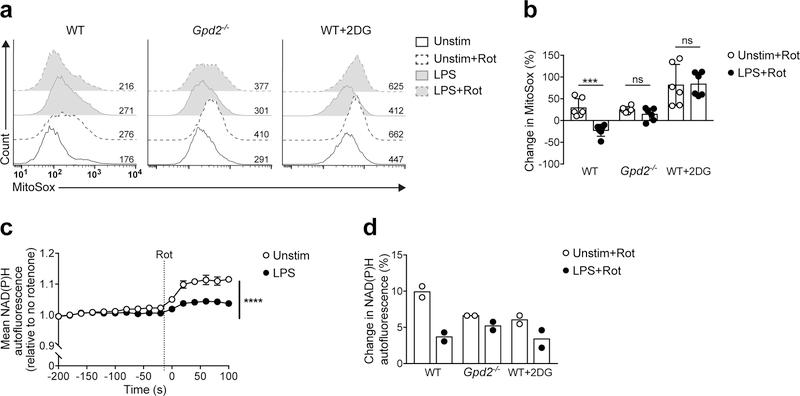
Macrophages are activated during microbial infection to coordinate inflammatory responses and host defense. Here we find that in macrophages activated by bacterial lipopolysaccharide (LPS), mitochondrial glycerol 3-phosphate dehydrogenase (GPD2) regulates glucose oxidation to drive inflammatory responses. GPD2, a component of the glycerol phosphate shuttle, boosts glucose oxidation to fuel the production of acetyl coenzyme A, acetylation of histones and induction of genes encoding inflammatory mediators. While acute exposure to LPS drives macrophage activation, prolonged exposure to LPS triggers tolerance to LPS, where macrophages induce immunosuppression to limit the detrimental effects of sustained inflammation. The shift in the inflammatory response is modulated by GPD2, which coordinates a shutdown of oxidative metabolism; this limits the availability of acetyl coenzyme A for histone acetylation at genes encoding inflammatory mediators and thus contributes to the suppression of inflammatory responses. Therefore, GPD2 and the glycerol phosphate shuttle integrate the extent of microbial stimulation with glucose oxidation to balance the beneficial and detrimental effects of the inflammatory response.
巨噬细胞在微生物感染时被激活,以协调炎症反应和宿主防御。在这里,我们发现,在细菌脂多糖 (LPS) 激活的巨噬细胞中,线粒体甘油-3-磷酸脱氢酶 (GPD2) 调节葡萄糖氧化以驱动炎症反应。GPD2 是甘油磷酸穿梭的一个组成部分,可促进葡萄糖氧化,为乙酰辅酶 A 的产生、组蛋白的乙酰化和编码炎症介质的基因的诱导提供燃料。虽然急性 LPS 暴露会驱动巨噬细胞的激活,但长期 LPS 暴露会引发对 LPS 的耐受,其中巨噬细胞会诱导免疫抑制,以限制持续炎症的有害影响。GPD2 调节炎症反应的转变,协调氧化代谢的关闭;这限制了乙酰辅酶 A 用于编码炎症介质的基因的组蛋白乙酰化的可用性,从而有助于抑制炎症反应。因此,GPD2 和甘油磷酸穿梭将微生物刺激的程度与葡萄糖氧化结合起来,以平衡炎症反应的有益和有害影响。

 Zotero 插件