
狗主人使用三种不同的测量设备测量不同体积的干狗粮的准确性。
Dog owner's accuracy measuring different volumes of dry dog food using three different measuring devices.
机构信息
Department of Population Medicine, University of Guelph, Ontario Veterinary College, Guelph, Ontario, Canada
Department of Clinical Studies, University of Guelph, Ontario Veterinary College, Guelph, Ontario, Canada.
出版信息
Vet Rec. 2019 Nov 16;185(19):599. doi: 10.1136/vr.105319. Epub 2019 Aug 13.
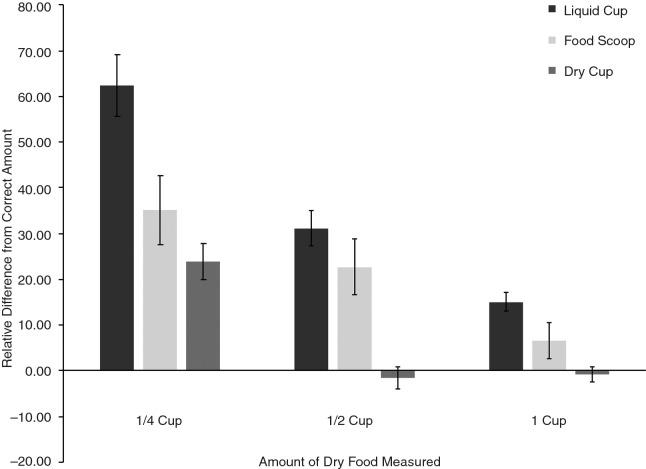
Prior research demonstrates significant inaccuracy when repeatedly measuring the same amount of dry dog food using a dry-food measuring cup, bringing into question the accuracy of measuring devices. This study aimed to determine dog owners' accuracy when measuring different volumes of dry dog food using different types of measuring devices. One hundred dog owners, randomly assigned one of three measuring devices (a one-cup dry-food measuring cup, a two-cup graduated-liquid measuring cup or a two-cup commercial food scoop), were asked to measure ¼, ½ and 1 cup of dry dog food. Accuracy was assessed with an electronic gram scale by comparing measured volumes with the correct weight in grams. Individual accuracy ranged from -47.83% to 152.17% across devices and volumes. Measuring accuracy was found to be associated with the volume of food measured (p<0.001) and the type of measuring device used (p<0.001). Findings highlight approaches for decreasing excess intake of calories by dogs, including promotion of tactics to improve measurement accuracy (eg, gram scales, volume-calibrated dry-food measuring devices), especially for measuring small volumes.
先前的研究表明,使用干食量杯重复测量相同数量的干狗粮时会出现显著的不准确,这使得测量仪器的准确性受到质疑。本研究旨在确定狗主人使用不同类型的测量设备测量不同体积的干狗粮时的准确性。100 名狗主人被随机分配使用三种测量设备之一(一杯干食量杯、两杯刻度液体量杯或两杯商用食品勺),要求他们测量 1/4 杯、1/2 杯和 1 杯干狗粮。通过将测量体积与正确的克重进行比较,使用电子克秤评估准确性。在不同的设备和体积下,个体的准确性范围从-47.83%到 152.17%不等。测量准确性与测量的食物量(p<0.001)和使用的测量设备类型(p<0.001)有关。研究结果突出了减少狗摄入过多卡路里的方法,包括推广提高测量准确性的策略(例如,克秤、体积校准的干食量杯),尤其是在测量小体积时。


 Zotero 插件