
晚期肝细胞癌系统治疗的药物遗传学。
Pharmacogenetics of the systemic treatment in advanced hepatocellular carcinoma.
机构信息
Clinical and Experimental Pharmacology, Centro di Riferimento Oncologico di Aviano (CRO) IRCCS, Aviano (PN) 33081, Italy.
Department of Medical Oncology, Centro di Riferimento Oncologico di Aviano (CRO) IRCCS, Aviano (PN) 33081, Italy.
出版信息
World J Gastroenterol. 2019 Aug 7;25(29):3870-3896. doi: 10.3748/wjg.v25.i29.3870.
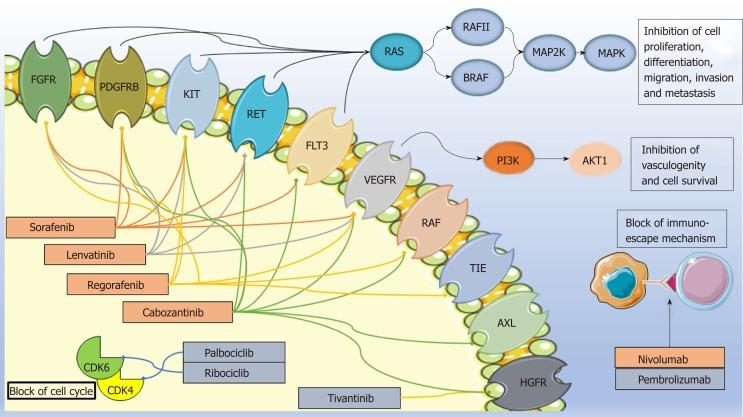
Hepatocellular carcinoma (HCC) accounts for the majority of primary liver cancers. To date, most patients with HCC are diagnosed at an advanced tumor stage, excluding them from potentially curative therapies (., resection, liver transplantation, percutaneous ablation). Treatments with palliative intent include chemoembolization and systemic therapy. Among systemic treatments, the small-molecule multikinase inhibitor sorafenib has been the only systemic treatment available for advanced HCC over 10 years. More recently, other small-molecule multikinase inhibitors (., regorafenib, lenvatinib, cabozantinib) have been approved for HCC treatment. The promising immune checkpoint inhibitors (., nivolumab, pembrolizumab) are still under investigation in Europe while in the US nivolumab has already been approved by FDA in sorafenib refractory or resistant patients. Other molecules, such as the selective CDK4/6inhibitors (., palbociclib, ribociclib), are in earlier stages of clinical development, and the c-MET inhibitor tivantinib did not show positive results in a phase III study. However, even if the introduction of targeted agents has led to great advances in patient response and survival with an acceptable toxicity profile, a remarkable inter-individual heterogeneity in therapy outcome persists and constitutes a significant problem in disease management. Thus, the identification of biomarkers that predict which patients will benefit from a specific intervention could significantly affect decision-making and therapy planning. Germ-line variants have been suggested to play an important role in determining outcomes of HCC systemic therapy in terms of both toxicity and treatment efficacy. Particularly, a number of studies have focused on the role of genetic polymorphisms impacting the drug metabolic pathway and membrane translocation as well as the drug mechanism of action as predictive/prognostic markers of HCC treatment. The aim of this review is to summarize and critically discuss the pharmacogenetic literature evidences, with particular attention to sorafenib and regorafenib, which have been used longer than the others in HCC treatment.
肝细胞癌(HCC)占原发性肝癌的大多数。迄今为止,大多数 HCC 患者在肿瘤晚期被诊断出来,使他们无法接受潜在的治愈性治疗(例如切除术、肝移植、经皮消融)。姑息性治疗包括化疗栓塞和系统治疗。在系统治疗中,小分子多激酶抑制剂索拉非尼是 10 多年来唯一可用于晚期 HCC 的系统治疗药物。最近,其他小分子多激酶抑制剂(regorafenib、lenvatinib、cabozantinib)已被批准用于 HCC 治疗。有前途的免疫检查点抑制剂(nivolumab、pembrolizumab)仍在欧洲进行研究,而在美国,nivolumab 已被 FDA 批准用于索拉非尼耐药或抵抗的患者。其他分子,如选择性 CDK4/6 抑制剂(palbociclib、ribociclib),处于临床开发的早期阶段,c-MET 抑制剂 tivantinib 在 III 期研究中未显示出阳性结果。然而,即使引入靶向药物使患者的反应和生存得到了显著改善,且具有可接受的毒性特征,但治疗结果在个体之间仍存在显著的异质性,这是疾病管理中的一个重大问题。因此,确定能够预测哪些患者将从特定干预中受益的生物标志物,可能会对决策和治疗计划产生重大影响。胚系变异已被认为在 HCC 系统治疗的毒性和治疗效果方面起着重要作用。特别是,许多研究都集中在影响药物代谢途径和膜转运以及药物作用机制的遗传多态性上,将其作为 HCC 治疗的预测/预后标志物。本综述的目的是总结和批判性讨论药物遗传学文献证据,特别关注索拉非尼和regorafenib,因为它们在 HCC 治疗中的应用时间比其他药物更长。

 Zotero 插件