
新辅助肝动脉灌注化疗在 A 型 Child-Pugh 分级的晚期肝细胞癌患者中的作用和局限性。
Role and limitation of neoadjuvant hepatic arterial infusion chemotherapy in advanced hepatocelluar carcinoma patients with Child-Pugh class A.
机构信息
Department of Surgery, College of Medicine, Yeungnam University, 170 Hyeonchungno, Nam-gu, Daegu, 42415, Republic of Korea.
出版信息
World J Surg Oncol. 2019 Aug 15;17(1):143. doi: 10.1186/s12957-019-1685-6.
BACKGROUND
Patients with advanced hepatocellular carcinoma (HCC) have a poor oncologic outcome. In this study, we evaluated the role and limitation of neoadjuvant hepatic arterial infusion chemotherapy (HAIC) in advanced HCC patients with Child-Pugh class A and the efficacy of liver resection subsequent to downstaging after neoadjuvant HAIC.
METHODS
In the present retrospective study, 103 patients with advanced HCC, who underwent neoadjuvant HAIC from April 2003 to March 2015 were analyzed. Response to HAIC was evaluated by dividing time period into after 3 cycles and after 6 cycles, each defined as early and late period. Liver resection after neoadjuvant HAIC was offered in patients who were considered as possible candidates for curative resection with tumor-free margin as well as sufficient future liver remnant volume.
RESULTS
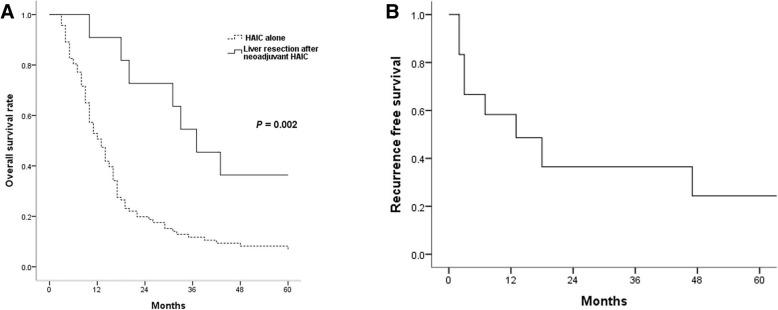
The median survival time (MST) in all patients was 14 ± 1.7 months. Response rate and disease control rate were 36.3% (37) and 81.4% (83) in early period, respectively, and 26.4% (14) and 47.2% (25), in late period, respectively (P = 0.028). Twelve patients (11.7%) underwent liver resection after neoadjuvant HAIC and the MST was 37 ± 6.6 months. One-, 3-, and 5-year recurrence-free survival after liver resection were 58.3%, 36.5%, and 24.3% respectively. Liver resection was identified as the only independent prognostic factor that associated with overall survival in multivariate analysis (P = 0.002) CONCLUSION: HAIC could be further alternative for the treatment of advanced HCC in patients with good liver function. If liver resection is possible after neoadjuvant HAIC, liver resection would provide better outcomes than HAIC alone.
背景
晚期肝细胞癌(HCC)患者的肿瘤预后较差。在本研究中,我们评估了新辅助肝动脉灌注化疗(HAIC)在肝功能良好的晚期 HCC 患者中的作用和局限性,以及新辅助 HAIC 降期后行肝切除术的疗效。
方法
本回顾性研究分析了 2003 年 4 月至 2015 年 3 月期间接受新辅助 HAIC 的 103 例晚期 HCC 患者。根据治疗周期将患者分为 3 个周期后和 6 个周期后,分别定义为早期和晚期。新辅助 HAIC 后,对无肿瘤切缘及足够未来肝残余量的患者进行肝切除术。
结果
所有患者的中位生存时间(MST)为 14±1.7 个月。早期的反应率和疾病控制率分别为 36.3%(37 例)和 81.4%(83 例),晚期的反应率和疾病控制率分别为 26.4%(14 例)和 47.2%(25 例)(P=0.028)。12 例(11.7%)患者接受新辅助 HAIC 后行肝切除术,MST 为 37±6.6 个月。肝切除术后 1、3、5 年无复发生存率分别为 58.3%、36.5%和 24.3%。多因素分析显示,肝切除是唯一与总生存相关的独立预后因素(P=0.002)。
结论
HAIC 可作为肝功能良好的晚期 HCC 患者的另一种治疗选择。如果新辅助 HAIC 后可行肝切除术,肝切除术比单独 HAIC 提供更好的疗效。
 Zotero 插件