
阿奇霉素脂质体作为一种治疗宫颈阴道细菌感染的局部治疗新方法。
Azithromycin-liposomes as a novel approach for localized therapy of cervicovaginal bacterial infections.
机构信息
Department of Pharmaceutical Technology, Faculty of Pharmacy and Biochemistry, University of Zagreb, 10000 Zagreb, Croatia.
Pharmaceutical Sciences Laboratory, Faculty of Science and Engineering, Åbo Akademi and University of Helsinki, 20520 Turku, Finland.
出版信息
Int J Nanomedicine. 2019 Jul 30;14:5957-5976. doi: 10.2147/IJN.S211691. eCollection 2019.
BACKGROUND
Efficient localized cervicovaginal antibacterial therapy, enabling the delivery of antibiotic to the site of action at lower doses while escaping systemic drug effects and reducing the risk of developing microbial resistance, is attracting considerable attention. Liposomes have been shown to allow sustained drug release into vaginal mucosa and improve delivery of antibiotics to bacterial cells and biofilms. Azithromycin (AZI), a potent broad-spectrum macrolide antibiotic, has not yet been investigated for localized therapy of cervicovaginal infections, although it is administered orally for the treatment of sexually transmitted diseases. Encapsulation of AZI in liposomes could improve its solubility, antibacterial activity, and allow the prolonged drug release in the cervicovaginal tissue, while avoiding systemic side effects.
PURPOSE
The objective of this study was to develop AZI-liposomes and explore their potentials for treating cervicovaginal infections.
METHODS
AZI-liposomes that differed in bilayer elasticity/rigidity and surface charge were prepared and evaluated under simulated cervicovaginal conditions to yield optimized liposomes, which were assessed for antibacterial activity against several planktonic and biofilm-forming strains and intracellular AZI vaginal deposition/penetration, and in vitro cytotoxicity toward cervical cells.
RESULTS
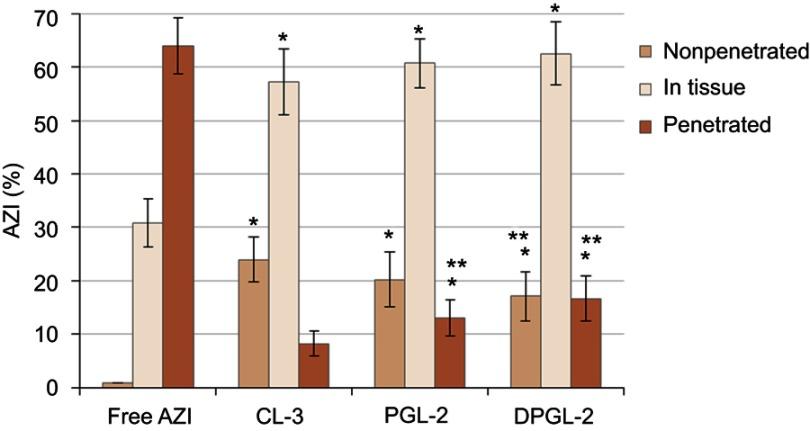
Negatively charged liposomes with rigid bilayers (CL-3), propylene glycol liposomes (PGL-2) and deformable propylene glycol liposomes (DPGL-2) were efficient against planktonic ATCC 700928 and K-12. CL-3 was superior for preventing the formation of ATCC 700928 and K-12 biofilms, with IC values (concentrations that inhibit biofilm viability by 50%) up to 8-fold lower than those of the control (free AZI). DPGL-2 was the most promising for eradication of already formed biofilms and for treating infections. All AZI-liposomes were biocompatible with cervical cells and improved localization of the drug inside vaginal tissue compared with the control.
CONCLUSION
The performed studies confirm the potentials of AZI-liposomes for localized cervicovaginal therapy.
背景
高效的局部宫颈阴道抗菌治疗,能够以较低的剂量将抗生素递送到作用部位,同时避免全身药物作用,降低产生微生物耐药性的风险,因此受到了广泛关注。脂质体已被证明能够持续将药物释放到阴道黏膜中,并改善抗生素向细菌细胞和生物膜的递送。阿奇霉素(AZI)是一种强效的广谱大环内酯类抗生素,尚未被研究用于局部治疗宫颈阴道感染,尽管它被口服用于治疗性传播疾病。将 AZI 包封在脂质体中可以提高其溶解度、抗菌活性,并允许在宫颈阴道组织中延长药物释放,同时避免全身副作用。
目的
本研究旨在开发 AZI 脂质体,并探索其用于治疗宫颈阴道感染的潜力。
方法
根据模拟宫颈阴道条件,制备了 AZI 脂质体,其双层弹性/刚性和表面电荷不同,以获得优化的脂质体,并评估其对几种浮游和生物膜形成菌株的抗菌活性,以及细胞内 AZI 阴道沉积/渗透,以及对宫颈细胞的体外细胞毒性。
结果
带负电荷的刚性双层脂质体(CL-3)、丙二醇脂质体(PGL-2)和可变形丙二醇脂质体(DPGL-2)对浮游 ATCC 700928 和 K-12 有效。CL-3 对预防 ATCC 700928 和 K-12 生物膜的形成更为有效,IC 值(抑制生物膜活力 50%的浓度)比对照(游离 AZI)低 8 倍。DPGL-2 最有希望根除已形成的生物膜并治疗感染。所有 AZI 脂质体与宫颈细胞相容,并与对照相比提高了药物在阴道组织中的定位。
结论
进行的研究证实了 AZI 脂质体用于局部宫颈阴道治疗的潜力。



 Zotero 插件