
母亲年龄与加拿大严重孕产妇发病率和死亡率的关联。
Association of Maternal Age With Severe Maternal Morbidity and Mortality in Canada.
机构信息
Department of Anesthesia and Pain Medicine, The Hospital for Sick Children, Toronto, Ontario, Canada.
Program in Child Health Evaluative Sciences, SickKids Research Institute, Toronto, Ontario, Canada.
出版信息
JAMA Netw Open. 2019 Aug 2;2(8):e199875. doi: 10.1001/jamanetworkopen.2019.9875.
IMPORTANCE
Over the past 2 decades, there has been a trend toward increasing maternal age in many high-income countries. Maternal age may lead to greater attendant morbidity and mortality for Canadian mothers.
OBJECTIVE
To investigate the association of maternal age, adjusting for patient-level and hospital-level factors, with severe maternal morbidity (SMM) and maternal death in Canada.
DESIGN, SETTING, AND PARTICIPANTS: A nationwide population-based cohort study of all antepartum, peripartum, and postpartum women and adolescents seen at Canadian acute care hospitals from April 1, 2004, to March 31, 2015. All analyses were completed on September 13, 2018.
EXPOSURES
Maternal age at the index delivery.
MAIN OUTCOMES AND MEASURES
Severe maternal morbidity and maternal death during pregnancy and within 6 weeks after termination of pregnancy.
RESULTS
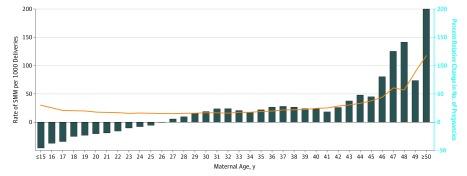
During the study period, there were 3 162 303 new pregnancies (mean [SD] maternal age, 29.5 [5.6] years) and 3 533 259 related hospital admissions. There were 54 219 episodes of SMM (17.7 cases per 1000 deliveries) in the entire study period, with a 9.8% relative increase from 2004-2005 to 2014-2015, in addition to an increasing proportion of pregnancies to older mothers. Independent patient-level factors associated with SMM included increasing Maternal Comorbidity Index; maternal age 19 years or younger and 30 years or older, with the greatest risk experienced by women 45 years or older (odds ratio [OR], 2.69; 95% CI, 2.34-3.06 compared with maternal age 20-24 years); and lowest income quintile (OR, 1.19; 95% CI, 1.14-1.22 compared with highest income quintile). Hospital-level factors associated with SMM included specific provinces. Independent patient-level factors associated with maternal mortality included increasing Maternal Comorbidity Index, age 40 to 44 years (OR, 3.39; 95% CI, 1.68-6.82 compared with age 20-24 years), age 45 years or older (OR, 4.39; 95% CI, 1.01-19.10 compared with age 20-24 years), and lowest income quintile (OR, 4.14; 95% CI, 2.03-8.50 compared with highest income quintile). Hospital-level factors associated with maternal mortality included lowest hospital pregnancy volume.
CONCLUSIONS AND RELEVANCE
In Canada, maternal age and SMM have increased over the past decade. Results of this study suggest that province of residence, maternal comorbidity, residence income quintile, and extremes of maternal age, especially those 45 years or older, were associated with SMM and mortality. These findings are relevant to prospective parents, their health care team, and public health planning.
重要性
在过去的 20 年中,许多高收入国家的产妇年龄呈上升趋势。产妇年龄可能导致加拿大母亲的发病率和死亡率更高。
目的
调查产妇年龄与加拿大严重产妇发病率(SMM)和产妇死亡之间的关联,调整患者水平和医院水平的因素。
设计、设置和参与者:这是一项全国性的基于人群的队列研究,纳入了 2004 年 4 月 1 日至 2015 年 3 月 31 日在加拿大急症医院就诊的所有产前、围产期和产后妇女和青少年。所有分析均于 2018 年 9 月 13 日完成。
暴露
分娩时产妇的年龄。
主要结果和测量指标
妊娠期间和终止妊娠后 6 周内的严重产妇发病率和产妇死亡。
结果
在研究期间,有 3162303 例新妊娠(平均[SD]产妇年龄为 29.5[5.6]岁)和 3533259 例相关住院病例。整个研究期间发生了 54219 例 SMM(每 1000 例分娩中有 17.7 例),与 2004-2005 年至 2014-2015 年相比,相对增加了 9.8%,同时高龄产妇的比例也在增加。与 SMM 相关的独立患者水平因素包括:母体合并症指数增加;年龄为 19 岁或以下和 30 岁或以上,其中 45 岁或以上的女性风险最大(比值比[OR],2.69;95%CI,2.34-3.06,与 20-24 岁年龄组相比);以及最低收入五分位数(OR,1.19;95%CI,1.14-1.22,与最高收入五分位数相比)。与 SMM 相关的医院水平因素包括特定省份。与产妇死亡率相关的独立患者水平因素包括:母体合并症指数增加,40-44 岁(OR,3.39;95%CI,1.68-6.82,与 20-24 岁年龄组相比),45 岁或以上(OR,4.39;95%CI,1.01-19.10,与 20-24 岁年龄组相比),以及最低收入五分位数(OR,4.14;95%CI,2.03-8.50,与最高收入五分位数相比)。与产妇死亡率相关的医院水平因素包括最低的医院妊娠量。
结论和相关性
在加拿大,产妇年龄和 SMM 在过去十年中有所增加。本研究结果表明,居住地、产妇合并症、居住地收入五分位数以及产妇年龄的极值,特别是 45 岁或以上,与 SMM 和死亡率相关。这些发现与准父母、他们的医疗保健团队和公共卫生规划有关。
 Zotero 插件