
一份针对人类细菌病原体全基因组测序的循序渐进的初学者方案。
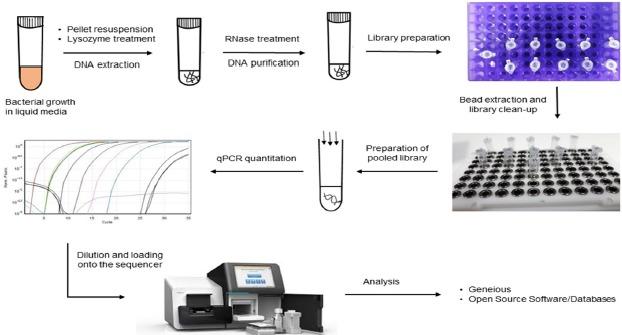
A step-by-step beginner's protocol for whole genome sequencing of human bacterial pathogens.
作者信息
Gautam Sanjay S, Kc Rajendra, Leong Kelvin Wc, Mac Aogáin Micheál, O'Toole Ronan F
机构信息
School of Medicine, College of Health and Medicine, University of Tasmania, Hobart, TAS 7001, Australia.
School of Molecular Sciences, College of Science, Health and Engineering, La Trobe University, Victoria 3690, Australia.
出版信息
J Biol Methods. 2019 Mar 15;6(1):e110. doi: 10.14440/jbm.2019.276. eCollection 2019.
Bacterial whole genome sequencing (WGS) is becoming a widely-used technique in research, clinical diagnostic, and public health laboratories. It enables high resolution characterization of bacterial pathogens in terms of properties that include antibiotic resistance, molecular epidemiology, and virulence. The introduction of next-generation sequencing instrumentation has made WGS attainable in terms of costs. However, the lack of a beginner's protocol for WGS still represents a barrier to its adoption in some settings. Here, we present detailed step-by-step methods for obtaining WGS data from a range of different bacteria (Gram-positive, Gram-negative, and acid-fast) using the Illumina platform. Modifications have been performed with respect to DNA extraction and library normalization to maximize the output from the laboratory consumables invested. The protocol represents a simplified and reproducible method for producing high quality sequencing data. The key advantages of this protocol include: simplicity of the protocol for users with no prior genome sequencing experience and reproducibility of the protocol across a wide range of bacteria.
细菌全基因组测序(WGS)正在成为研究、临床诊断和公共卫生实验室中广泛使用的技术。它能够根据包括抗生素耐药性、分子流行病学和毒力等特性,对细菌病原体进行高分辨率表征。下一代测序仪器的引入使WGS在成本方面变得可行。然而,缺乏针对WGS的初学者协议在某些情况下仍然是其应用的障碍。在这里,我们展示了使用Illumina平台从一系列不同细菌(革兰氏阳性菌、革兰氏阴性菌和抗酸菌)中获取WGS数据的详细分步方法。在DNA提取和文库标准化方面进行了改进,以最大限度地提高所投入实验室耗材的产出。该方案代表了一种用于产生高质量测序数据的简化且可重复的方法。该方案的主要优点包括:对于没有先前基因组测序经验的用户来说协议简单,并且该协议在广泛的细菌范围内具有可重复性。
 Zotero 插件