
液体大气压基质辅助激光解吸/电离质谱为疾病诊断的基质辅助激光解吸/电离质谱分析增添了增强功能。
Liquid Atmospheric Pressure Matrix-Assisted Laser Desorption/Ionization Mass Spectrometry Adds Enhanced Functionalities to MALDI MS Profiling for Disease Diagnostics.
作者信息
Hale Oliver J, Morris Michael, Jones Barney, Reynolds Christopher K, Cramer Rainer
机构信息
Department of Chemistry, University of Reading, Whiteknights, Reading RG6 6AD, U.K.
Waters Corporation, Stamford Avenue, Wilmslow SK9 4AX, U.K.
出版信息
ACS Omega. 2019 Jul 26;4(7):12759-12765. doi: 10.1021/acsomega.9b01476. eCollection 2019 Jul 31.
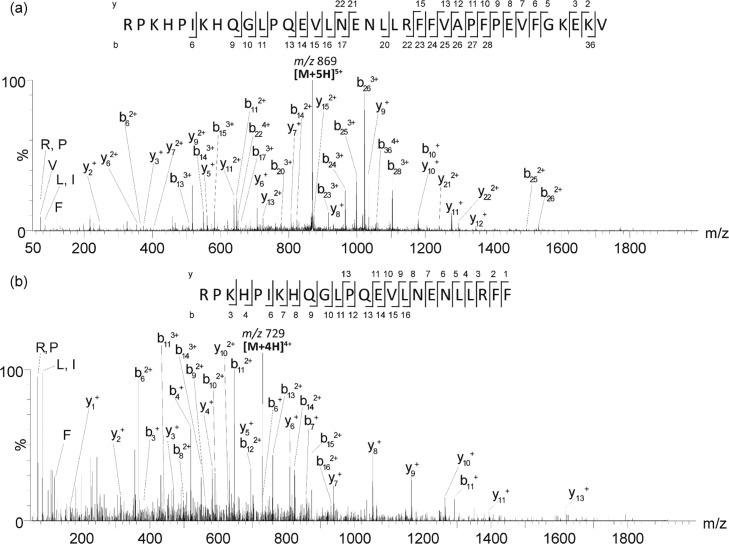
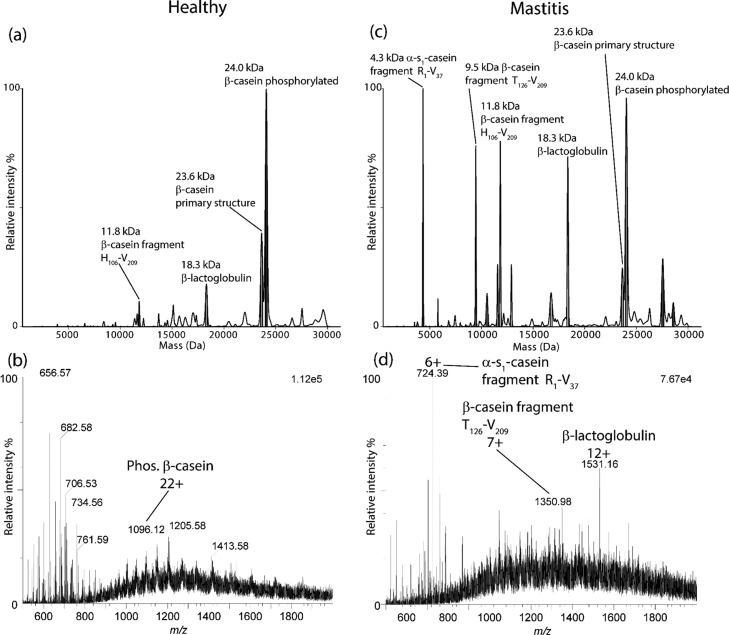
A liquid matrix-assisted laser desorption/ionization (liquid MALDI) method has been developed for high-throughput atmospheric pressure (AP) mass spectrometry (MS) analysis of the molecular content of crude bioliquids for disease diagnostics. The presented method is rapid and highly robust, enabling its application in environments where speed and low-cost high-throughput analyses are required. Importantly, because of the creation of multiply charged analyte ions, it provides additional functionalities that conventional solid MALDI MS profiling is lacking, including the use of high-performance mass analyzers with limited / range. The concomitant superior MS/MS performance that is achieved similar to ESI MS/MS adds greater analytical power and specificity to MALDI MS profiling while retaining the advantages of a fast laser-based analysis system and off-line large-scale sample preparation. The potential of this MALDI MS profiling method is demonstrated on the detection of dairy cow mastitis, which is a substantial economic burden on the dairy industry with losses of hundreds of dollars per diseased cow per year, equating to a total annual loss of billions of dollars, as well as leading to the use of large quantities of antibiotics, adding to the proliferation of antimicrobial resistance. Only small amounts of aliquots obtained from the daily farm milking process were prepared for liquid MALDI MS profiling using a simple one-pot/two-step analyte extraction. Automated analysis was performed using a custom-built AP-MALDI ion source, enabling the simultaneous detection of lipids, peptides, and proteins. Diagnostic, multiply charged, proteinaceous ions were easily sequenced and identified by MS/MS experiments. Samples were classified according to mastitis status using multivariate analysis, achieving 98.5% accuracy (100% specificity) determined by "leave 20% out" cross-validation. The methodology is generally applicable to AP-MALDI MS profiling on most commercial high-resolution mass spectrometers, with the potential for expansion into hospitals for rapid assessment of human and other biofluids.
一种用于疾病诊断的粗生物液体分子含量高通量大气压(AP)质谱(MS)分析的液体基质辅助激光解吸/电离(液体MALDI)方法已经开发出来。所提出的方法快速且高度稳健,使其能够应用于需要快速和低成本高通量分析的环境中。重要的是,由于产生了多电荷分析物离子,它提供了传统固体MALDI MS分析所缺乏的额外功能,包括使用具有有限质量范围的高性能质量分析仪。与电喷雾电离质谱/质谱(ESI MS/MS)类似,同时实现的卓越的串联质谱(MS/MS)性能为MALDI MS分析增加了更大的分析能力和特异性,同时保留了基于激光的快速分析系统和离线大规模样品制备的优势。这种MALDI MS分析方法的潜力在奶牛乳腺炎的检测中得到了证明,奶牛乳腺炎给乳制品行业带来了巨大的经济负担,每头患病奶牛每年损失数百美元,相当于每年总计损失数十亿美元,还导致大量抗生素的使用,加剧了抗菌药物耐药性的扩散。仅使用简单的一锅两步分析物提取法,从日常农场挤奶过程中获得的少量等分试样就被制备用于液体MALDI MS分析。使用定制的AP-MALDI离子源进行自动化分析,能够同时检测脂质、肽和蛋白质。通过MS/MS实验很容易对诊断性的、多电荷的蛋白质离子进行测序和鉴定。使用多变量分析根据乳腺炎状态对样品进行分类,通过“留出20%”交叉验证确定的准确率达到98.5%(特异性为100%)。该方法通常适用于大多数商用高分辨率质谱仪上的AP-MALDI MS分析,并且有可能扩展到医院用于对人体和其他生物流体进行快速评估。

 Zotero 插件