
人类感染肠炎沙门氏菌血清型 Javiana 的来源:系统评价。
Sources of human infection by Salmonella enterica serotype Javiana: A systematic review.
机构信息
Division of Epidemiology, Biostatistics, and Environmental Health, School of Public Health, University of Memphis, Memphis, Tennessee, United States of America.
Communicable and Environmental Diseases and Emergency Preparedness, Tennessee Department of Health, Nashville, Tennessee, United States of America.
出版信息
PLoS One. 2019 Sep 3;14(9):e0222108. doi: 10.1371/journal.pone.0222108. eCollection 2019.
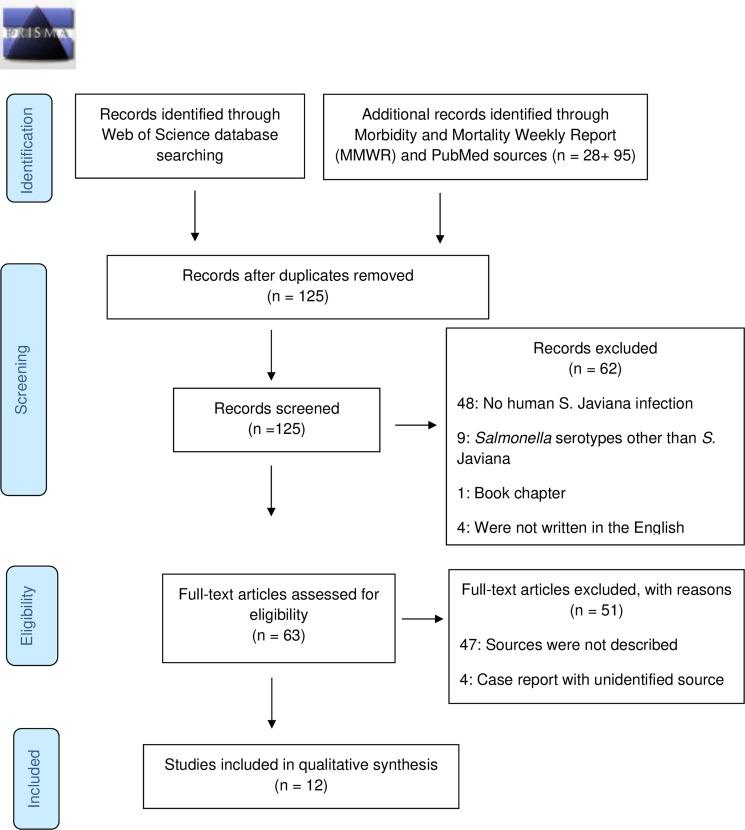
Non-typhoidal Salmonella (NTS) infection is one of the major causes of diarrheal disease throughout the world. In recent years, an increase in human S. Javiana infection has been reported from the southern part of the United States. However, the sources and routes of transmission of this Salmonella serotype are not well understood. The objective of this study was to perform a systematic review of the literature to identify risk factors for human S. Javiana infection. Using PRISMA guidelines, we conducted a systematic search in Web of Science, PubMed, and the Morbidity and Mortality Weekly Report (MMWR). Searches returned 63 potential articles, of which 12 articles met all eligibility criteria and were included in this review. A review of the literature indicated that both food and non-food (such as animal contact) exposures are responsible for the transmission of S. Javiana infection to humans. Consumption of fresh produce (tomatoes and watermelons), herbs (paprika-spice), dairy products (cheese), drinking contaminated well water and animal contact were associated with human S. Javiana infections. Based on the findings of this study, control of human S. Javiana infection should include three factors, (a) consumption of drinking water after treatment, (b) safe animal contact, and (c) safe food processing and handling procedures. The risk factors of S. Javiana infections identified in the current study provide helpful insight into the major vehicles of transmission of S. Javiana. Eventually, this will help to improve the risk management of this Salmonella serotype to reduce the overall burden of NTS infection in humans.
非伤寒沙门氏菌(NTS)感染是全世界腹泻病的主要原因之一。近年来,据报道美国南部地区人类感染 S. Javiana 的病例有所增加。然而,这种沙门氏菌血清型的来源和传播途径尚不清楚。本研究的目的是对文献进行系统回顾,以确定人类 S. Javiana 感染的危险因素。我们使用 PRISMA 指南,在 Web of Science、PubMed 和 Morbidity and Mortality Weekly Report(MMWR)中进行了系统搜索。搜索共返回 63 篇潜在文章,其中 12 篇符合所有纳入标准,并纳入本综述。文献回顾表明,食物和非食物(如动物接触)暴露均可导致 S. Javiana 感染人类。食用新鲜农产品(西红柿和西瓜)、草药(辣椒粉)、乳制品(奶酪)、饮用受污染的井水和动物接触与人类 S. Javiana 感染有关。基于本研究的结果,控制人类 S. Javiana 感染应包括三个因素,(a)饮用水处理后的饮用,(b)安全的动物接触,和(c)安全的食品加工和处理程序。本研究确定的 S. Javiana 感染危险因素为 S. Javiana 的主要传播途径提供了有益的见解。最终,这将有助于改善对该血清型沙门氏菌的风险管理,以降低人类 NTS 感染的总体负担。
 Zotero 插件