
反应转移在评估癌症患者生活质量结局研究中的作用:一项系统综述。
The Role of Response-Shift in Studies Assessing Quality of Life Outcomes Among Cancer Patients: A Systematic Review.
作者信息
Ilie Gabriela, Bradfield Jillian, Moodie Louise, Lawen Tarek, Ilie Alzena, Lawen Zeina, Blackman Chloe, Gainer Ryan, Rutledge Robert D H
机构信息
Department of Community Health and Epidemiology, Faculty of Medicine, Dalhousie University, Halifax Regional Municipality, NS, Canada.
Department of Urology, Faculty of Medicine, Dalhousie University, Halifax Regional Municipality, NS, Canada.
出版信息
Front Oncol. 2019 Aug 20;9:783. doi: 10.3389/fonc.2019.00783. eCollection 2019.
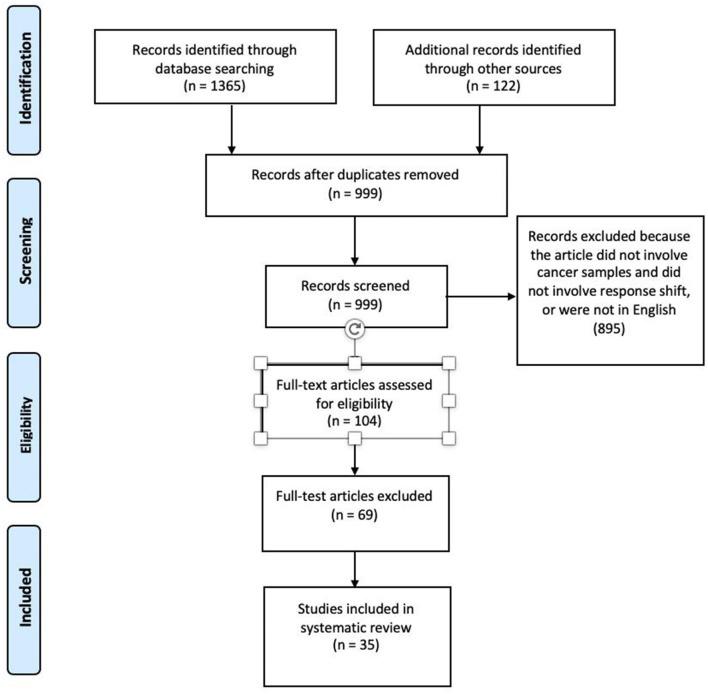
Response-shift has been cited as an important measurement consideration when assessing patient reported quality of life (QoL) outcomes over time among patients with severe chronic conditions. Here we report the results of a systematic review of response shift in studies assessing QoL among cancer patients. A systematic review using MEDLINE, EMBASE, and PsychINFO along with a manual search of the cited references of the articles selected, was conducted. A quality review was performed using STROBE criteria and reported according to PRISMA guidelines. A systematic review of 1,487 records published between 1,887 and December 2018 revealed 104 potentially eligible studies, and 35 studies met inclusion criteria for content and quality. The most common cancer patient populations investigated in these studies were breast (18 studies), lung (14 studies), prostate (eight studies), and colorectal (eight studies). Response shift was identified among 34 of the 35 studies reviewed. Effect sizes were reported in 17 studies assessing QoL outcomes among cancer patients; 12 of which had negligible to small effect sizes, four reported medium effect sizes which were related to physical, global QoL, pain, and social (role) functioning and one reported a large effect size (fatigue). The most prevalent method for assessing response shift was the , which is prone to recall bias, followed by the method. Given the heterogeneity among the characteristics of the samples and designs reviewed, as well as the overall small to negligible effect sizes for the effects reported, conclusions stating that changes due to internal cognitive shifts in perceived QoL should account for changes observed in cancer patients' QoL outcomes should be interpreted with caution. Further work is needed in this area of research. Future studies should control for patient characteristics, time elapsed between diagnosis and baseline assessment and evaluate their contribution to the presence of response shift. Time between assessments should include short and longer periods between assessments and evaluate whether the presence of response shift holds over time. Possible avenues for inquiry for future investigation are discussed.
在评估患有严重慢性病的患者随时间推移的患者报告生活质量(QoL)结果时,反应转移被认为是一个重要的测量考虑因素。在此,我们报告了一项对评估癌症患者QoL的研究中反应转移的系统评价结果。我们使用MEDLINE、EMBASE和PsychINFO进行了系统评价,并对所选文章的引用参考文献进行了手工检索。使用STROBE标准进行了质量评价,并根据PRISMA指南进行报告。对1887年至2018年12月期间发表的1487条记录进行的系统评价显示,有104项潜在符合条件的研究,35项研究符合内容和质量纳入标准。这些研究中调查的最常见癌症患者群体是乳腺癌(18项研究)、肺癌(14项研究)、前列腺癌(8项研究)和结直肠癌(8项研究)。在所审查的35项研究中有34项发现了反应转移。17项评估癌症患者QoL结果的研究报告了效应大小;其中12项效应大小可忽略不计至较小,4项报告了中等效应大小,这些效应大小与身体、总体QoL、疼痛和社会(角色)功能有关;1项报告了较大效应大小(疲劳)。评估反应转移最常用的方法是 ,该方法容易出现回忆偏差,其次是 方法。鉴于所审查样本和设计特征之间的异质性,以及所报告效应的总体效应大小较小至可忽略不计,关于由于感知QoL的内部认知转变导致的变化应解释癌症患者QoL结果中观察到的变化的结论应谨慎解释。该研究领域需要进一步开展工作。未来的研究应控制患者特征、诊断与基线评估之间的时间间隔,并评估它们对反应转移存在的影响。评估之间的时间应包括评估之间的短期和长期,并评估反应转移的存在是否随时间持续。讨论了未来调查可能的探究途径。
 Zotero 插件