
解释印度尼西亚儿童发育迟缓方面社会经济不平等现象的减少。
Explaining the fall of socioeconomic inequality in childhood stunting in Indonesia.
作者信息
Rizal Muhammad Fikru, van Doorslaer Eddy
机构信息
Center for Health Financing Policy and Health Insurance Management, Faculty of Medicine, Public Health, and Nursing, Universitas Gadjah Mada, Yogyakarta, Indonesia.
Erasmus School of Health Policy and Management, Erasmus University Rotterdam, Rotterdam, The Netherlands.
出版信息
SSM Popul Health. 2019 Aug 16;9:100469. doi: 10.1016/j.ssmph.2019.100469. eCollection 2019 Dec.
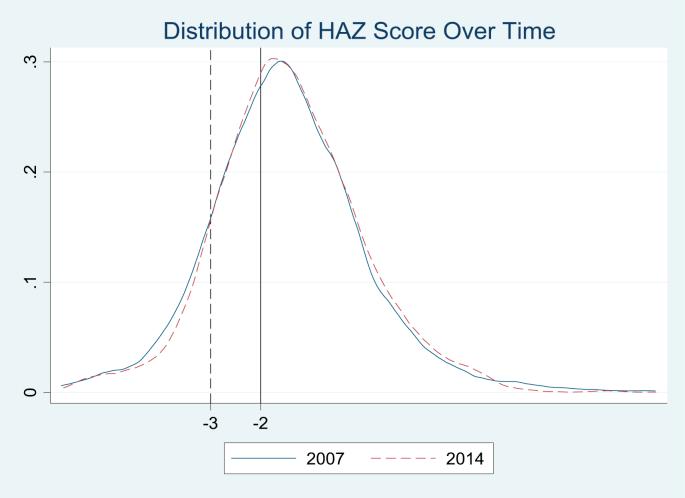
In spite of the enormous economic progress and development witnessed in Indonesia in the last few decades, still more than 30% of Indonesian children under the age of five suffer from stunting, or low height for age. This concern is exacerbated by the fact that stunting remains more concentrated among the poorer households, leading to further intergenerational transmission of poverty and ill health. We examine recent trends in the evolution of the prevalence of childhood stunting and severe stunting, its socioeconomic inequality and the factors that appear to have contributed to these developments. Using the two most recent waves of the we study the changes in the prevalence of (severe) stunting between 2007 and 2014 for children aged 0-59 months and their socioeconomic-inequality using the Erreygers Concentration Index (EI) and its regression-based decomposition. We find a significant drop in the rate of severe stunting but not in stunting, as well as a significant reduction in the degree of absolute inequality of stunting. A decomposition analysis shows that household wealth, maternal education, institutional delivery, and availability of adequate sanitation contribute most to socioeconomic inequality in under-five stunting. Further analysis of the change in inequality over time indicates that the reduction in the association of wealth with stunting and a substantial improvement of health care access of the poor (as proxied by immunizations and institutional deliveries) play the most important role in narrowing the stunting gap between richer and poorer kids. General economic growth, poverty reduction, and implementation of pro-poor health and social programs during the studied period such as the expansion of health insurance coverage for the poor and Conditional Cash Transfer program () are some plausible explanations of the observed result.
尽管在过去几十年里印度尼西亚取得了巨大的经济进步和发展,但仍有超过30%的五岁以下印度尼西亚儿童发育迟缓,即身高低于同龄人正常水平。发育迟缓在较贫困家庭中更为集中,这一情况加剧了人们的担忧,因为它会导致贫困和健康问题的代际传递。我们研究了儿童发育迟缓和严重发育迟缓患病率演变的近期趋势、其社会经济不平等状况以及似乎促成这些发展的因素。利用印度尼西亚家庭生活调查(IFLS)的最新两期数据,我们研究了2007年至2014年期间0 - 59个月儿童(严重)发育迟缓患病率的变化,以及利用埃尔雷格斯集中指数(EI)及其基于回归的分解方法研究其社会经济不平等状况。我们发现严重发育迟缓率显著下降,但发育迟缓率未下降,而且发育迟缓的绝对不平等程度也显著降低。分解分析表明,家庭财富、母亲教育程度、机构分娩以及充足卫生设施的可及性对五岁以下儿童发育迟缓的社会经济不平等影响最大。对不平等随时间变化的进一步分析表明,财富与发育迟缓之间关联的减弱以及穷人获得医疗保健的大幅改善(以免疫接种和机构分娩为代表)在缩小贫富儿童发育迟缓差距方面发挥了最重要作用。在研究期间的总体经济增长、减贫以及扶贫健康和社会项目(如扩大穷人医疗保险覆盖范围和有条件现金转移支付项目(CCT))的实施是对观察结果的一些合理的解释。


 Zotero 插件