
寻求庇护者所经历的创伤事件对其心理健康和医疗服务利用的影响。
Impact of traumatic events incurred by asylum-seekers on mental health and utilization of medical services.
机构信息
Emergency management & disaster medicine department, School of Public Health, Sackler Faculty of Medicine, Tel Aviv University, Tel Aviv, Israel.
National Center for Trauma & Emergency Medicine Research, the Gertner Institute for Health Policy and Epidemiology, Tel Hashomer, Ramat Gan, Israel.
出版信息
Scand J Trauma Resusc Emerg Med. 2019 Sep 6;27(1):85. doi: 10.1186/s13049-019-0665-8.
BACKGROUND
Asylum-seekers from Africa immigrate to Israel through the Sinai desert and are often exposed to traumatic events.
OBJECTIVE
To identify the scope and types of medical services required by asylum-seekers and the relationship between delayed medical care to development of post-traumatic stress disorder (PTSD) and overutilization of medical services.
METHODS
Asylum-seekers that entered Israel between 2009 and 2012 who utilized the Open Clinic of Physicians for Human Rights were interviewed to record their experiences in the Sinai, and document the traumatic events they were exposed to, their medical diagnoses, and clinic visits. Linkages between diagnoses to exposure to traumatic events and period of time until presentation to the clinic were investigated.
RESULTS
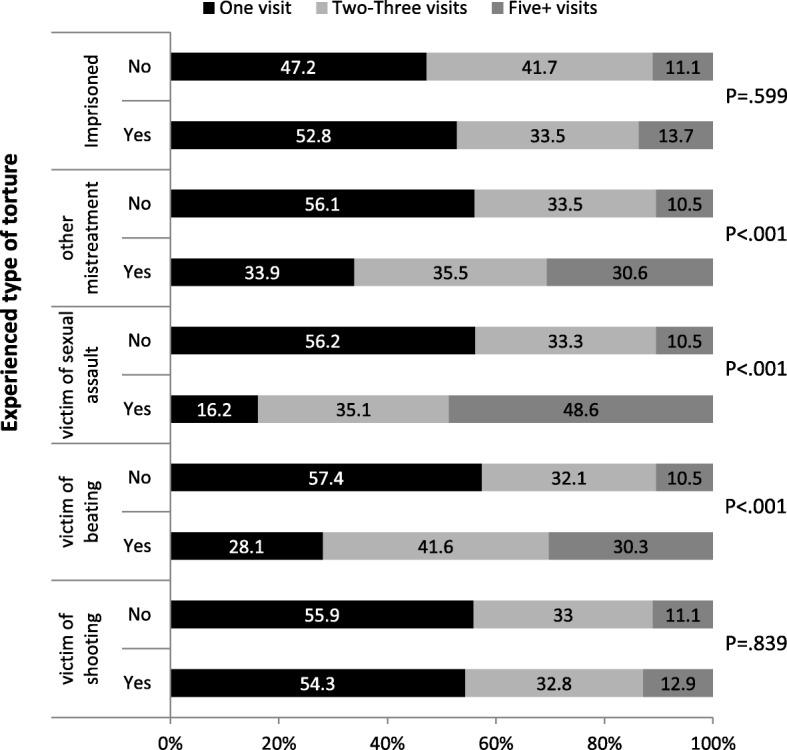
Male vs female asylum-seekers visited the clinic more times (24% vs 15% respectively, utilized > 5 visits). Higher ransom and longer periods in Sinai correlated with higher number of clinic visits and PTSD. Asylum-seekers with PTSD versus other medical complaints approached the clinic more times (> 5 visits). Asylum-seekers that approached the clinic closer to their arrival time (up to 18 months from arrival) versus a later period (> 18 months) presented a significantly lower prevalence of PTSD (3.4 and 40.5% respectively; p < 0.001) and lower utilization of clinic's services (p < 0.001).
CONCLUSIONS
PTSD among asylum-seekers appears to be associated more with length of exposure to stressful events than number/types of traumatic events and with delay in receiving medical care. Improving access to medical care may reduce asylum-seekers' development of PTSD and lead to lower utilization of services.
背景
来自非洲的寻求庇护者通过西奈沙漠移民到以色列,他们经常接触到创伤性事件。
目的
确定寻求庇护者所需的医疗服务范围和类型,以及医疗延迟与创伤后应激障碍(PTSD)发展之间的关系和过度使用医疗服务之间的关系。
方法
2009 年至 2012 年间进入以色列的寻求庇护者,利用人权医师开放诊所,记录他们在西奈的经历,并记录他们接触到的创伤性事件、诊断和就诊情况。调查诊断与暴露于创伤性事件之间以及就诊前的时间之间的联系。
结果
男性与女性寻求庇护者就诊次数更多(分别为 24%和 15%,就诊次数超过 5 次)。赎金越高,在西奈的时间越长,与就诊次数和 PTSD 越高有关。与其他医疗投诉相比,患有 PTSD 的寻求庇护者就诊次数更多(就诊次数超过 5 次)。与就诊时间较晚(到达后超过 18 个月)相比,就诊时间更接近到达时间(到达后 18 个月内)的寻求庇护者,PTSD 的患病率(分别为 3.4%和 40.5%;p<0.001)和诊所服务的利用率(p<0.001)明显较低。
结论
寻求庇护者中的 PTSD 似乎与接触应激性事件的时间长短有关,而与创伤性事件的数量/类型关系不大,与获得医疗护理的延迟有关。改善医疗服务的获取途径可能会减少寻求庇护者患 PTSD 的风险,并降低服务的利用率。

 Zotero 插件