
出生体重对身体成分的影响:来自出生队列和孟德尔随机化研究的证据。
The effect of birth weight on body composition: Evidence from a birth cohort and a Mendelian randomization study.
机构信息
School of Public Health, Li Ka Shing Faculty of Medicine, The University of Hong Kong, Hong Kong, China.
City University of New York Graduate School of Public Health and Health Policy, New York, New York, United States of America.
出版信息
PLoS One. 2019 Sep 10;14(9):e0222141. doi: 10.1371/journal.pone.0222141. eCollection 2019.
BACKGROUND
Lower birth weight is associated with diabetes although the underlying mechanisms are unclear. Muscle mass could be a modifiable link and hence a target of intervention. We assessed the associations of birth weight with muscle and fat mass observationally in a population with little socio-economic patterning of birth weight and using Mendelian randomization (MR) for validation.
METHODS
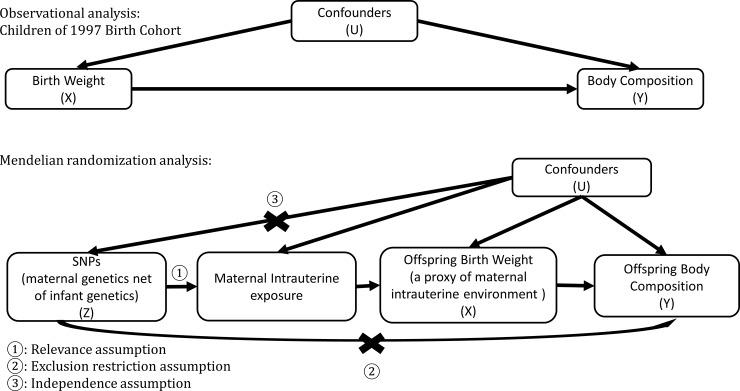
In the population-representative "Children of 1997" birth cohort (n = 8,327), we used multivariable linear regression to assess the adjusted associations of birth weight (kg) with muscle mass (kg) and body fat (%) at ~17.5 years. Genetically predicted birth weight (effect size) was applied to summary genetic associations with fat-free mass and fat mass (kg) from the UK Biobank (n = ~331,000) to obtain unconfounded estimates using inverse-variance weighting.
RESULTS
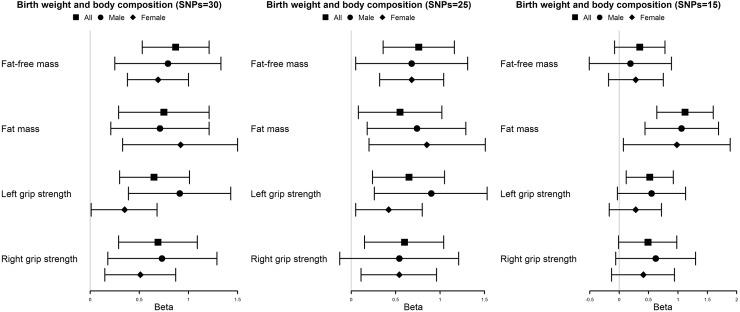
Observationally, birth weight was positively associated with muscle mass (3.29 kg per kg birth weight, 95% confidence interval (CI) 2.83 to 3.75) and body fat (1.09% per kg birth weight, 95% CI 0.54 to 1.65). Stronger associations with muscle mass were observed in boys than in girls (p for interaction 0.004). Using MR, birth weight was positively associated with fat-free mass (0.77 kg per birth weight z-score, 95% CI 0.22 to 1.33) and fat mass (0.58, 95% CI 0.01 to 1.15). No difference by sex was evident.
CONCLUSION
Higher birth weight increasing muscle mass may be relevant to lower birth weight increasing the risk of diabetes and suggests post-natal muscle mass as a potential target of intervention.
背景
尽管其潜在机制尚不清楚,但出生体重较低与糖尿病有关。肌肉量可能是一个可改变的环节,因此也是干预的目标。我们通过观察性研究评估了在出生体重社会经济模式差异较小的人群中,出生体重与肌肉量和体脂量之间的关联,并使用孟德尔随机化(MR)进行验证。
方法
在具有代表性的“1997 年儿童”出生队列(n=8327)中,我们使用多变量线性回归评估出生体重(kg)与 17.5 岁左右的肌肉量(kg)和体脂量(%)之间的调整关联。通过 UK Biobank(n=~331,000)中脂肪量和脂肪量(kg)的全基因组关联汇总数据,应用遗传预测的出生体重(效应量)进行分析,采用逆方差加权法获得无偏估计值。
结果
观察性研究表明,出生体重与肌肉量呈正相关(每公斤出生体重增加 3.29 公斤,95%置信区间(CI)为 2.83 至 3.75),与体脂量呈正相关(每公斤出生体重增加 1.09%,95%CI 为 0.54 至 1.65)。在男孩中观察到与肌肉量的相关性强于女孩(交互作用 p 值=0.004)。使用 MR 分析,出生体重与无脂肪量呈正相关(出生体重 z 分数每增加 0.77 公斤,95%CI 为 0.22 至 1.33),与脂肪量呈正相关(0.58,95%CI 为 0.01 至 1.15)。性别间无差异。
结论
较高的出生体重增加肌肉量可能与较低的出生体重增加糖尿病风险有关,提示出生后肌肉量可能是干预的潜在目标。

 Zotero 插件