
B 细胞库序列分析阐明 UNG 和错配修复蛋白在人类体细胞超突变中的作用。
Repertoire Sequencing of B Cells Elucidates the Role of UNG and Mismatch Repair Proteins in Somatic Hypermutation in Humans.
机构信息
Department of Immunology, Erasmus Medical Center, University Medical Center Rotterdam, Rotterdam, Netherlands.
Laboratory for Immunology, Department of Pediatrics, Leiden University Medical Center, Leiden, Netherlands.
出版信息
Front Immunol. 2019 Aug 27;10:1913. doi: 10.3389/fimmu.2019.01913. eCollection 2019.
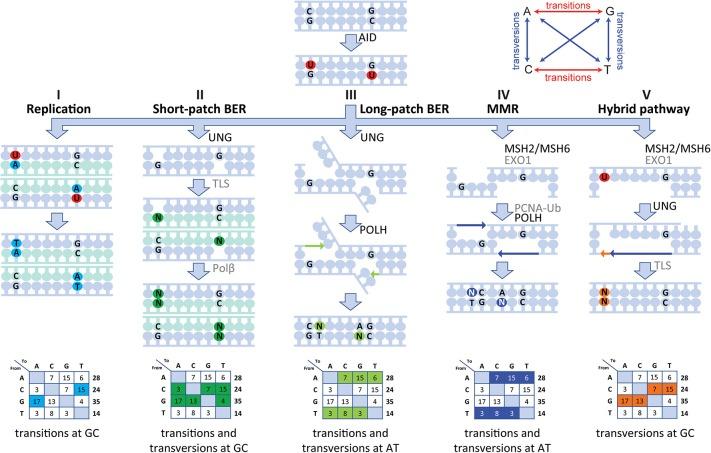
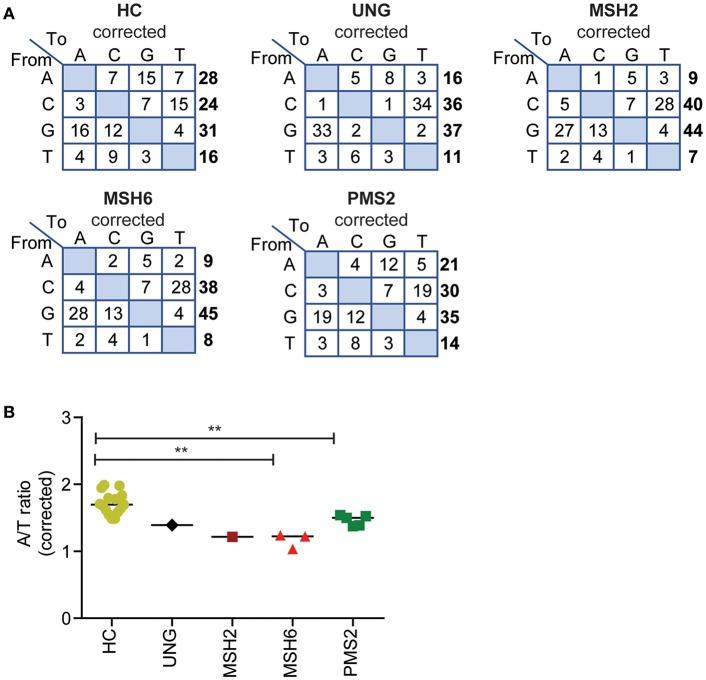
The generation of high-affinity antibodies depends on somatic hypermutation (SHM). SHM is initiated by the activation-induced cytidine deaminase (AID), which generates uracil (U) lesions in the B-cell receptor (BCR) encoding genes. Error-prone processing of U lesions creates a typical spectrum of point mutations during SHM. The aim of this study was to determine the molecular mechanism of SHM in humans; currently available knowledge is limited by the number of mutations analyzed per patient. We collected a unique cohort of 10 well-defined patients with bi-allelic mutations in genes involved in base excision repair (BER) () or mismatch repair (MMR) (, or ) and are the first to present next-generation sequencing (NGS) data of the BCR, allowing us to study SHM extensively in humans. Analysis using ARGalaxy revealed selective skewing of SHM mutation patterns specific for each genetic defect, which are in line with the five-pathway model of SHM that was recently proposed based on mice data. However, trans-species comparison revealed differences in the role of PMS2 and MSH2 in strand targeting between mice and man. In conclusion, our results indicate a role for UNG, MSH2, MSH6, and PMS2 in the generation of SHM in humans comparable to their function in mice. However, we observed differences in strand targeting between humans and mice, emphasizing the importance of studying molecular mechanisms in a human setting. The here developed method combining NGS and ARGalaxy analysis of BCR mutation data forms the basis for efficient SHM analyses of other immune deficiencies.
高亲和力抗体的产生依赖于体细胞高频突变(SHM)。SHM 是由激活诱导的胞嘧啶脱氨酶(AID)启动的,它在 B 细胞受体(BCR)编码基因中产生尿嘧啶(U)损伤。U 损伤的易错处理在 SHM 过程中产生了典型的点突变谱。本研究旨在确定人类 SHM 的分子机制;目前的知识仅限于每位患者分析的突变数量。我们收集了一个独特的队列,其中包括 10 名具有碱基切除修复(BER)()或错配修复(MMR)(,或)中涉及的基因双等位基因突变的明确患者,并且是首次呈现 BCR 的下一代测序(NGS)数据,使我们能够在人类中广泛研究 SHM。使用 ARGalaxy 进行的分析揭示了每种遗传缺陷特有的 SHM 突变模式的选择性倾斜,这与最近基于小鼠数据提出的 SHM 的五通路模型一致。然而,跨物种比较显示了 PMS2 和 MSH2 在小鼠和人类之间的链靶向中的作用差异。总之,我们的结果表明 UNG、MSH2、MSH6 和 PMS2 在人类 SHM 的产生中发挥作用,与它们在小鼠中的功能相当。然而,我们观察到人类和小鼠之间的链靶向存在差异,强调了在人类环境中研究分子机制的重要性。本研究开发的将 NGS 和 ARGalaxy 分析 BCR 突变数据相结合的方法为其他免疫缺陷的有效 SHM 分析奠定了基础。



 Zotero 插件