
出生体重与 2 型糖尿病及血糖特征的关联:一项孟德尔随机化研究。
Association of Birth Weight With Type 2 Diabetes and Glycemic Traits: A Mendelian Randomization Study.
机构信息
Key Laboratory of Molecular Cardiovascular Sciences, Peking University, Ministry of Education, Beijing, China.
Department of Global Health, School of Public Health, Peking University, Beijing, China.
出版信息
JAMA Netw Open. 2019 Sep 4;2(9):e1910915. doi: 10.1001/jamanetworkopen.2019.10915.
IMPORTANCE
Observational studies have shown associations of birth weight with type 2 diabetes (T2D) and glycemic traits, but it remains unclear whether these associations represent causal associations.
OBJECTIVE
To test the association of birth weight with T2D and glycemic traits using a mendelian randomization analysis.
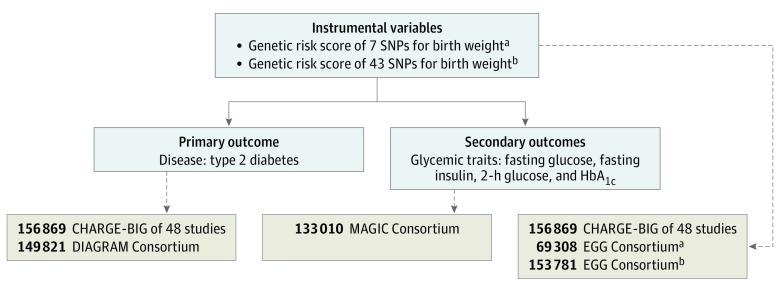
DESIGN, SETTING, AND PARTICIPANTS: This mendelian randomization study used a genetic risk score for birth weight that was constructed with 7 genome-wide significant single-nucleotide polymorphisms. The associations of this score with birth weight and T2D were tested in a mendelian randomization analysis using study-level data. The association of birth weight with T2D was tested using both study-level data (7 single-nucleotide polymorphisms were used as an instrumental variable) and summary-level data from the consortia (43 single-nucleotide polymorphisms were used as an instrumental variable). Data from 180 056 participants from 49 studies were included.
MAIN OUTCOMES AND MEASURES
Type 2 diabetes and glycemic traits.
RESULTS
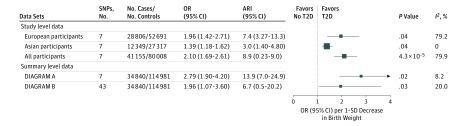
This mendelian randomization analysis included 49 studies with 41 155 patients with T2D and 80 008 control participants from study-level data and 34 840 patients with T2D and 114 981 control participants from summary-level data. Study-level data showed that a 1-SD decrease in birth weight due to the genetic risk score was associated with higher risk of T2D among all participants (odds ratio [OR], 2.10; 95% CI, 1.69-2.61; P = 4.03 × 10⁻⁵), among European participants (OR, 1.96; 95% CI, 1.42-2.71; P = .04), and among East Asian participants (OR, 1.39; 95% CI, 1.18-1.62; P = .04). Similar results were observed from summary-level analyses. In addition, each 1-SD lower birth weight was associated with 0.189 SD higher fasting glucose concentration (β = 0.189; SE = 0.060; P = .002), but not with fasting insulin, 2-hour glucose, or hemoglobin A1c concentration.
CONCLUSIONS AND RELEVANCE
In this study, a genetic predisposition to lower birth weight was associated with increased risk of T2D and higher fasting glucose concentration, suggesting genetic effects on retarded fetal growth and increased diabetes risk that either are independent of each other or operate through alterations of integrated biological mechanisms.
重要性
观察性研究表明,出生体重与 2 型糖尿病(T2D)和血糖特征之间存在关联,但目前尚不清楚这些关联是否代表因果关联。
目的
使用孟德尔随机化分析来检验出生体重与 T2D 和血糖特征的关联。
设计、设置和参与者:本孟德尔随机化研究使用了一个基于 7 个全基因组显著单核苷酸多态性的出生体重遗传风险评分。在孟德尔随机化分析中,使用研究水平数据来检验该评分与出生体重和 T2D 的关联。使用研究水平数据(7 个单核苷酸多态性作为工具变量)和来自联盟的汇总水平数据(43 个单核苷酸多态性作为工具变量)来检验出生体重与 T2D 的关联。纳入了来自 49 项研究的 180056 名参与者的数据。
主要结局和测量指标
2 型糖尿病和血糖特征。
结果
该孟德尔随机化分析包括 49 项研究,其中 41155 名 T2D 患者和 80008 名对照参与者来自研究水平数据,34840 名 T2D 患者和 114981 名对照参与者来自汇总水平数据。研究水平数据表明,由于遗传风险评分,出生体重每降低 1 个标准差,所有参与者患 T2D 的风险就会增加(比值比[OR],2.10;95%CI,1.69-2.61;P=4.03×10⁻⁵),在欧洲参与者中(OR,1.96;95%CI,1.42-2.71;P=0.04),在东亚参与者中(OR,1.39;95%CI,1.18-1.62;P=0.04)。汇总分析也得到了类似的结果。此外,出生体重每降低 1 个标准差,空腹血糖浓度就会升高 0.189 个标准差(β=0.189;SE=0.060;P=0.002),但与空腹胰岛素、2 小时血糖或糖化血红蛋白浓度无关。
结论和相关性
在这项研究中,较低的出生体重遗传倾向与 T2D 风险增加和空腹血糖浓度升高相关,这表明胎儿生长迟缓的遗传效应和糖尿病风险增加,要么彼此独立,要么通过改变综合生物机制来发挥作用。
 Zotero 插件