
醛固酮抑制治疗早期杜氏肌营养不良相关性心肌病的稳定性:多中心 AIDMD 试验结果。
Stabilization of Early Duchenne Cardiomyopathy With Aldosterone Inhibition: Results of the Multicenter AIDMD Trial.
机构信息
Ohio State University Wexner Medical Center Columbus OH.
Nationwide Children's Hospital Columbus OH.
出版信息
J Am Heart Assoc. 2019 Oct;8(19):e013501. doi: 10.1161/JAHA.119.013501. Epub 2019 Sep 24.
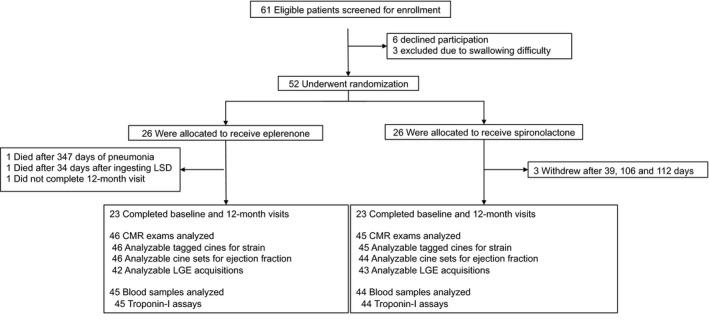
Background Duchenne muscular dystrophy incurs nearly universal dilated cardiomyopathy by the third decade of life, preceded by myocardial damage and impaired left ventricular strain by cardiac magnetic resonance. It has been shown that (1) mineralocorticoid receptor antagonist therapy with spironolactone attenuated damage while maintaining function when given early in a mouse model and (2) low-dose eplerenone stabilized left ventricular strain in boys with Duchenne muscular dystrophy and evident myocardial damage but preserved ejection fraction. We hypothesized that moderate-dose spironolactone versus eplerenone would provide similar cardioprotection in this first head-to-head randomized trial of available mineralocorticoid receptor antagonists, the AIDMD (Aldosterone Inhibition in Duchenne Muscular Dystrophy) trial. Methods and Results This was a multicenter, double-blind, randomized, noninferiority trial. Subjects were randomized to eplerenone, 50 mg, or spironolactone, 50 mg, orally once daily for 12 months. The primary outcome was change in left ventricular systolic strain at 12 months. Among 52 enrolled male subjects, aged 14 (interquartile range, 12-18) years, spironolactone was noninferior to eplerenone (∆strain, 0.4 [interquartile range, -0.4 to 0.6] versus 0.2 [interquartile range, -0.2 to 0.7]; =0.542). Renal and pulmonary function remained stable in both groups, and no subjects experienced serious hyperkalemia. Infrequent adverse events included gynecomastia in one subject in the spironolactone arm and facial rash in one subject in the eplerenone arm. Conclusions In boys with Duchenne muscular dystrophy and preserved left ventricular ejection fraction, spironolactone added to background therapy is noninferior to eplerenone in preserving contractile function. These findings support early mineralocorticoid receptor antagonist therapy as effective and safe in a genetic disease with high cardiomyopathy risk. Clinical Trial Registration URL: http://www.clinicaltrials.gov. Unique identifier: NCT02354352.
背景
杜氏肌营养不良症在生命的第三个十年几乎普遍发生扩张型心肌病,此前通过心脏磁共振检查已发现心肌损伤和左心室应变受损。已经表明,(1)在小鼠模型中早期给予螺内酯(一种盐皮质激素受体拮抗剂)治疗可减轻损伤并维持功能,(2)小剂量依普利酮可稳定患有杜氏肌营养不良症且有明显心肌损伤但射血分数保留的男孩的左心室应变。我们假设,在这项首次头对头随机试验中,中剂量螺内酯与依普利酮这两种现有的盐皮质激素受体拮抗剂在可提供的治疗中具有相似的心脏保护作用,该试验为 AIDMD(醛固酮抑制在杜氏肌营养不良症中)试验。
方法和结果
这是一项多中心、双盲、随机、非劣效性试验。受试者随机接受依普利酮 50mg 或螺内酯 50mg,每日口服一次,持续 12 个月。主要终点为 12 个月时左心室收缩应变的变化。在 52 名入组的 14 岁(四分位距,12-18 岁)男性受试者中,螺内酯不劣于依普利酮(应变变化,0.4 [四分位距,-0.4 至 0.6] 与 0.2 [四分位距,-0.2 至 0.7];=0.542)。两组的肾功能和肺功能均保持稳定,且无受试者发生严重高钾血症。少见的不良反应包括螺内酯组 1 例受试者出现男性乳房发育,依普利酮组 1 例受试者出现面部皮疹。
结论
在患有杜氏肌营养不良症且保留左心室射血分数的男孩中,螺内酯联合背景治疗在维持收缩功能方面不劣于依普利酮。这些发现支持在高心肌病风险的遗传性疾病中早期使用盐皮质激素受体拮抗剂治疗的有效性和安全性。
临床试验注册网址

 Zotero 插件