
慢性创伤性脑病和阿尔茨海默病中的tau蛋白病变:异同
Tau Pathology in Chronic Traumatic Encephalopathy and Alzheimer's Disease: Similarities and Differences.
作者信息
Katsumoto Atsuko, Takeuchi Hideyuki, Tanaka Fumiaki
机构信息
Department of Neurology and Stroke Medicine, Graduate School of Medicine, Yokohama City University, Yokohama, Japan.
出版信息
Front Neurol. 2019 Sep 10;10:980. doi: 10.3389/fneur.2019.00980. eCollection 2019.
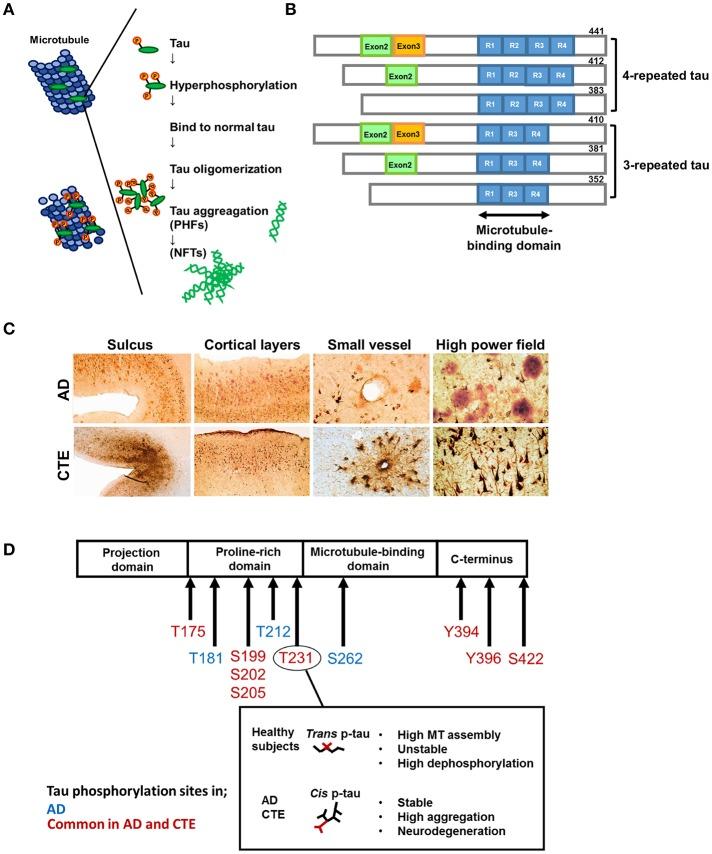
Traumatic brain injury (TBI) has been associated with the development of Alzheimer's disease (AD) because these conditions share common pathological hallmarks: amyloid-β and hyperphosphorylated tau accumulation. However, given recent data it is uncertain if a history of TBI leads to the development of AD. Moreover, chronic traumatic encephalopathy (CTE), caused by repetitive mild TBI and characterized by progressive neurodegeneration with hyperphosphorylated tau, has come to be recognized as distinct from AD. Therefore, it is important to elucidate the clinical outcomes and molecular mechanisms underlying tau pathology following TBI. We summarize the histopathological features and clinical course of TBI in CTE, comparing the tau pathology with that in AD. Following brain injury, diffuse axonal injury, and hyperphosphorylated tau aggregates are observed within a shorter period than in AD. Hyperphosphorylated tau deposition usually begins in the perivascular area of the sulci in the cerebral cortex, then spreads unevenly in the cortex in CTE, while AD shows diffuse distribution of hyperphosphorylated tau in the cortical areas. We also highlight the molecular profile of tau and the implications of tau progression throughout the brain in both diseases. Tau contains phosphorylation sites common to both conditions. In particular, phosphorylation at Thr triggers a conformational change to the toxic form of tau, which is suggested to drive neurodegeneration. Although the mechanism of rapid tau accumulation remains unknown, the structural diversity of tau might result in these different outcomes. Finally, future perspectives on CTE in terms of tau reduction are discussed.
创伤性脑损伤(TBI)与阿尔茨海默病(AD)的发生有关,因为这些病症具有共同的病理特征:淀粉样β蛋白和过度磷酸化tau蛋白的积累。然而,根据最近的数据,尚不确定TBI病史是否会导致AD的发生。此外,由重复性轻度TBI引起的慢性创伤性脑病(CTE),其特征是伴有过度磷酸化tau蛋白的进行性神经退行性变,已被认为与AD不同。因此,阐明TBI后tau蛋白病理的临床结果和分子机制很重要。我们总结了CTE中TBI的组织病理学特征和临床过程,并将tau蛋白病理与AD中的进行比较。脑损伤后,与AD相比,在更短的时间内就会观察到弥漫性轴索损伤和过度磷酸化tau蛋白聚集体。在CTE中,过度磷酸化tau蛋白沉积通常始于大脑皮质沟回的血管周围区域,然后在皮质中不均匀扩散,而AD则显示过度磷酸化tau蛋白在皮质区域弥漫分布。我们还强调了两种疾病中tau蛋白的分子特征以及tau蛋白在全脑进展的影响。Tau蛋白含有两种病症共有的磷酸化位点。特别是,苏氨酸位点的磷酸化会引发tau蛋白向毒性形式的构象变化,这被认为会驱动神经退行性变。尽管tau蛋白快速积累的机制尚不清楚,但tau蛋白的结构多样性可能导致了这些不同的结果。最后,讨论了在减少tau蛋白方面对CTE的未来展望。
 Zotero 插件