
囊性纤维化患者长期治疗的依从性:一项将处方、配药和住院数据相联系的法国横断面研究。
Adherence to long-term therapies in cystic fibrosis: a French cross-sectional study linking prescribing, dispensing, and hospitalization data.
作者信息
Rouzé Héloïse, Viprey Marie, Allemann Samuel, Dima Alexandra L, Caillet Pascal, Denis Angélique, Poupon-Bourdy Stéphanie, Camara Boubou, Llerena Catherine, Reix Philippe, Durieu Isabelle, Reynaud Quitterie, Touzet Sandrine
机构信息
Public Health Department, Hospices Civils de Lyon, Lyon, France.
HESPER Lab-EA 7425, Université de Lyon-Université Claude Bernard Lyon 1, Lyon, France.
出版信息
Patient Prefer Adherence. 2019 Sep 4;13:1497-1510. doi: 10.2147/PPA.S211769. eCollection 2019.
BACKGROUND
Cystic fibrosis (CF) is a life-shortening genetic condition that usually affects several organs and involves significant treatment burden. Adherence to medication is important for successful CF management.
OBJECTIVE
To describe medication adherence according to age, therapeutic class, and pharmaceutical form in adults and children followed in four regional CF centers in France.
METHODS
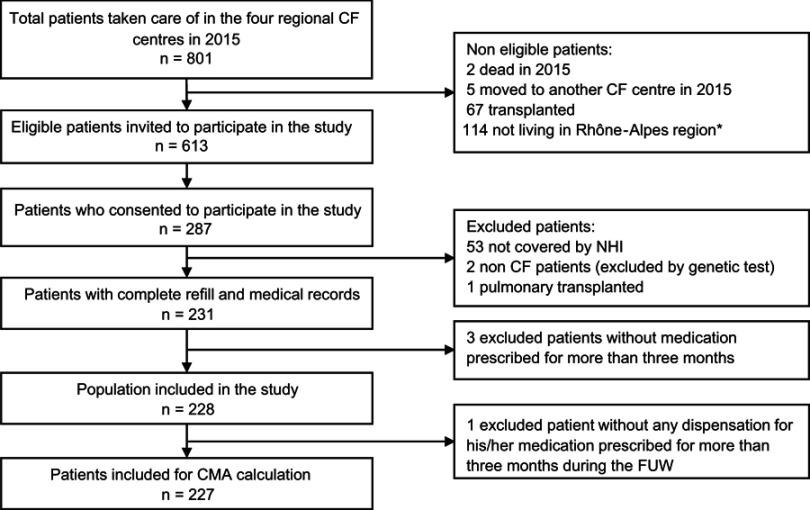
We conducted a cross-sectional study with non-transplanted patients followed in two adult and two pediatric centers during 2015 who were covered by the French National Health Insurance (NHI). Sociodemographic, clinical, hospitalization, and prescription data were collected from patient medical records. Medication dispensations were extracted from the regional French NHI database. Adherence was calculated over 12 months using continuous medication availability (CMA) accounting for dose adjustments and hospitalizations. Drug-specific CMA was computed in R with the AdhereR package for each medication prescribed more than 3 months, which was averaged to obtain a composite CMA score (cCMA) for all treatments and per therapeutic class as well as pharmaceutical form for each patient.
RESULTS
A total of 228 patients were included. The number of chronic medications increased with age (=0.50, <0.001): a median of 7 medications per patient were prescribed. The mean±SD cCMA was significantly different between age groups (=0.0098): it was 0.71±0.20 for the 0-5 years age group, 0.73±0.16 for 6-11 years, 0.64±0.17 for 12-17 years, 0.57±0.23 for 18-25 years, and 0.65±0.20 for the over 25 years age group. cCMA varied significantly according to pharmaceutical forms: the mean±SD cCMA was 0.70±0.21 for oral medications and 0.54±0.28 for inhaled medications (<0.001).
CONCLUSION
This study suggests that adherence to medication regimens in CF patients remains suboptimal and varies substantially between age groups and pharmaceutical forms. These variations in adherence should be considered when developing effective strategies to improve adherence.
背景
囊性纤维化(CF)是一种缩短寿命的遗传疾病,通常会影响多个器官,并带来巨大的治疗负担。坚持用药对于成功管理CF至关重要。
目的
描述法国四个地区CF中心随访的成人和儿童患者按年龄、治疗类别和药物剂型划分的用药依从性。
方法
我们对2015年在两个成人中心和两个儿科中心随访的未移植患者进行了一项横断面研究,这些患者由法国国家健康保险(NHI)承保。从患者病历中收集社会人口学、临床、住院和处方数据。用药配给量从法国地区NHI数据库中提取。使用考虑剂量调整和住院情况的连续用药可得性(CMA)计算12个月期间的依从性。使用AdhereR软件包在R中为每种处方超过3个月的药物计算特定药物的CMA,将其平均以获得每位患者所有治疗、每个治疗类别以及每种药物剂型的综合CMA评分(cCMA)。
结果
共纳入228例患者。慢性药物数量随年龄增加(=0.50,<0.001):每位患者开具的药物中位数为7种。年龄组之间的平均±标准差cCMA有显著差异(=0.0098):0至5岁年龄组为0.71±0.20,6至11岁为0.73±0.16,12至17岁为0.64±0.17,18至25岁为0.57±0.23,25岁以上年龄组为0.65±0.20。cCMA因药物剂型而异:口服药物的平均±标准差cCMA为0.70±0.21,吸入药物为0.54±0.28(<0.001)。
结论
本研究表明,CF患者的用药方案依从性仍不理想,且在年龄组和药物剂型之间存在很大差异。在制定提高依从性的有效策略时,应考虑这些依从性差异。

 Zotero 插件