
孕期各阶段双酚暴露与出生体重的关联:一项中国的产前队列研究。
Associations of Trimester-Specific Exposure to Bisphenols with Size at Birth: A Chinese Prenatal Cohort Study.
机构信息
Key Laboratory of Environment and Health (HUST), Ministry of Education & Ministry of Environmental Protection, and State Key Laboratory of Environmental Health (Incubation), School of Public Health, Tongji Medical College, Huazhong University of Science and Technology, Wuhan, Hubei, China.
Department of Epidemiology, Brown University School of Public Health, Providence, Rhode Island, USA.
出版信息
Environ Health Perspect. 2019 Oct;127(10):107001. doi: 10.1289/EHP4664. Epub 2019 Oct 1.
BACKGROUND
Bisphenol A (BPA) is an endocrine disruptor that affects fetal growth in experimental studies. Bisphenol F (BPF) and bisphenol S (BPS), which have been substituted for BPA in some consumer products, have also shown endocrine-disrupting effects in experimental models. However, the effects of BPF and BPS on fetal growth in humans are unknown.
OBJECTIVES
Our goal was to investigate trimester-specific associations of urinary concentrations of BPA, BPF, and BPS with size at birth.
METHODS
The present study included 845 pregnant women from Wuhan, China (2013-2015), who provided one urine sample in each of the first, second, and third trimesters. Linear regressions with generalized estimating equations were applied to estimate trimester-specific associations of urinary bisphenol concentrations with birth weight, birth length, and ponderal index. Linear mixed-effects models were used to identify potential critical windows of susceptibility to bisphenols by comparing the exposure patterns of newborns in the 10th percentile of each birth anthropometric measurement to that of those in the 90th percentile.
RESULTS
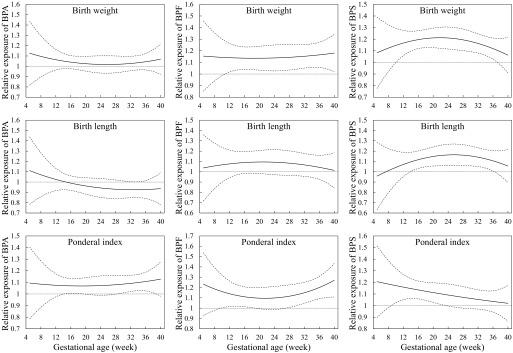
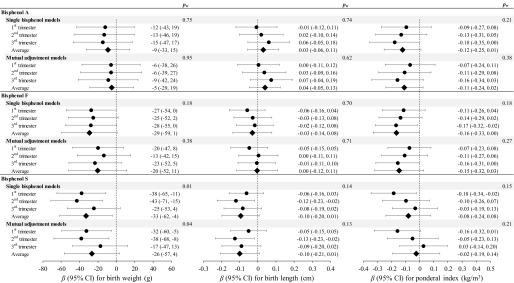
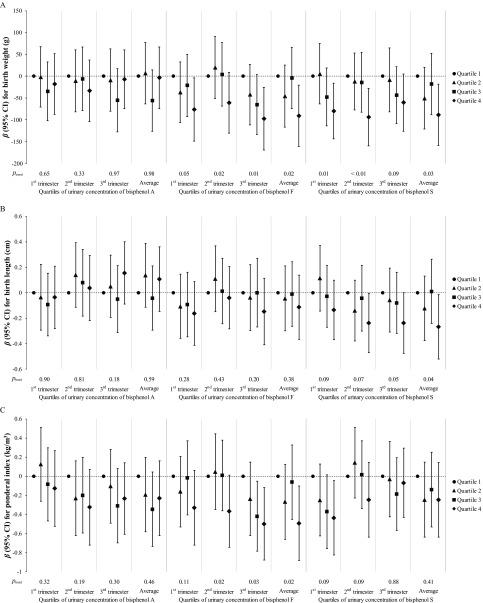
Medians (25th-75th percentiles) of urinary concentrations of BPA, BPF, and BPS were 1.40 (0.19-3.85), 0.65 (0.34-1.39), and 0.38 (0.13-1.11) ng/mL, respectively. Urinary BPA concentrations in different trimesters were inversely, but not significantly, associated with birth weight and ponderal index. Urinary concentrations of BPF and BPS during some trimesters were associated with significantly lower birth weight, birth length, or ponderal index, with significant trend -values () across quartiles of BPF and BPS concentrations. The observed associations were unchanged after additionally adjusting for other bisphenols. In addition, newborns in the 10th percentile of each birth anthropometry measure had higher BPF and BPS exposures during pregnancy than newborns in the 90th percentile of each outcome.
CONCLUSIONS
Prenatal exposure to BPF and BPS was inversely associated with size at birth in this cohort. Replication in other populations is needed. https://doi.org/10.1289/EHP4664.
背景
双酚 A(BPA)是一种内分泌干扰物,在实验研究中会影响胎儿生长。双酚 F(BPF)和双酚 S(BPS)已被某些消费产品替代 BPA,它们在实验模型中也显示出内分泌干扰作用。然而,BPF 和 BPS 对人类胎儿生长的影响尚不清楚。
目的
我们的目标是研究孕妇尿液中 BPA、BPF 和 BPS 浓度与出生时大小的特定孕期关联。
方法
本研究纳入了 845 名来自中国武汉的孕妇(2013-2015 年),她们在每个孕期的第一、二、三期分别提供了一份尿液样本。应用广义估计方程的线性回归来估计尿液中双酚浓度与出生体重、出生长度和体重指数的特定孕期关联。使用线性混合效应模型,通过比较每个出生体测指标第 10 百分位数的新生儿与第 90 百分位数的新生儿的暴露模式,确定对双酚类物质易感性的潜在关键窗口期。
结果
BPA、BPF 和 BPS 的尿液浓度中位数(25 至 75 百分位数)分别为 1.40(0.19-3.85)、0.65(0.34-1.39)和 0.38(0.13-1.11)ng/mL。不同孕期的尿液 BPA 浓度与出生体重和体重指数呈负相关,但无统计学意义。孕期某些时期的 BPF 和 BPS 浓度与出生体重、出生长度或体重指数显著降低有关,且 BPF 和 BPS 浓度四分位数间呈显著趋势值()。在额外调整其他双酚类物质后,观察到的关联仍然不变。此外,每个出生体测指标第 10 百分位数的新生儿在孕期的 BPF 和 BPS 暴露量高于每个结局第 90 百分位数的新生儿。
结论
在本队列中,孕妇产前接触 BPF 和 BPS 与出生时的体型呈负相关。需要在其他人群中进行复制研究。https://doi.org/10.1289/EHP4664.
 Zotero 插件