
上肢关节运动学使用可穿戴磁和惯性测量单元:基于骨性标志识别的解剖校准程序。
Upper limb joint kinematics using wearable magnetic and inertial measurement units: an anatomical calibration procedure based on bony landmark identification.
机构信息
School of Sport and Exercise Sciences, "e-Campus" University, Novedrate, Italia.
Unità Operativa Complessa di Neurologia, Fondazione Policlinico Universitario A. Gemelli IRCCS, Roma, Italia.
出版信息
Sci Rep. 2019 Oct 8;9(1):14449. doi: 10.1038/s41598-019-50759-z.
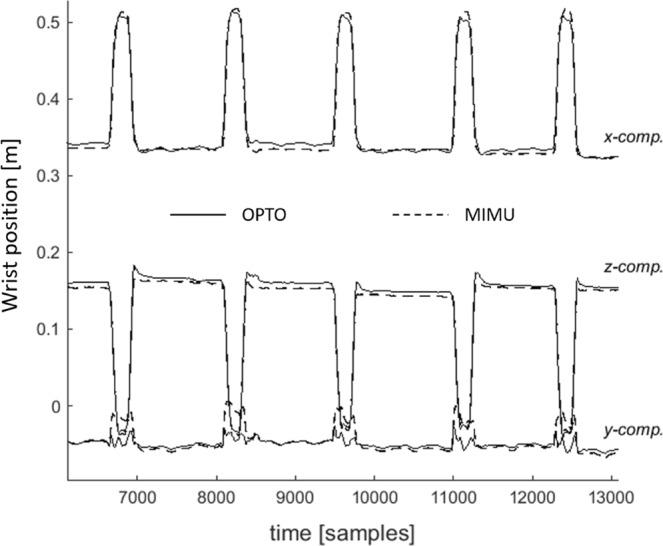
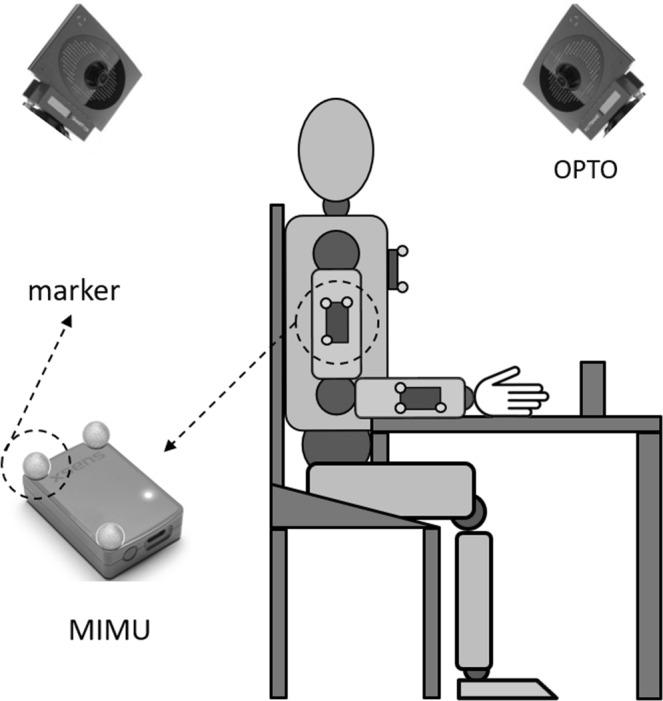
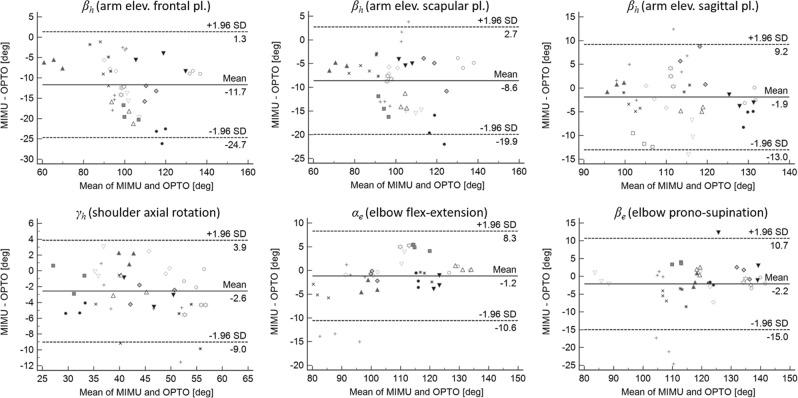
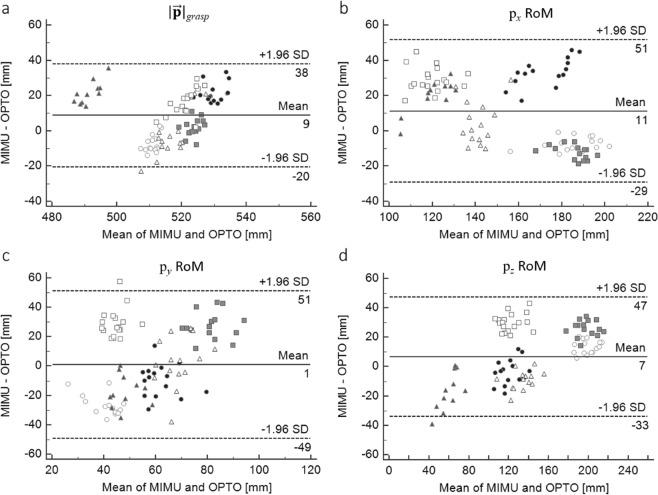
The estimate of a consistent and clinically meaningful joint kinematics using wearable inertial and magnetic sensors requires a sensor-to-segment coordinate system calibration. State-of-the-art calibration procedures for the upper limb are based on functional movements and/or pre-determined postures, which are difficult to implement in subjects that have impaired mobility or are bedridden in acute units. The aim of this study was to develop and validate an alternative calibration procedure based on the direct identification of palpable anatomical landmarks (ALs) for an inertial and magnetic sensor-based upper limb movement analysis protocol. The proposed calibration procedure provides an estimate of three-dimensional shoulder/elbow angular kinematics and the linear trajectory of the wrist according to the standards proposed by the International Society of Biomechanics. The validity of the method was assessed against a camera-based optoelectronic system during uniaxial joint rotations and a reach-to-grasp task. Joint angular kinematics was found as characterised by a low-biased range of motion (<-2.6°), a low root mean square deviation (RMSD) (<4.4°) and a high waveform similarity coefficient (R > 0.995) with respect to the gold standard. Except for the cranio-caudal direction, the linear trajectory of the wrist was characterised by a low-biased range of motion (<11 mm) together with a low RMSD (8 mm) and high waveform similarity (R > 0.968). The proposed method enabled the estimation of reliable joint kinematics without requiring any active involvement of the patient during the calibration procedure, complying with the metrological standards and requirements of clinical movement analysis.
使用可穿戴惯性和磁传感器对一致且具有临床意义的关节运动进行估计,需要进行传感器到节段坐标系校准。上肢的最新校准程序基于功能运动和/或预定姿势,对于行动不便或急性单位卧床不起的患者来说,这些程序难以实施。本研究的目的是开发和验证一种替代的校准程序,该程序基于可触知的解剖学标志(AL)的直接识别,用于基于惯性和磁传感器的上肢运动分析协议。所提出的校准程序根据国际生物力学学会提出的标准,提供了三维肩部/肘部角度运动学和手腕的线性轨迹的估计。该方法的有效性在单轴关节旋转和伸手抓握任务期间通过基于摄像机的光电系统进行了评估。关节角度运动学的特点是运动范围低偏差(< -2.6°),均方根偏差(RMSD)低(<4.4°),与黄金标准的波形相似系数高(R> 0.995)。除了颅尾方向外,手腕的线性轨迹的特点是运动范围低偏差(<11mm),同时 RMSD 低(8mm),波形相似性高(R> 0.968)。该方法无需患者在校准过程中进行任何主动参与,即可实现可靠关节运动学的估计,符合计量标准和临床运动分析的要求。


 Zotero 插件