
经磁共振成像(MRI)确诊的单节段神经根病患者的疼痛部位在哪里,以及这些疼痛模式的临床可解释性如何?一项横断面诊断准确性研究。
Where do patients with MRI-confirmed single-level radiculopathy experience pain, and what is the clinical interpretability of these pain patterns? A cross-sectional diagnostic accuracy study.
作者信息
Albert Hanne B, Hansen Jeanette Kaae, Søgaard Helle, Kent Peter
机构信息
The Modic Clinic, Odense, Denmark.
2Research Department, Spine Centre of Southern Denmark, Lillebaelt Hospital, Middelfart, Denmark.
出版信息
Chiropr Man Therap. 2019 Oct 7;27:50. doi: 10.1186/s12998-019-0273-8. eCollection 2019.
BACKGROUND
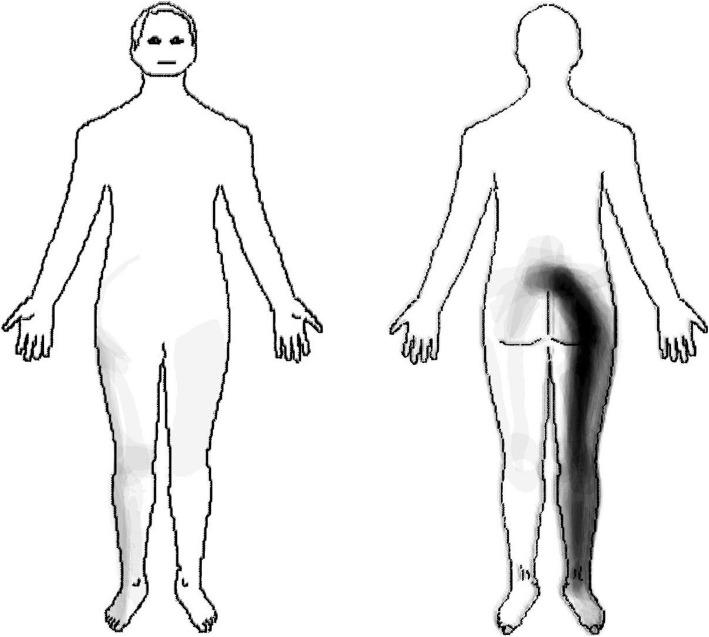
Clinicians nominate the distribution of leg pain as being important in diagnosing nerve root involvement. This study aimed to identify: (i) common unisegmental radicular pain patterns and whether they were dermatomal, and (ii) whether these radicular pain patterns assisted clinician discrimination of the nerve root level involved.
METHODS
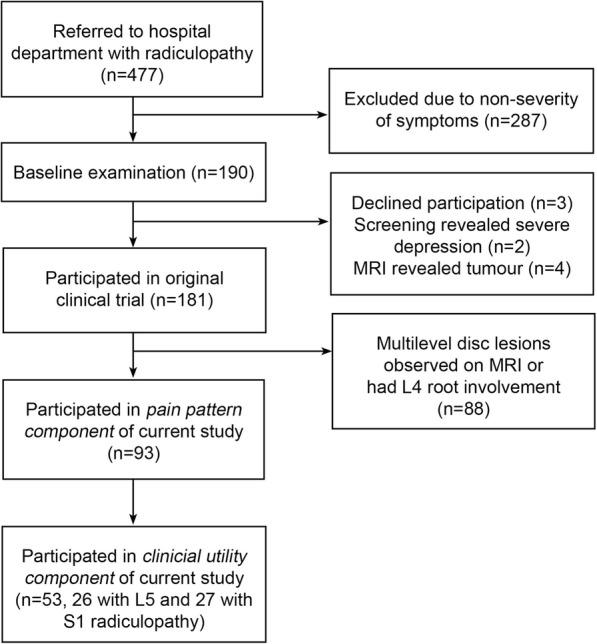
A cross-sectional diagnostic accuracy study of adult patients with radicular leg pain at a hospital in Denmark. All patients had positive neurological signs (average 2.8 signs - hypoalgesia, diminished reflexes, muscle weakness, positive Straight Leg Raise test).Part 1 (pain patterns) was a secondary analysis of baseline pain pattern data collected during a clinical trial. The pain charts of 93 patients with an MRI and clinically confirmed single-level disc herniation with nerve root compression were digitised and layered to form a composite picture of the radicular patterns for the L5 and S1 nerve roots, which were then compared to published dermatomes.In Part 2 (clinical utility) we prospectively measured the discriminative ability of the identified pain patterns. The accuracy was calculated of three groups of six clinicians at classifying the nerve root affected in a randomized sequence of 53 patients, when not shown, briefly shown or continuously shown the composite pain patterns. In each group were two chiropractors, two medical doctors and two physiotherapists.
RESULTS
There was a wide overlap in pain patterns from compromised L5 and S1 nerve roots but some distinguishing features. These pain patterns had approximately 50 to 80% overlap with published dermatomes. Clinicians were unable to determine with any accuracy above chance whether an individual pain drawing was from a person with a compromised L5 or S1 nerve root, and use of the composite pain drawings did not improve that accuracy.
CONCLUSIONS
While pain distribution may be an indication of radiculopathy, pain patterns from L5 or S1 nerve root compression only approximated those of sensory dermatomes, and level-specific knowledge about radicular pain patterns did not assist clinicians' diagnostic accuracy of the nerve root impinged. These results indicate that, on their own, pain patterns provide very limited additional diagnostic information about which individual nerve root is affected.
背景
临床医生认为腿部疼痛的分布对诊断神经根受累很重要。本研究旨在确定:(i)常见的单节段神经根性疼痛模式及其是否为皮节性的,以及(ii)这些神经根性疼痛模式是否有助于临床医生辨别受累的神经根水平。
方法
在丹麦一家医院对患有神经根性腿痛的成年患者进行横断面诊断准确性研究。所有患者均有阳性神经体征(平均2.8个体征——痛觉减退、反射减弱、肌肉无力、直腿抬高试验阳性)。第1部分(疼痛模式)是对一项临床试验中收集的基线疼痛模式数据进行的二次分析。对93例经MRI检查且临床确诊为单节段椎间盘突出伴神经根受压患者的疼痛图表进行数字化处理并分层,以形成L5和S1神经根的神经根模式复合图,然后将其与已发表的皮节图进行比较。在第2部分(临床应用)中,我们前瞻性地测量了所确定的疼痛模式的辨别能力。计算了三组共六名临床医生在对53例患者的随机序列进行分类时,在不展示、简要展示或持续展示复合疼痛模式的情况下,判断受影响神经根的准确性。每组中有两名脊椎按摩师、两名医生和两名物理治疗师。
结果
L5和S1神经根受损的疼痛模式有广泛重叠,但也有一些区别特征。这些疼痛模式与已发表的皮节图有大约50%至80%的重叠。临床医生无法准确判断某一幅个体疼痛图是来自L5或S1神经根受损的患者,使用复合疼痛图也未提高准确性。
结论
虽然疼痛分布可能是神经根病的一个指标,但L5或S1神经根受压的疼痛模式仅与感觉皮节的模式近似,关于神经根性疼痛模式的特定水平知识无助于临床医生对受压神经根的诊断准确性。这些结果表明,仅凭疼痛模式提供的关于哪个个体神经根受影响的额外诊断信息非常有限。


 Zotero 插件