
高通量16S rRNA测序用于评估潜在活性细菌和食源性病原体:即食食品的一个案例
High-Throughput 16S rRNA Sequencing to Assess Potentially Active Bacteria and Foodborne Pathogens: A Case Example in Ready-to-Eat Food.
作者信息
Mira Miralles Marina, Maestre-Carballa Lucia, Lluesma-Gomez Monica, Martinez-Garcia Manuel
机构信息
Department of Physiology, Genetics and Microbiology, University of Alicante, Building 12, C/San Vicente, 03080 Alicante, Spain.
出版信息
Foods. 2019 Oct 11;8(10):480. doi: 10.3390/foods8100480.
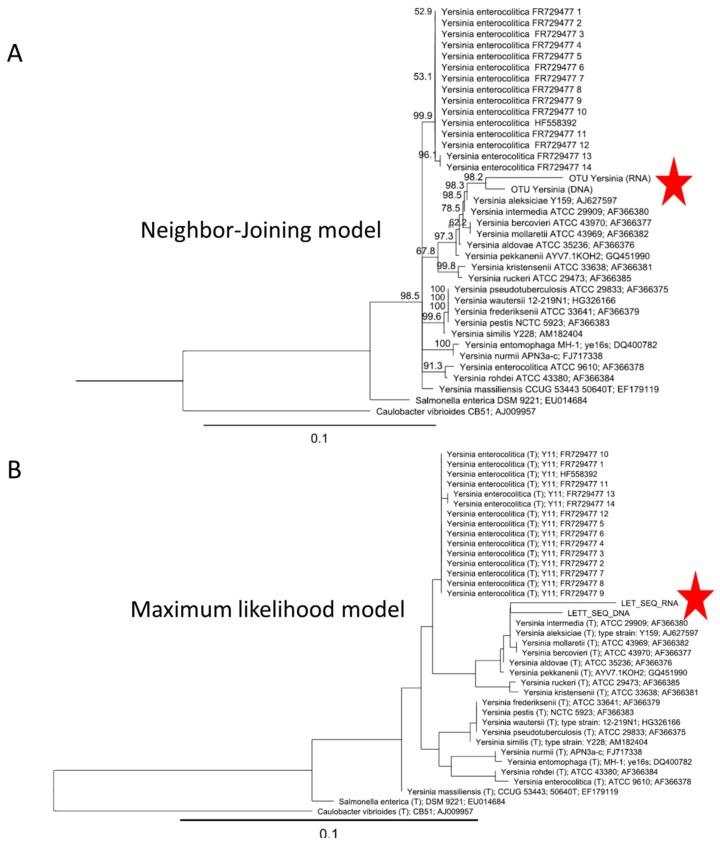
Technologies to detect the entire bacterial diversity spectra and foodborne pathogens in food represent a fundamental advantage in the control of foodborne illness. Here, we applied high-throughput 16S rRNA sequencing of amplicons obtained by PCR and RT-PCR from extracted DNA and RNA targeting the entire bacterial community and the active bacterial fraction present in some of the most consumed and distributed ready-to-eat (RTE) salad brands in Europe. Customer demands for RTE food are increasing worldwide along with the number of associated foodborne illness and outbreaks. The total aerobic bacterial count in the analyzed samples was in the range of 2-4 × 10 CFU/g (SD ± 1.54 × 10). Culture validated methods did not detect spp., , and other fecal coliforms. 16S rRNA gene Illumina next-generation sequencing (NGS) data were congruent with these culture-based results and confirmed that these and other well-known foodborne bacterial pathogens, such as , were not detected. However, the fine-resolution of the NGS method unveiled the presence of the opportunistic pathogens and (relative frequency of 1.33-7.33%) that were metabolically active in addition to non-pathogenic, active members of spp. (relative frequency of 0.0015-0.003%). The common ail and foxA marker genes of were not detected by qPCR. Finally, our NGS data identified to non-pathogenic spp. as the most abundant and metabolically active bacteria in the analyzed RTE salads (53-75% of bacterial abundance). Our data demonstrate the power of sequencing, in parallel, both 16S rRNA and rDNA to identify and discriminate those potentially and metabolically active bacteria and pathogens to provide a more complete view that facilitates the control of foodborne diseases, although further work should be conducted to determine the sensitivity of this method for targeting bacteria.
检测食品中细菌多样性谱和食源性病原体的技术是控制食源性疾病的一项基本优势。在此,我们应用高通量16S rRNA测序技术,通过PCR和RT-PCR从提取的DNA和RNA中扩增出针对整个细菌群落以及欧洲一些消费和分销最多的即食(RTE)沙拉品牌中存在的活性细菌部分的扩增子。随着全球食源性疾病和疫情爆发数量的增加,全球客户对即食食品的需求也在上升。分析样品中的总需氧菌数在2-4×10 CFU/g范围内(标准差±1.54×10)。经培养验证的方法未检测到某些菌属、某些菌以及其他粪大肠菌群。16S rRNA基因的Illumina下一代测序(NGS)数据与这些基于培养的结果一致,并证实未检测到这些以及其他知名的食源细菌病原体,如某些菌。然而,NGS方法的高分辨率揭示了机会性病原体某些菌和某些菌的存在(相对频率为1.33-7.33%),它们除了是某些菌属的非致病活性成员(相对频率为0.0015-0.003%)外还具有代谢活性。通过qPCR未检测到某些菌的常见ail和foxA标记基因。最后,我们的NGS数据确定非致病的某些菌属是分析的即食沙拉中最丰富且代谢活跃的细菌(占细菌丰度的53-75%)。我们的数据证明了同时对16S rRNA和rDNA进行测序以识别和区分潜在和代谢活跃细菌及病原体的能力,从而提供更完整的视图以促进食源性疾病的控制,尽管还应开展进一步工作来确定该方法针对细菌的敏感性。

 Zotero 插件