
碳纳米管诱导的肺部炎症和纤维化过程中,成纤维细胞中NF-κB的激活及其促纤维化功能
Activation and Pro-Fibrotic Function of NF-κB in Fibroblastic Cells During Pulmonary Inflammation and Fibrosis Induced by Carbon Nanotubes.
作者信息
Dong Jie, Ma Qiang
机构信息
Receptor Biology Laboratory, Toxicology and Molecular Biology Branch, Health Effects Laboratory Division, National Institute for Occupational Safety and Health, Centers for Disease Control and Prevention, Morgantown, WV, United States.
出版信息
Front Pharmacol. 2019 Oct 2;10:1140. doi: 10.3389/fphar.2019.01140. eCollection 2019.
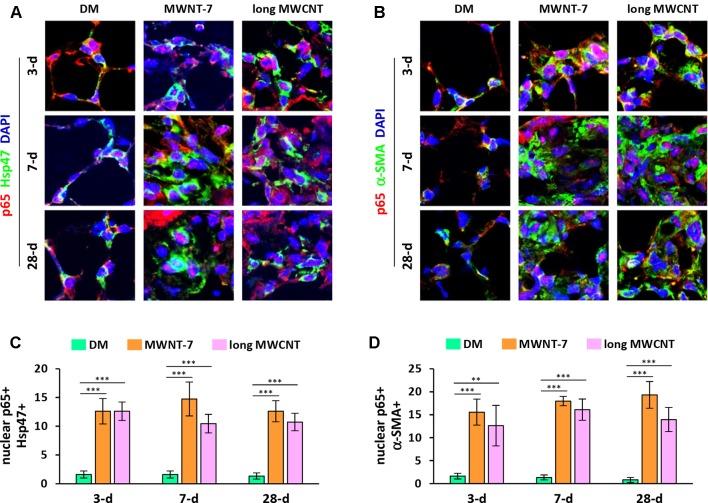
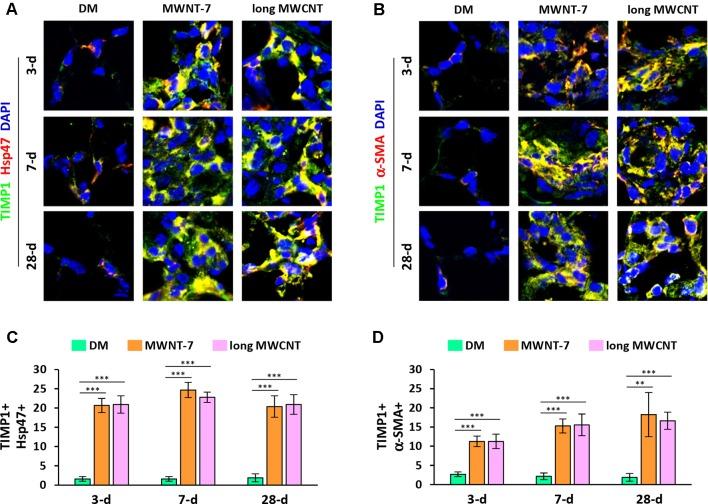
Exposure to insoluble particles in the lung elicits inflammatory responses that eliminate deposited particulates and repair damaged tissue. Overzealous or prolonged responses lead to chronic conditions, such as fibrosis and malignancy, which are frequently progressive and refractory to drug therapy leading to high rates of disability and mortality. The molecular events underlying the progression of lung inflammation to chronic pathology, in particular, the conversion to fibrosis, remain poorly understood. Fibrogenic multi-walled carbon nanotubes (MWCNTs) have been shown to stimulate prominent acute inflammation that evolves into chronic lesions characterized by chronic inflammation, interstitial fibrosis, and granulomas in mouse lungs. In this communication, we examined the activation of nuclear factor-κB (NF-κB) signaling in fibroblastic cells during the inflammatory and fibrotic progression induced by MWCNTs. Wild-type C57BL/6J male mice were exposed to two fibrogenic MWCNTs (Mitsui XNRI MWNT-7 and long MWCNTs) by pharyngeal aspiration. Both MWCNTs strongly stimulated the nuclear translocation of NF-κB p65 in lung fibroblasts and myofibroblasts during the acute and chronic responses. Phosphorylated NF-κB p65 at serine 276, a marker of NF-κB activation, was markedly induced by MWCNTs in the nucleus of fibroblastic cells. Moreover, two NF-κB-regulated genes encoding pro-fibrotic mediators, tissue inhibitor of metalloproteinase 1 (TIMP1), and osteopontin (OPN), respectively, were significantly induced in lung fibroblasts and myofibroblasts. These results demonstrate that NF-κB is activated to mediate transactivation of pro-fibrotic genes in fibroblastic cells during pulmonary acute and chronic responses to CNTs, providing a mechanistic framework for analyzing gene regulation in pulmonary fibrotic progression through NF-κB signaling.
肺部暴露于不溶性颗粒会引发炎症反应,以清除沉积的颗粒并修复受损组织。过度或长期的反应会导致慢性疾病,如纤维化和恶性肿瘤,这些疾病通常呈进行性发展且对药物治疗难治,导致高致残率和死亡率。肺部炎症向慢性病理状态进展,尤其是向纤维化转变的分子机制仍知之甚少。已表明具有致纤维化作用的多壁碳纳米管(MWCNTs)可刺激小鼠肺部出现显著的急性炎症,并发展为以慢性炎症、间质纤维化和肉芽肿为特征的慢性病变。在本报告中,我们研究了MWCNTs诱导的炎症和纤维化进展过程中成纤维细胞内核因子-κB(NF-κB)信号通路的激活情况。野生型C57BL/6J雄性小鼠通过咽内吸入暴露于两种具有致纤维化作用的MWCNTs(三井XNRI MWNT-7和长MWCNTs)。在急性和慢性反应过程中,两种MWCNTs均强烈刺激肺成纤维细胞和肌成纤维细胞中NF-κB p65的核转位。NF-κB激活的标志物——丝氨酸276位点磷酸化的NF-κB p65在成纤维细胞的细胞核中被MWCNTs显著诱导。此外,两种分别编码促纤维化介质金属蛋白酶组织抑制剂1(TIMP1)和骨桥蛋白(OPN)的NF-κB调控基因在肺成纤维细胞和肌成纤维细胞中均被显著诱导。这些结果表明,在肺部对碳纳米管的急性和慢性反应过程中,NF-κB被激活以介导成纤维细胞中促纤维化基因的反式激活,为通过NF-κB信号通路分析肺纤维化进展中的基因调控提供了一个机制框架。


 Zotero 插件