
在中国两种野生鼠类中鉴定出 ViatorumXVa 亚型家族的隐孢子虫。
Identification of Cryptosporidium viatorum XVa subtype family in two wild rat species in China.
机构信息
Hunan Provincial Key Laboratory of Protein Engineering in Animal Vaccines, College of Veterinary Medicine, Hunan Agricultural University, Changsha, 410128, Hunan, People's Republic of China.
State Key Laboratory of Veterinary Etiological Biology, Key Laboratory of Veterinary Parasitology of Gansu Province, Lanzhou Veterinary Research Institute, Chinese Academy of Agricultural Sciences, Lanzhou, 730046, Gansu, People's Republic of China.
出版信息
Parasit Vectors. 2019 Oct 28;12(1):502. doi: 10.1186/s13071-019-3763-6.
BACKGROUND
Cryptosporidium viatorum is a minor Cryptosporidium pathogen in humans. Currently, there is limited information regarding the prevalence and genotypes of C. viatorum in animals in China.
METHODS
In this study, 228 faecal samples were collected from two wild rat species (Leopoldamys edwardsi and Berylmys bowersi) in Chongqing Municipality and Guangdong Province, China. These specimens were analyzed for C. viatorum and then subtyped it using PCR and sequence analysis of the small subunit ribosomal RNA (SSU rRNA) and 60-kilodalton glycoprotein (gp60) genes, respectively.
RESULTS
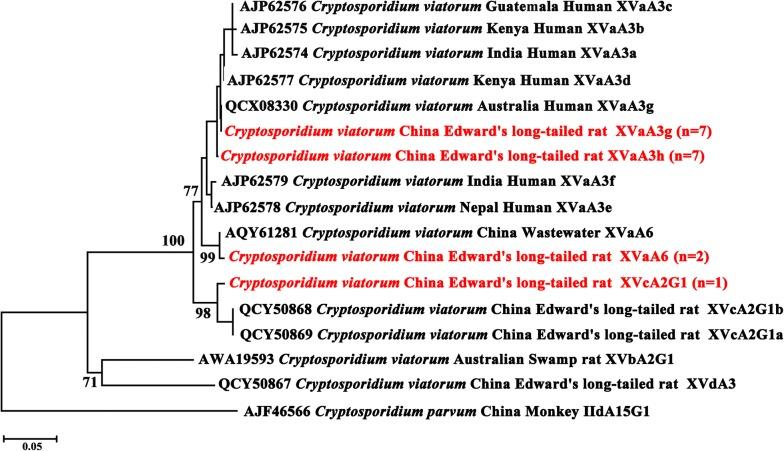
A total of 25 (11.0%) faecal samples were tested positive for C. viatorum by SSU rRNA assay. Of these samples, 4 (3.6%) came from L. edwardsi and 21 (18.0%) from B. bowersi. Of the 25 C. viatorum-positive samples, 17 were successfully amplified at the gp60 gene locus, which represented four subtypes belonging to two subtype families, including XVa (XVaA6, XVaA3g, XVaA3h) and XVc (XVcA2G1). Phylogenetic analysis based on the gp60 amino acid sequences indicated that all of the C. viatorum isolates grouped together, supporting the conclusion that C. viatorum from the wild rats represent two subtype families.
CONCLUSIONS
These results indicate an occurrence of C. viatorum XVa subtype family from rats which is genetically identical to those found in humans. Our findings suggest that wild rats may be a potential source of human cryptosporidiosis.
背景
旅行型隐孢子虫是人类中一种次要的隐孢子虫病原体。目前,关于中国动物中隐孢子虫的流行情况和基因型的信息有限。
方法
本研究从中国重庆市和广东省的两种野生鼠种(爱德华氏小家鼠和鲍氏鼷鼠)中采集了 228 份粪便样本。通过 PCR 和小亚基核糖体 RNA(SSU rRNA)和 60 千道尔顿糖蛋白(gp60)基因序列分析分别对这些标本进行了隐孢子虫检测和亚型分析。
结果
SSU rRNA 检测法共检测出 25 份(11.0%)粪便样本为隐孢子虫阳性。其中,4 份(3.6%)来自 L. edwardsi,21 份(18.0%)来自 B. bowersi。在 25 份隐孢子虫阳性样本中,有 17 份成功扩增了 gp60 基因座,代表了属于两个亚型家族的四个亚型,包括 XVa(XVaA6、XVaA3g、XVaA3h)和 XVc(XVcA2G1)。基于 gp60 氨基酸序列的系统发育分析表明,所有的隐孢子虫分离株都聚集在一起,支持了从野生鼠中分离出的隐孢子虫属于两个亚型家族的结论。
结论
这些结果表明,从大鼠中分离出的隐孢子虫 XVa 亚型家族与人类中发现的基因相同。我们的研究结果表明,野生鼠可能是人类隐孢子虫病的潜在来源。
 Zotero 插件