
ZW 性染色体在澳大利亚蜥蜴(鬣蜥科)中起源于核仁组织区的重复和易位的组合。
ZW Sex Chromosomes in Australian Dragon Lizards (Agamidae) Originated from a Combination of Duplication and Translocation in the Nucleolar Organising Region.
机构信息
Institute for Applied Ecology, Faculty of Science and Technology, University of Canberra, Canberra ACT 2617, Australia.
Department of Genetics, Faculty of Science, Kasetsart University, Bangkok 10900, Thailand.
出版信息
Genes (Basel). 2019 Oct 30;10(11):861. doi: 10.3390/genes10110861.
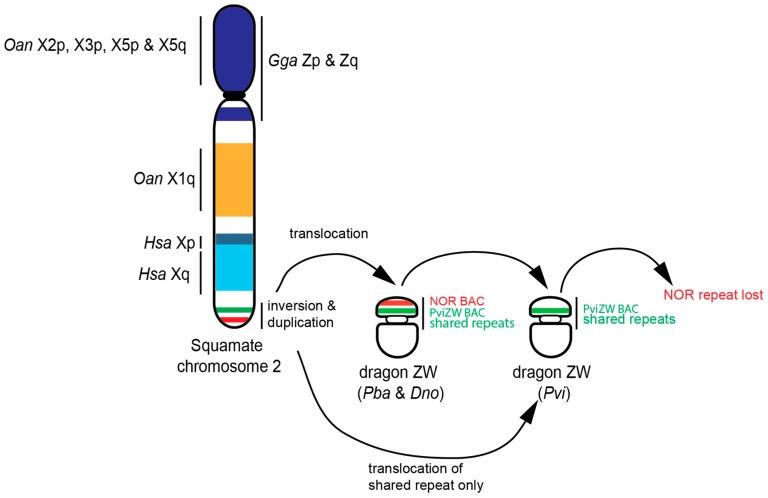
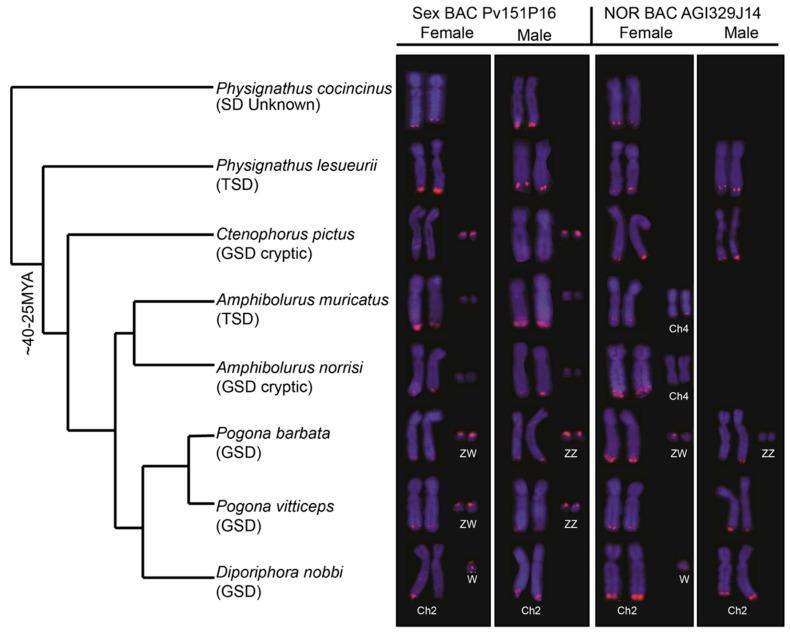
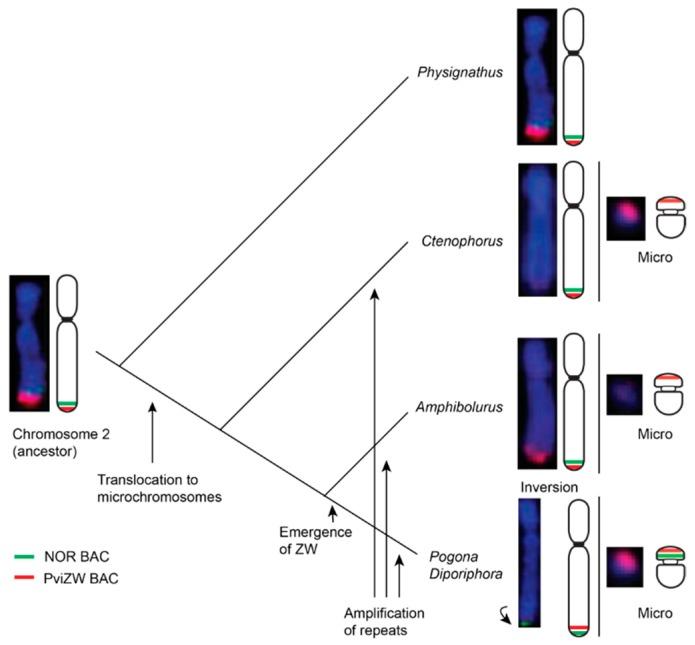
Sex chromosomes in some reptiles share synteny with distantly related amniotes in regions orthologous to squamate chromosome 2. The latter finding suggests that chromosome 2 was formerly part of a larger ancestral (amniote) super-sex chromosome and raises questions about how sex chromosomes are formed and modified in reptiles. Australian dragon lizards (Agamidae) are emerging as an excellent model for studying these processes. In particular, they exhibit both genotypic (GSD) and temperature-dependent (TSD) sex determination, show evidence of transitions between the two modes and have evolved non-homologous ZW sex microchromosomes even within the same evolutionary lineage. They therefore represent an excellent group to probe further the idea of a shared ancestral super-sex chromosome and to investigate mechanisms for transition between different sex chromosome forms. Here, we compare sex chromosome homology among eight dragon lizard species from five genera to identify key cytological differences and the mechanisms that may be driving sex chromosome evolution in this group. We performed fluorescence in situ hybridisation to physically map bacterial artificial chromosome (BAC) clones from the bearded dragon, ZW sex chromosomes and a nucleolar organising region (NOR) probe in males and females of eight Agamid species exhibiting either GSD or TSD. We show that the sex chromosome derived BAC clone hybridises near the telomere of chromosome 2q in all eight species examined. This clone also hybridises to the sex microchromosomes of three species (, and ) and a pair of microchromosomes in three others (, and ). No other chromosomes are marked by the probe in two species from the closely related genus . A probe bearing nucleolar organising region (NOR) sequences maps close to the telomere of chromosome 2q in all eight species, and to the ZW pair in and , the W microchromosome in , and several microchromosomes in . Our findings provide evidence of sequence homology between chromosome 2 and the sex chromosomes of multiple agamids. These data support the hypothesis that there was an ancestral sex chromosome in amniotes that gave rise to squamate chromosome 2 and raises the prospect that some particular property of this chromosome has favoured its role as a sex chromosome in amniotes. It is likely that the amplification of repetitive sequences associated with this region has driven the high level of heterochromatinisation of the sex-specific chromosomes in three species of agamid. Our data suggest a possible mechanism for chromosome rearrangement, including inversion and duplication near the telomeric regions of the ancestral chromosome 2 and subsequent translocation to the ZW sex microchromosomes in three agamid species. It is plausible that these chromosome rearrangements involving sex chromosomes also drove speciation in this group.
在一些爬行动物中,性染色体与亲缘关系较远的羊膜动物的染色体 2 区具有同线性。这一发现表明,染色体 2 曾经是一个更大的祖先(羊膜动物)超性染色体的一部分,这引发了关于性染色体在爬行动物中是如何形成和修饰的问题。澳大利亚蜥蜴(蜥蜴科)正成为研究这些过程的一个极好模型。特别是,它们表现出基因型(GSD)和温度依赖性(TSD)性别决定,显示出两种模式之间转换的证据,并在同一进化谱系中进化出非同源的 ZW 性微染色体。因此,它们是一个极好的群体,可以进一步探讨共同祖先超性染色体的概念,并研究不同性染色体形式之间转换的机制。在这里,我们比较了来自五个属的八种蜥蜴物种的性染色体同源性,以确定关键的细胞学差异和可能推动该组性染色体进化的机制。我们进行了荧光原位杂交,以物理映射来自胡须龙的细菌人工染色体 (BAC) 克隆,雄性和雌性的八种蜥蜴物种中表现出 GSD 或 TSD 的 ZW 性染色体和核仁组织区域 (NOR) 探针。我们表明,来自 8 种被检查物种的性染色体衍生的 BAC 克隆在染色体 2q 的端粒附近杂交。该克隆还与三种物种( 、 和 )的性微染色体和另外三种物种( 、 和 )的一对微染色体杂交。在来自密切相关的属的两种物种中,没有其他染色体被该探针标记。携带核仁组织区域 (NOR) 序列的探针在所有 8 种物种中都靠近染色体 2q 的端粒定位,在 和 中靠近 ZW 对,在 中靠近 W 微染色体,在 中靠近几个微染色体。我们的发现提供了多个蜥蜴属的染色体 2 和性染色体之间序列同源性的证据。这些数据支持了在羊膜动物中有一个祖先性染色体的假设,该染色体产生了蜥蜴科的染色体 2,并提出了该染色体的某些特性可能有利于它在羊膜动物中作为性染色体的观点。很可能是与该区域相关的重复序列的扩增导致了三种蜥蜴属的性染色体特异性染色体的高度异染色化。我们的数据表明了一种染色体重排的可能机制,包括在祖先染色体 2 的端粒附近的倒位和重复,以及随后在三个蜥蜴属的 ZW 性微染色体中的易位。涉及性染色体的这些染色体重排很可能也推动了该组的物种形成。

 Zotero 插件