
比较产超广谱β-内酰胺酶大肠埃希菌在尿路感染和环境水中的分布。
Comparative distribution of extended-spectrum beta-lactamase-producing Escherichia coli from urine infections and environmental waters.
机构信息
Department of Laboratory Medicine, Faculty of Medicine and Health, Örebro University, Örebro, Sweden.
The Life Science Centre-Biology, School of Science and Technology, Örebro University, Örebro, Sweden.
出版信息
PLoS One. 2019 Nov 7;14(11):e0224861. doi: 10.1371/journal.pone.0224861. eCollection 2019.
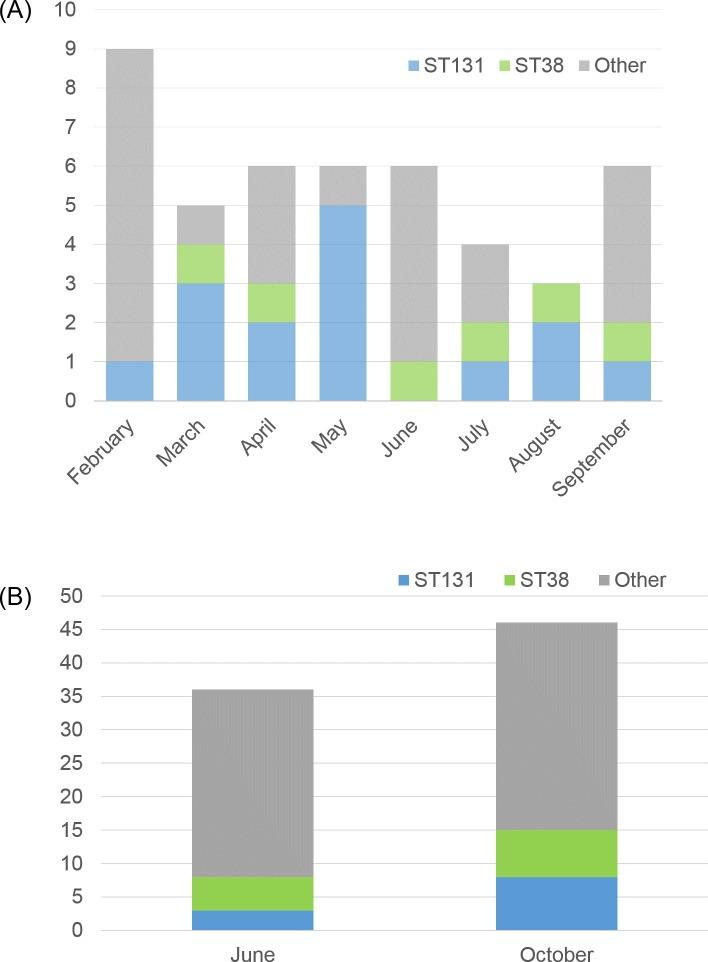
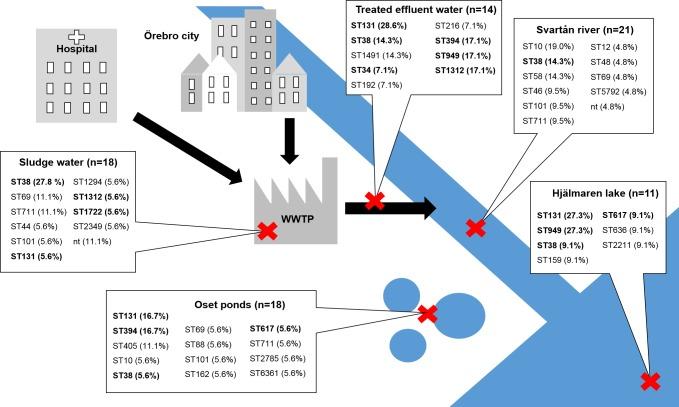
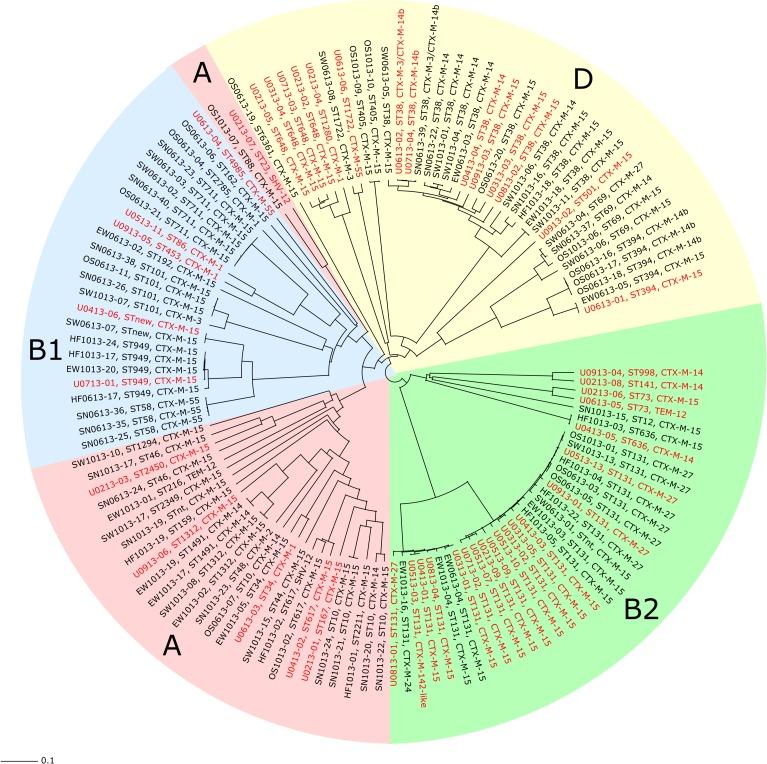
Extended-spectrum beta-lactamase (ESBL)-producing Escherichia coli have been reported in natural environments, and may be released through wastewater. In this study, the genetic relationship between ESBL-producing E. coli collected from patient urine samples (n = 45, both hospitalized patients and out-patients) and from environmental water (n = 82, from five locations), during the same time period, was investigated. Three independent water samples were collected from the municipal wastewater treatment plant, both incoming water and treated effluent water; the receiving river and lake; and a bird sanctuary near the lake, on two different occasions. The water was filtered and cultured on selective chromID ESBL agar plates in order to detect and isolate ESBL-producing E. coli. Illumina whole genome sequencing was performed on all bacterial isolates (n = 127). Phylogenetic group B2 was more common among the clinical isolates than the environmental isolates (44.4% vs. 17.1%, p < 0.01) due to a significantly higher prevalence of sequence type (ST) 131 (33.3% vs. 13.4%, p < 0.01). ST131 was, however, one of the most prevalent STs among the environmental isolates. There was no significant difference in diversity between the clinical isolates (DI 0.872 (0.790-0.953)) and the environmental isolates (DI 0.947 (0.920-0.969)). The distribution of ESBL genes was similar: blaCTX-M-15 dominated, followed by blaCTX-M-14 and blaCTX-M-27 in both the clinical (60.0%, 8.9%, and 6.7%) and the environmental isolates (62.2%, 12.2%, and 8.5%). Core genome multi-locus sequence typing showed that five environmental isolates, from incoming wastewater, treated wastewater, Svartån river and Hjälmaren lake, were indistinguishable or closely related (≤10 allele differences) to clinical isolates. Isolates of ST131, serotype O25:H4 and fimtype H30, from the environment were as closely related to the clinical isolates as the isolates from different patients were. This study confirms that ESBL-producing E. coli are common in the aquatic environment even in low-endemic regions and suggests that wastewater discharge is an important route for the release of ESBL-producing E. coli into the aquatic environment.
已在自然环境中发现产超广谱β-内酰胺酶(ESBL)的大肠杆菌,并且可能通过废水释放。在这项研究中,在同一时期,调查了从患者尿液样本(住院患者和门诊患者各 45 例)和环境水中(来自五个地点的 82 例)收集的产 ESBL 大肠杆菌之间的遗传关系。从城市污水处理厂的进水和处理后的出水、接收河流和湖泊以及湖泊附近的鸟类保护区,在两个不同的场合,分别采集了三个独立的水样。将水样过滤并在选择性 chromID ESBL 琼脂平板上培养,以检测和分离产 ESBL 的大肠杆菌。对所有细菌分离株(n = 127)进行 Illumina 全基因组测序。与环境分离株相比,临床分离株的 B2 群更为常见(44.4%对 17.1%,p < 0.01),这主要是由于序列型(ST)131 的流行率更高(33.3%对 13.4%,p < 0.01)。然而,ST131 是环境分离株中最常见的 ST 之一。临床分离株(DI 0.872(0.790-0.953))和环境分离株(DI 0.947(0.920-0.969))之间的多样性没有显著差异。ESBL 基因的分布相似:blaCTX-M-15 占主导地位,其次是 blaCTX-M-14 和 blaCTX-M-27,无论是在临床(60.0%、8.9%和 6.7%)还是环境分离株(62.2%、12.2%和 8.5%)中均如此。核心基因组多位点序列分型显示,来自进水、处理水、Svartån 河和 Hjälmaren 湖的五株环境分离株与临床分离株无法区分或密切相关(≤10 个等位基因差异)。环境中的 ST131、O25:H4 血清型和 fimtype H30 分离株与临床分离株的关系与不同患者的分离株一样密切。本研究证实,产 ESBL 的大肠杆菌在水生环境中很常见,即使在低流行地区也是如此,这表明废水排放是将产 ESBL 的大肠杆菌释放到水生环境中的重要途径。

 Zotero 插件