
关怀之年方法:在一般实践中为长期疾病的护理和支持计划制定模型和交付方案。
The Year of Care approach: developing a model and delivery programme for care and support planning in long term conditions within general practice.
机构信息
Year of Care Partnerships, Northumbria Healthcare NHS Foundation Trust, Wansbeck Hospital, Ashington, Northumberland, NE63 9JJ, England.
Northumbria University, Coach Lane Campus, Benton, Newcastle upon Tyne, NE7 7XA, England.
出版信息
BMC Fam Pract. 2019 Nov 8;20(1):153. doi: 10.1186/s12875-019-1042-4.
BACKGROUND
People with long term conditions (LTCs) make most of the daily decisions and carry out the activities which affect their health and quality of life. Only a fraction of each contact with a health care professional (HCP) is spent supporting this. This paper describes how care and support planning (CSP) and an implementation framework to redesign services, were developed to address this in UK general practice. Focussed on what is important to each individual, CSP brings together traditional clinical issues and the person's lived experience in a solution focussed, forward looking conversation with an emphasis on 'people not diseases'.
METHODS
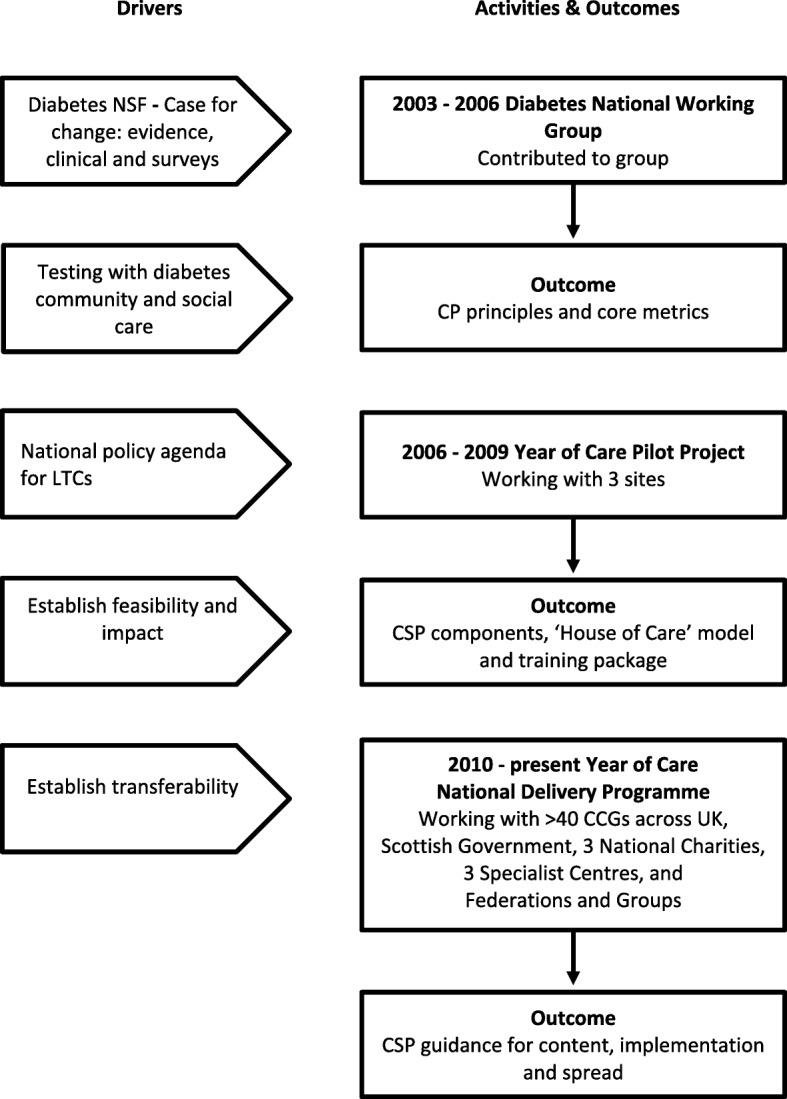
The components of CSP were developed in three health communities using diabetes as an exemplar. This model was extended and refined for other single conditions and multimorbidity across 40 sites and two nations, over 15 years. Working with local teams and communities the authors used theoretical models of care, implementation and spread, developing and tailoring training, support and resources to embed CSP as usual care, sharing learning across a community of practice.
RESULTS
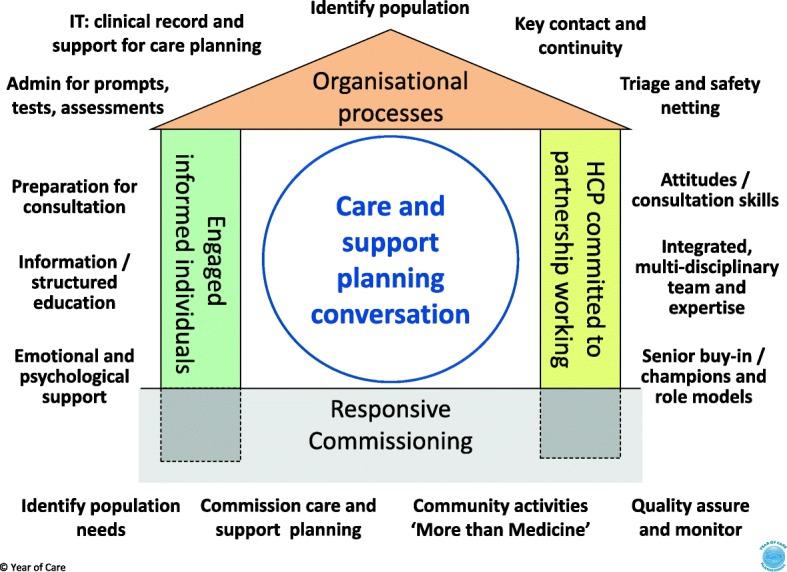
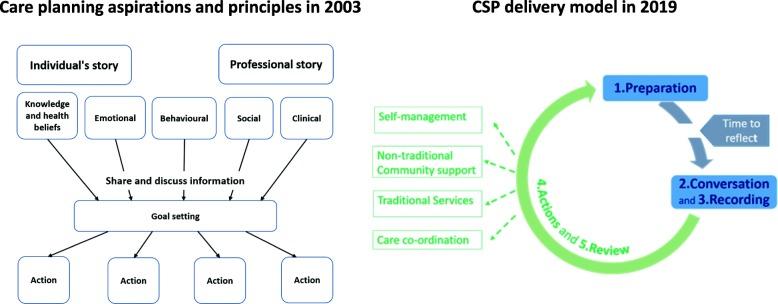
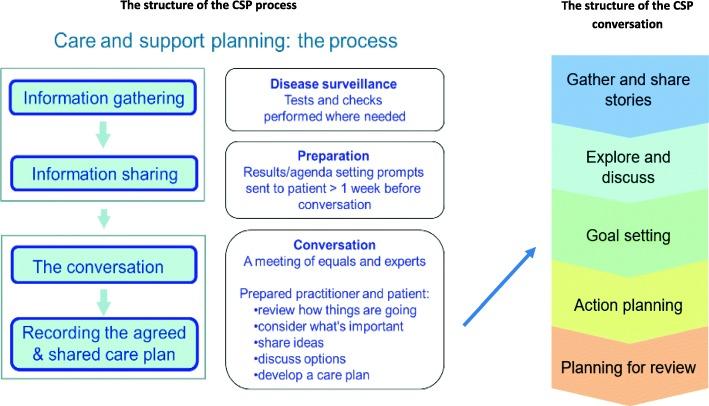
The purpose, content, process, developmental hurdles and impact of this CSP model are described, alongside an implementation strategy. There is now a robust, reproducible five step model; preparation, conversation, recording, actions and review. Uniquely, preparation, involving information sharing with time for reflection, enables an uncluttered conversation with a professional focussed on what is important to each person. The components of the Year of Care House act as a checklist for implementation, a metaphor for their interdependence and a flexible framework. Spreading CSP involved developing exemplar practices and building capacity across local health communities. These reported improved patient experience, practitioner job satisfaction, health behaviours and outcomes, teamwork, practice organisation, resource use, and links with wider community activities.
CONCLUSIONS
Tested in multiple settings, CSP is a reproducible and practical model of planned care applicable to all LTCs, with the capacity to be transformative for people with LTCs and health care professionals. It recaptures relational dimensions of care with transactional elements in the background. Options for applying this model and implementation framework at scale now need to be explored.
背景
患有长期疾病(LTCs)的人做出了大部分影响其健康和生活质量的日常决策并开展相关活动。但在与医疗保健专业人员(HCP)的每次接触中,只有一小部分用于支持这些决策和活动。本文描述了如何制定护理和支持计划(CSP)以及实施框架来重新设计服务,以解决英国全科医生面临的这一问题。CSP 关注于每个人的重要事项,将传统的临床问题和个人的生活体验汇集在一起,形成以解决方案为重点、着眼未来的对话,强调“以人为本而非以疾病为本”。
方法
CSP 的组成部分是在三个健康社区中使用糖尿病作为范例开发的。该模型在 15 年中扩展到两个国家的 40 个地点的其他单一疾病和多种合并症,并进行了改进和完善。作者与当地团队和社区合作,使用护理、实施和传播的理论模型,开发并调整培训、支持和资源,将 CSP 作为常规护理进行嵌入,并在实践社区中分享学习经验。
结果
本文描述了该 CSP 模型的目的、内容、流程、发展障碍和影响,以及实施策略。现在有一个稳健、可重复的五步模型:准备、对话、记录、行动和审查。独特的是,准备工作涉及信息共享和时间反思,为与专业人员进行无干扰的对话创造了条件,而对话则侧重于每个人的重要事项。年度护理之屋的各个组成部分可作为实施的清单、相互依存的隐喻以及灵活的框架。推广 CSP 涉及开发范例实践和建立当地卫生社区的能力。这报告称,患者体验、从业者工作满意度、健康行为和结果、团队合作、实践组织、资源利用以及与更广泛的社区活动的联系都得到了改善。
结论
在多个环境中进行测试后,CSP 是一种可复制和实用的计划性护理模式,适用于所有 LTCs,有潜力为患有 LTCs 的患者和医疗保健专业人员带来变革。它重新捕捉了护理的关系维度,并在背景中融入了交易元素。现在需要探索在更大范围内应用这种模式和实施框架的选择。
 Zotero 插件