
斑马鱼癌症模型——在非哺乳动物脊椎动物中模拟人类癌症的新见解。
Zebrafish Models of Cancer-New Insights on Modeling Human Cancer in a Non-Mammalian Vertebrate.
机构信息
Institute of Molecular Genetics of the Czech Academy of Sciences, v. v. i. Vídeňská 1083, 142 20 Prague 4, Czech Republic.
出版信息
Genes (Basel). 2019 Nov 15;10(11):935. doi: 10.3390/genes10110935.
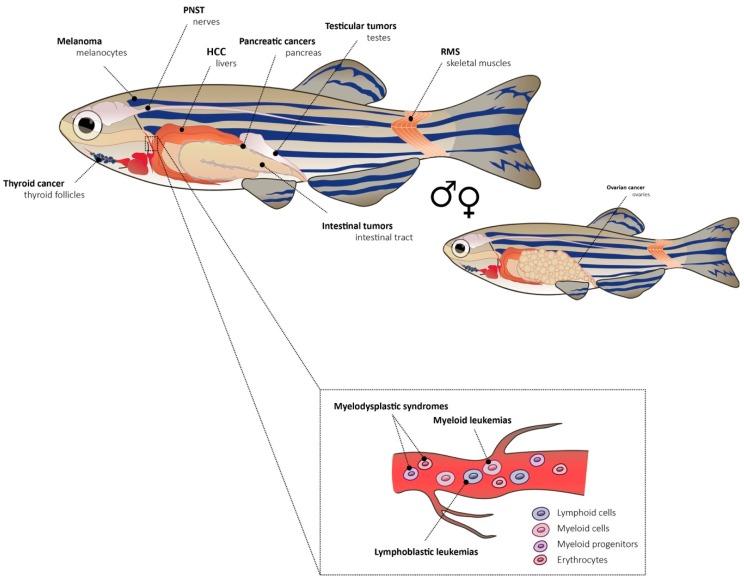
Zebrafish () is a valuable non-mammalian vertebrate model widely used to study development and disease, including more recently cancer. The evolutionary conservation of cancer-related programs between human and zebrafish is striking and allows extrapolation of research outcomes obtained in fish back to humans. Zebrafish has gained attention as a robust model for cancer research mainly because of its high fecundity, cost-effective maintenance, dynamic visualization of tumor growth in vivo, and the possibility of chemical screening in large numbers of animals at reasonable costs. Novel approaches in modeling tumor growth, such as using transgene electroporation in adult zebrafish, could improve our knowledge about the spatial and temporal control of cancer formation and progression in vivo. Looking at genetic as well as epigenetic alterations could be important to explain the pathogenesis of a disease as complex as cancer. In this review, we highlight classic genetic and transplantation models of cancer in zebrafish as well as provide new insights on advances in cancer modeling. Recent progress in zebrafish xenotransplantation studies and drug screening has shown that zebrafish is a reliable model to study human cancer and could be suitable for evaluating patient-derived xenograft cell invasiveness. Rapid, large-scale evaluation of in vivo drug responses and kinetics in zebrafish could undoubtedly lead to new applications in personalized medicine and combination therapy. For all of the above-mentioned reasons, zebrafish is approaching a future of being a pre-clinical cancer model, alongside the mouse. However, the mouse will continue to be valuable in the last steps of pre-clinical drug screening, mostly because of the highly conserved mammalian genome and biological processes.
斑马鱼(Zebrafish)是一种有价值的非哺乳动物脊椎动物模型,广泛用于研究发育和疾病,包括最近的癌症。人类和斑马鱼之间与癌症相关的程序在进化上是保守的,这使得在鱼类中获得的研究结果可以推断到人类身上。斑马鱼作为癌症研究的强大模型受到关注,主要是因为它具有高繁殖力、成本效益高的维护、体内肿瘤生长的动态可视化以及在合理成本下对大量动物进行化学筛选的可能性。肿瘤生长建模的新方法,例如在成年斑马鱼中使用转基因电穿孔,可以提高我们对体内癌症形成和进展时空控制的认识。研究遗传和表观遗传改变可能对于解释像癌症这样复杂的疾病的发病机制很重要。在这篇综述中,我们重点介绍了斑马鱼中经典的癌症遗传和移植模型,并提供了癌症建模进展的新见解。最近在斑马鱼异种移植研究和药物筛选方面的进展表明,斑马鱼是研究人类癌症的可靠模型,并且可能适合评估患者来源的异种移植物细胞的侵袭性。在斑马鱼中快速、大规模评估体内药物反应和动力学无疑将导致个性化医学和联合治疗的新应用。由于上述所有原因,斑马鱼正在成为一种临床前癌症模型,与小鼠并肩前行。然而,在临床前药物筛选的最后阶段,老鼠仍将具有重要价值,主要是因为哺乳动物基因组和生物学过程高度保守。
 Zotero 插件