
我是如何管理自然杀伤细胞缺陷的。
How I Manage Natural Killer Cell Deficiency.
机构信息
Department of Pediatrics, NewYork Presbyterian Morgan Stanley Children's Hospital, Columbia University Vagelos College of Physicians and Surgeons, 622 W 168th St., New York, NY, 10032, USA.
出版信息
J Clin Immunol. 2020 Jan;40(1):13-23. doi: 10.1007/s10875-019-00711-7. Epub 2019 Nov 22.
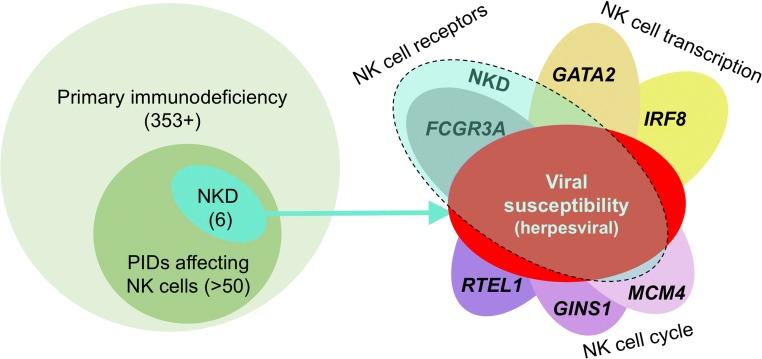
Natural killer (NK) cell deficiency (NKD) is a subset of primary immunodeficiency disorders (PID) in which an abnormality of NK cells represents a major immunological defect resulting in the patient's clinical immunodeficiency. This is distinct from a much larger group of PIDs that include an NK cell abnormality as a minor component of the immunodeficiency. Patients with NKD most frequently have atypical consequences of herpesviral infections. There are now 6 genes that have been ascribed to causing NKD, some exclusively and others that also cause other known immunodeficiencies. This list has grown in recent years and as such the mechanistic and molecular clarity around what defines an NKD is an emerging and important field of research. Continued increased clarity will allow for more rational approaches to the patients themselves from a therapeutic standpoint. Having evaluated numerous individuals for NKD, I share my perspective on approaching the diagnosis and managing these patients.
自然杀伤 (NK) 细胞缺陷 (NKD) 是原发性免疫缺陷疾病 (PID) 的一个亚类,其中 NK 细胞的异常表现为导致患者临床免疫缺陷的主要免疫缺陷。这与包括 NK 细胞异常作为免疫缺陷次要成分的更大一组 PID 不同。NKD 患者最常出现疱疹病毒感染的非典型后果。现在已经有 6 个基因被归因于导致 NKD,有些是专门的,有些也导致其他已知的免疫缺陷。近年来,这个列表一直在增加,因此,定义 NKD 的机制和分子清晰度是一个新兴的重要研究领域。随着清晰度的不断提高,将从治疗的角度为患者本身提供更合理的方法。在对许多 NKD 患者进行评估后,我分享了我对诊断和管理这些患者的看法。
 Zotero 插件