
胃食管结合部腺癌患者全身炎症反应指数的预后价值:倾向评分匹配分析。
Prognostic Value of the Systemic Inflammation Response Index in Patients with Adenocarcinoma of the Oesophagogastric Junction: A Propensity Score-Matched Analysis.
机构信息
Department of Radiation Oncology, The Third Affiliated Hospital of Soochow University, 185 Juqian Road, Changzhou 213003, China.
Department of Clinical Laboratory, The Third Affiliated Hospital of Soochow University, 185 Juqian Road, Changzhou 213003, China.
出版信息
Dis Markers. 2019 Nov 4;2019:4659048. doi: 10.1155/2019/4659048. eCollection 2019.
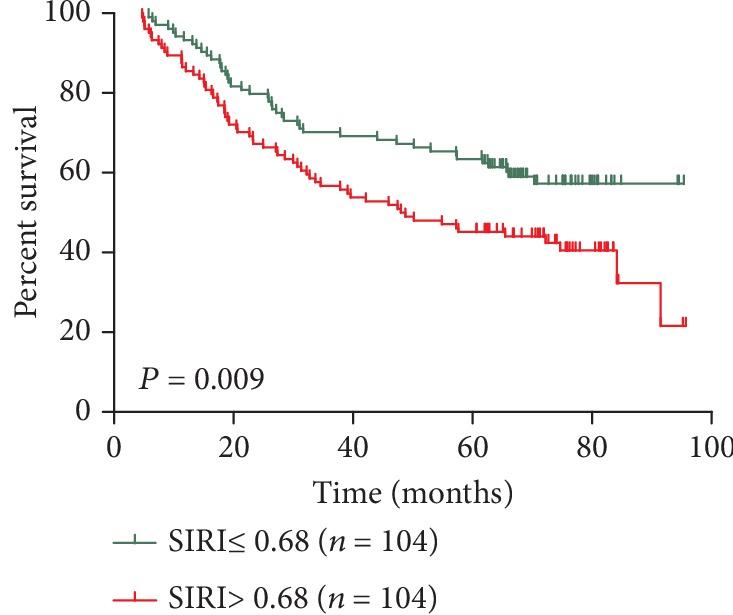
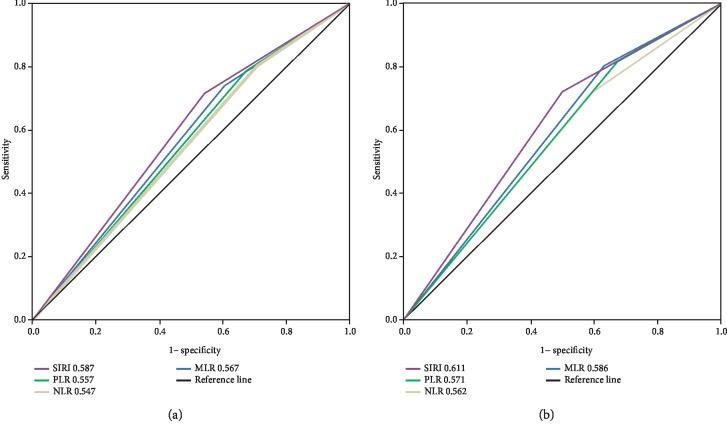
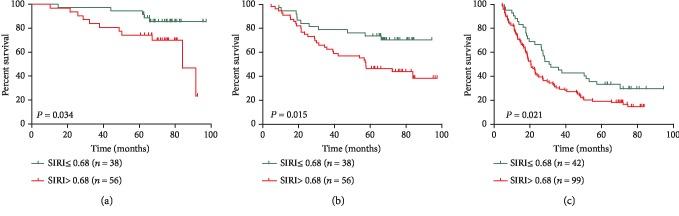
Systemic inflammation is closely related to the occurrence and development of tumours. Based on preoperative neutrophil, monocyte, and lymphocyte counts, a new systemic inflammation response index (SIRI) was established, and the predictive ability of the SIRI for the survival of patients with adenocarcinoma of the oesophagogastric junction (AEG) was evaluated by propensity score matching (PSM) analysis. A total of 302 AEG patients undergoing radical surgery were studied. Univariate and multivariate analyses were performed using Cox proportional hazards regression models. Time-dependent receiver operating characteristic (ROC) curves were used to compare the predictive capabilities of the SIRI. PSM was implemented to balance the baseline characteristics. The results showed that the SIRI, PLR, NLR, and MLR were associated with overall survival (OS) in AEG patients based on the Kaplan-Meier survival analysis. Multivariate analysis demonstrated that the SIRI was an independent prognostic factor. The AUC for the SIRI was significantly greater than that for the NLR, PLR, and MLR in predicting the 3- and 5-year OS of AEG patients. In PSM analysis, the SIRI remained an independent prognostic indicator of OS in AEG patients. The SIRI is a novel, simple, and inexpensive prognostic predictor for AEG. The prognostic value of the SIRI is superior to that of the PLR, NLR, and MLR. The SIRI can be used to distinguish the prognosis of AEG patients with different TNM stages and can be an important supplement to TNM staging.
系统性炎症与肿瘤的发生和发展密切相关。基于术前中性粒细胞、单核细胞和淋巴细胞计数,建立了一种新的全身炎症反应指数(SIRI),并通过倾向评分匹配(PSM)分析评估 SIRI 对胃食管结合部腺癌(AEG)患者生存的预测能力。共研究了 302 例接受根治性手术的 AEG 患者。使用 Cox 比例风险回归模型进行单因素和多因素分析。使用时间依赖性接收器工作特征(ROC)曲线比较 SIRI 的预测能力。实施 PSM 以平衡基线特征。结果显示,基于 Kaplan-Meier 生存分析,SIRI、PLR、NLR 和 MLR 与 AEG 患者的总生存(OS)相关。多因素分析表明,SIRI 是独立的预后因素。SIRI 预测 AEG 患者 3 年和 5 年 OS 的 AUC 明显大于 NLR、PLR 和 MLR。在 PSM 分析中,SIRI 仍然是 AEG 患者 OS 的独立预后指标。SIRI 是一种新的、简单的、经济的 AEG 预后预测指标。SIRI 的预后价值优于 PLR、NLR 和 MLR。SIRI 可用于区分不同 TNM 分期的 AEG 患者的预后,可作为 TNM 分期的重要补充。

 Zotero 插件