
利用热敏纳米囊泡在可调阈值温度下实现自组装方酸染料的高协同荧光开关,用于光学传感和成像。
Highly cooperative fluorescence switching of self-assembled squaraine dye at tunable threshold temperatures using thermosensitive nanovesicles for optical sensing and imaging.
机构信息
Research Institute for Science and Engineering, Waseda University, 3-4-1 Ohkubo, Shinjuku-ku, Tokyo, 169-8555, Japan.
School of Mechanical & Aerospace Engineering, Nanyang Technological University, 50 Nanyang Avenue, Singapore, 639798, Singapore.
出版信息
Sci Rep. 2019 Nov 29;9(1):17991. doi: 10.1038/s41598-019-54418-1.
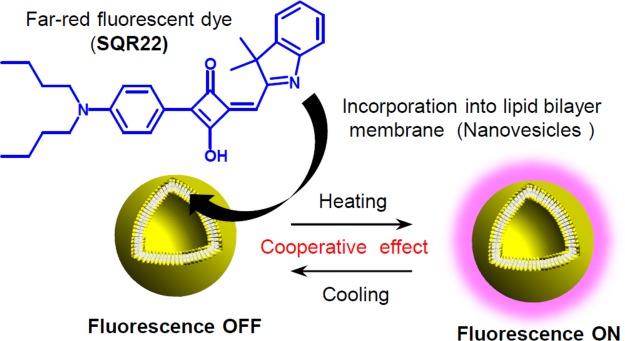
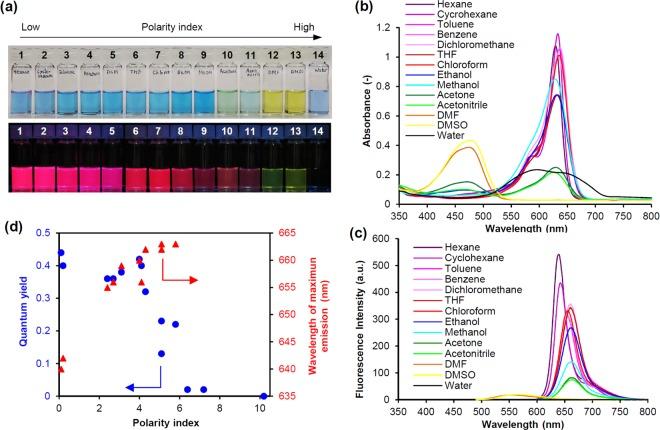
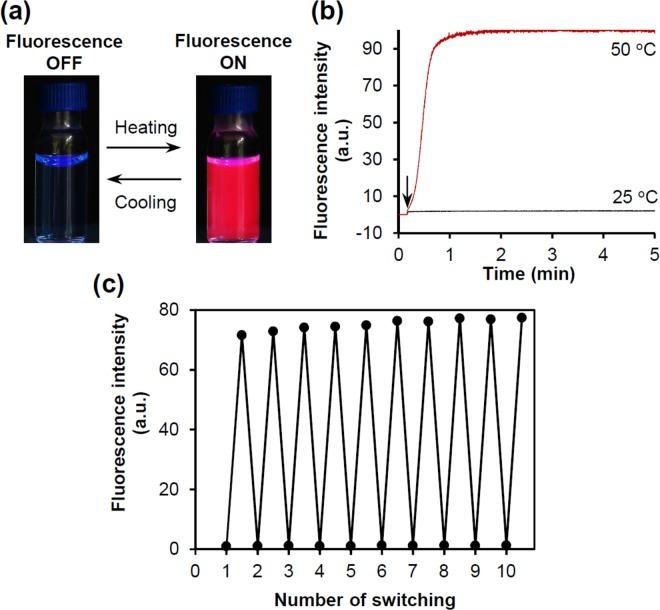
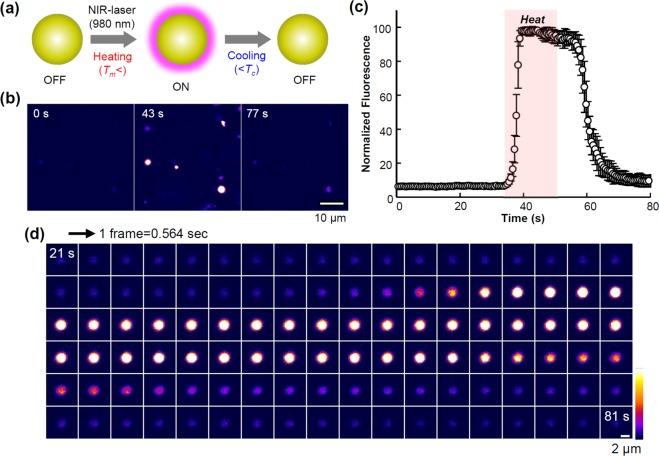
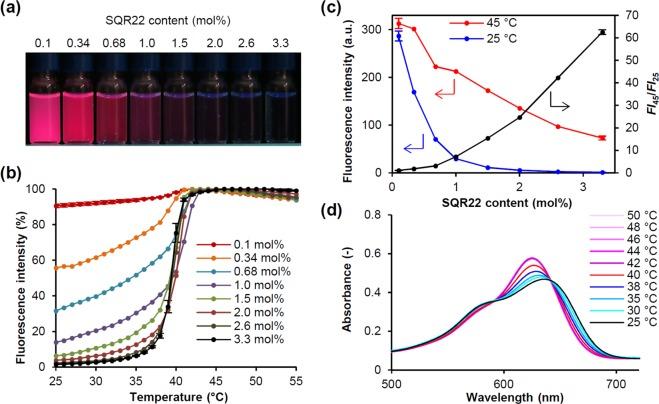
Thermosensitive fluorescent dyes can convert thermal signals into optical signals as a molecular nanoprobe. These nanoprobes are playing an increasingly important part in optical temperature sensing and imaging at the nano- and microscale. However, the ability of a fluorescent dye itself has sensitivity and accuracy limitations. Here we present a molecular strategy based on self-assembly to overcome such limitations. We found that thermosensitive nanovesicles composed of lipids and a unique fluorescent dye exhibit fluorescence switching characteristics at a threshold temperature. The switch is rapid and reversible and has a high signal to background ratio (>60), and is also highly sensitive to temperature (10-22%/°C) around the threshold value. Furthermore, the threshold temperature at which fluorescence switching is induced, can be tuned according to the phase transition temperature of the lipid bilayer membrane forming the nanovesicles. Spectroscopic analysis indicated that the fluorescence switching is induced by the aggregation-caused quenching and disaggregation-induced emission of the fluorescent dye in a cooperative response to the thermotropic phase transition of the membrane. This mechanism presents a useful approach for chemical and material design to develop fluorescent nanomaterials with superior fluorescence sensitivity to thermal signals for optical temperature sensing and imaging at the nano- and microscales.
热敏荧光染料可以将热信号转化为光学信号,作为一种分子纳米探针。这些纳米探针在纳米和微米尺度的光学温度传感和成像中发挥着越来越重要的作用。然而,荧光染料本身的能力具有灵敏度和准确性的局限性。在这里,我们提出了一种基于自组装的分子策略来克服这些限制。我们发现,由脂质和一种独特的荧光染料组成的热敏纳米囊泡在阈值温度下表现出荧光开关特性。这种开关快速且可逆,信号与背景的比值高(>60),并且对阈值附近的温度也非常敏感(10-22%/°C)。此外,荧光开关诱导的阈值温度可以根据形成纳米囊泡的脂质双层膜的相变温度进行调节。光谱分析表明,荧光开关是由荧光染料的聚集引起的猝灭和解聚集诱导的发射引起的,这是对膜的热致相转变的协同响应。这种机制为化学和材料设计提供了一种有用的方法,以开发对热信号具有优异荧光灵敏度的荧光纳米材料,用于纳米和微米尺度的光学温度传感和成像。



 Zotero 插件