
靶向衰老细胞:方法、机遇与挑战。
Targeting senescent cells: approaches, opportunities, challenges.
作者信息
von Kobbe Cayetano
机构信息
Centro de Biología Molecular "Severo Ochoa" (CBMSO), Consejo Superior de Investigaciones Científicas (CSIC), Universidad Autónoma de Madrid, Madrid 28049, Spain.
出版信息
Aging (Albany NY). 2019 Nov 30;11(24):12844-12861. doi: 10.18632/aging.102557.
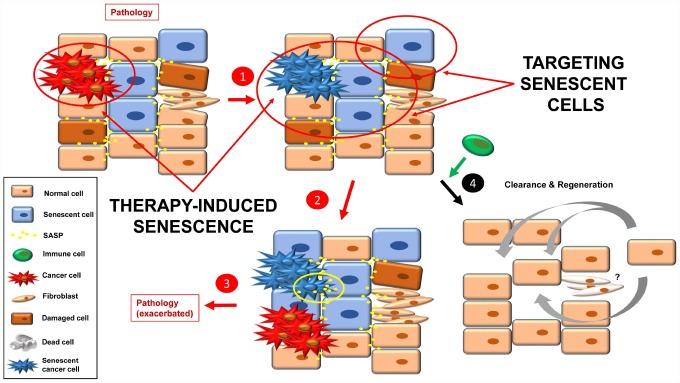
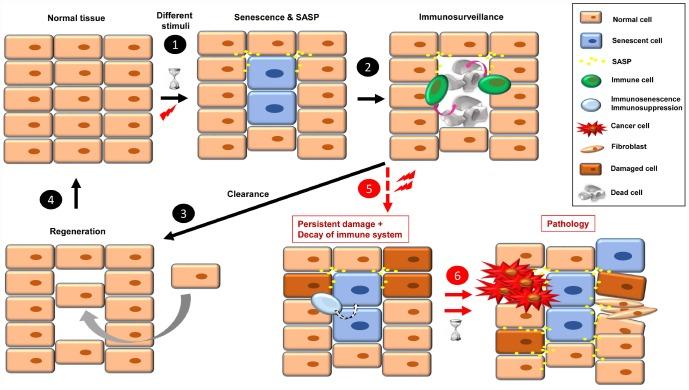
Cellular senescence is a hallmark of aging, whose onset is linked to a series of both cell and non-cell autonomous processes, leading to several consequences for the organism. To date, several senescence routes have been identified, which play a fundamental role in development, tumor suppression and aging, among other processes. The positive and/or negative effects of senescent cells are directly related to the time that they remain in the organism. Short-term (acute) senescent cells are associated with positive effects; once they have executed their actions, immune cells are recruited to remove them. In contrast, long-term (chronic) senescent cells are associated with disease; they secrete pro-inflammatory and pro-tumorigenic factors in a state known as senescence-associated secretory phenotype (SASP). In recent years, cellular senescence has become the center of attention for the treatment of aging-related diseases. Current therapies are focused on elimination of senescent cell functions in three main ways: i) use of senolytics; ii) inhibition of SASP; and iii) improvement of immune system functions against senescent cells (immunosurveillance). In addition, some anti-cancer therapies are based on the induction of senescence in tumor cells. However, these senescent-like cancer cells must be subsequently cleared to avoid a chronic pro-tumorigenic state. Here is a summary of different scenarios, depending on the therapy used, with a discussion of the pros and cons of each scenario.
细胞衰老作为衰老的一个标志,其发生与一系列细胞自主和非细胞自主过程相关联,对生物体产生多种影响。到目前为止,已经确定了几种衰老途径,它们在发育、肿瘤抑制和衰老等过程中发挥着重要作用。衰老细胞的正面和/或负面影响直接与其在生物体内留存的时间有关。短期(急性)衰老细胞具有正面影响;一旦它们执行完其功能,免疫细胞就会被招募来清除它们。相反,长期(慢性)衰老细胞与疾病相关;它们以一种称为衰老相关分泌表型(SASP)的状态分泌促炎和促肿瘤因子。近年来,细胞衰老已成为衰老相关疾病治疗的关注焦点。目前的治疗方法主要集中在通过三种主要方式消除衰老细胞的功能:i)使用衰老细胞溶解剂;ii)抑制SASP;iii)改善免疫系统针对衰老细胞的功能(免疫监视)。此外,一些抗癌疗法基于诱导肿瘤细胞衰老。然而,这些类似衰老的癌细胞随后必须被清除,以避免慢性促肿瘤状态。以下是根据所使用的治疗方法总结的不同情况,并对每种情况的优缺点进行了讨论。


 Zotero 插件