
青春期启动时间与男性成人骨折风险:基于人群的队列研究。
Pubertal timing and adult fracture risk in men: A population-based cohort study.
机构信息
Centre for Bone and Arthritis Research, Department of Internal Medicine and Clinical Nutrition, Institute of Medicine, Sahlgrenska Academy, University of Gothenburg, Gothenburg, Sweden.
Bioinformatics Core Facility, Sahlgrenska Academy, University of Gothenburg, Gothenburg, Sweden.
出版信息
PLoS Med. 2019 Dec 2;16(12):e1002986. doi: 10.1371/journal.pmed.1002986. eCollection 2019 Dec.
BACKGROUND
Puberty is a critical period for bone mass accrual, and late puberty in boys is associated with reduced bone mass in adult men. The role of variations in pubertal timing within the normal range for adult fracture risk in men is, however, unknown. We, therefore, assessed the association between age at peak height velocity (PHV), an objective measure of pubertal timing, and fracture risk in adult men.
METHODS AND FINDINGS
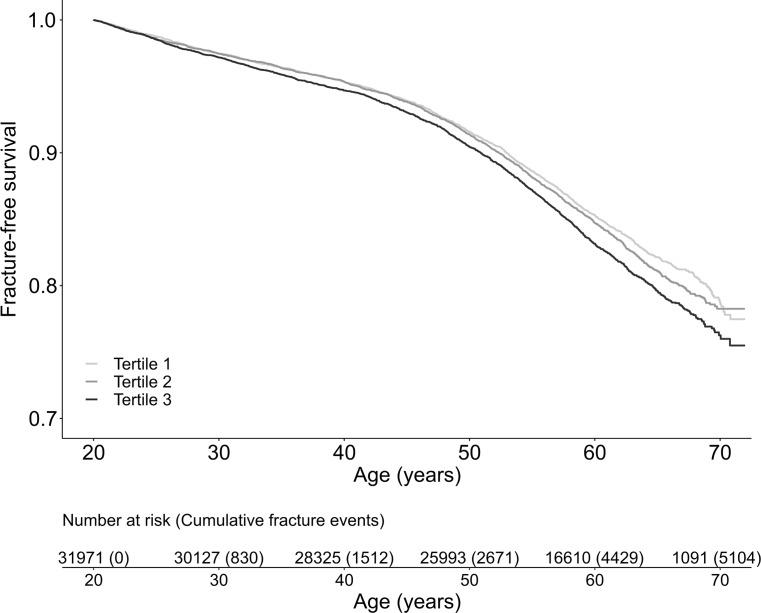
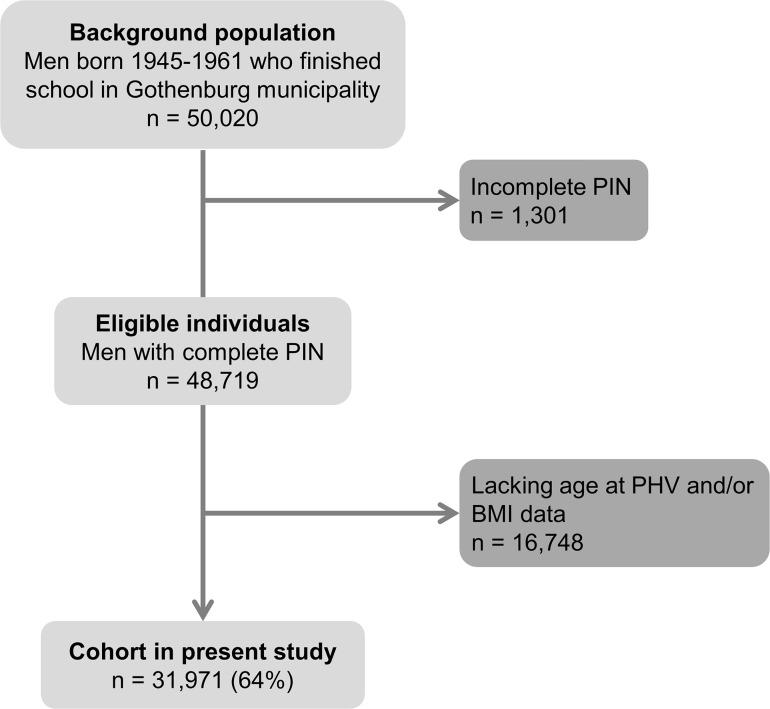
In the BMI Epidemiology Study Gothenburg, 31,971 Swedish men born between January 1, 1945, and December 31, 1961, with detailed growth data (height and weight) available from centrally archived school healthcare records and the conscription register were followed until December 31, 2016. Age at PHV was calculated according to a modified infancy-childhood-puberty model, and fracture information was retrieved from the Swedish National Patient Register. The mean ± SD age at PHV was 14.1 ± 1.1 years. In total, 5,872 men (18.4%) sustained at least 1 fracture after 20 years of age and 5,731 men (17.9%) sustained a non-vertebral fracture after 20 years of age during a mean ± SD follow-up of 37.3 ± 11.7 years. Cox proportional hazards models adjusted for birth year and country of origin revealed that age at PHV was associated with the risk of any fracture and non-vertebral fracture. Participants with age at PHV in the highest tertile (after 14.5 years of age) were at greater risk of any fracture (hazard ratio [HR] 1.15, 95% confidence interval [CI] 1.08-1.22, P < 0.001) and non-vertebral fracture (HR 1.16, 95% CI 1.09-1.24, P < 0.001) compared with those with age at PHV in the lowest tertile (at 13.6 years of age or younger). Additional adjustments for birthweight, childhood BMI, adult educational level, and young adult height did not attenuate the associations between age at PHV and adult fracture risk. Limitations of this study include the inability to adjust for important risk factors for fracture, inadequate power to assess the relation between pubertal timing and specific fracture types, and the limited generalizability to other populations.
CONCLUSIONS
In this study, we observed that late pubertal timing was associated with increased adult fracture risk in men. These findings suggest that information on pubertal timing might aid in the identification of those men at greatest risk of fracture.
背景
青春期是骨量积累的关键时期,男孩青春期延迟与成年男性骨量减少有关。然而,青春期时间变化在成年男性骨折风险中的作用尚不清楚。因此,我们评估了峰值身高速度(PHV)年龄,即青春期时间的一个客观测量指标,与成年男性骨折风险之间的关系。
方法和发现
在 BMI 流行病学研究哥德堡,我们对 1945 年 1 月 1 日至 1961 年 12 月 31 日期间出生的 31971 名瑞典男性进行了研究,这些男性在中央存档的学校保健记录和兵役登记中都有详细的生长数据(身高和体重)。根据改良的婴儿-儿童-青春期模型计算 PHV 年龄,骨折信息从瑞典国家患者登记处检索。PHV 年龄的平均值±标准差为 14.1±1.1 岁。在平均随访 37.3±11.7 年后,共有 5872 名男性(18.4%)在 20 岁后至少发生 1 次骨折,5731 名男性(17.9%)在 20 岁后发生非椎骨骨折。经出生年份和原籍国调整的 Cox 比例风险模型显示,PHV 年龄与任何骨折和非椎骨骨折的风险相关。PHV 年龄处于最高三分位组(14.5 岁以后)的参与者发生任何骨折(风险比[HR]1.15,95%置信区间[CI]1.08-1.22,P<0.001)和非椎骨骨折(HR 1.16,95%CI 1.09-1.24,P<0.001)的风险均高于 PHV 年龄处于最低三分位组(13.6 岁或以下)的参与者。进一步调整出生体重、儿童期 BMI、成年教育程度和青年期身高并没有降低 PHV 年龄与成年骨折风险之间的关联。本研究的局限性包括无法调整骨折的重要危险因素、评估青春期时间与特定骨折类型之间关系的能力有限,以及对其他人群的推广能力有限。
结论
在这项研究中,我们观察到青春期延迟与男性成年骨折风险增加有关。这些发现表明,青春期时间的信息可能有助于识别骨折风险最大的男性。
 Zotero 插件