
年龄相关的 Sox2+ 支持细胞在小鼠耳蜗中的转录组变化。
Age-related transcriptome changes in Sox2+ supporting cells in the mouse cochlea.
机构信息
Jiangsu Provincial Key Medical Discipline (Laboratory), Department of Otolaryngology Head and Neck Surgery, Affiliated Drum Tower Hospital of Nanjing University Medical School, No. 321 Zhongshan Road, Nanjing, 210008, China.
Research Institute of Otolaryngology, No. 321 Zhongshan Road, Nanjing, 210008, China.
出版信息
Stem Cell Res Ther. 2019 Dec 2;10(1):365. doi: 10.1186/s13287-019-1437-0.
BACKGROUND
Inner ear supporting cells (SCs) in the neonatal mouse cochlea are a potential source for hair cell (HC) regeneration, but several studies have shown that the regeneration ability of SCs decreases dramatically as mice age and that lost HCs cannot be regenerated in adult mice. To better understand how SCs might be better used to regenerate HCs, it is important to understand how the gene expression profile changes in SCs at different ages.
METHODS
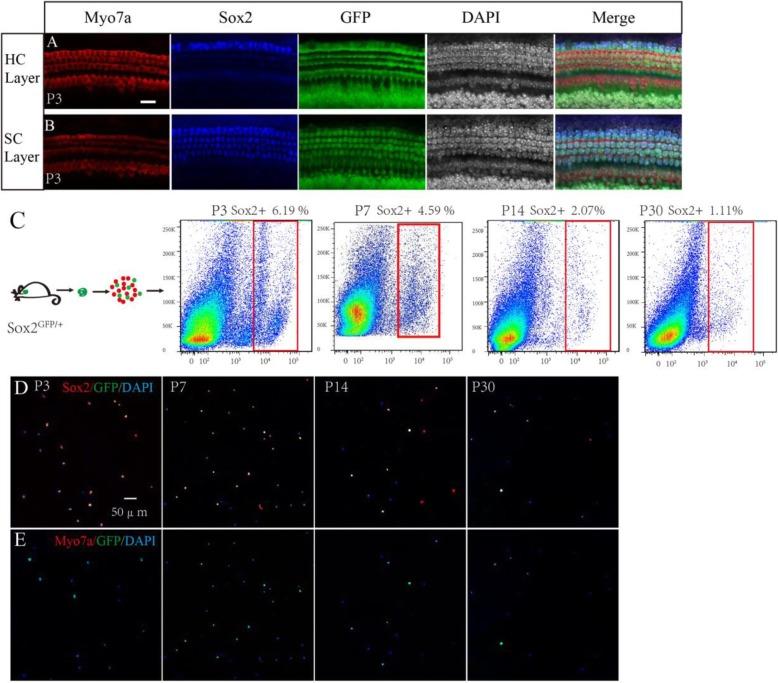
Here, we used Sox2 mice to isolate the Sox2+ SCs at postnatal day (P)3, P7, P14, and P30 via flow cytometry. Next, we used RNA-seq to determine the transcriptome expression profiles of P3, P7, P14, and P30 SCs. To further analyze the relationships between these age-related and differentially expressed genes in Sox2+ SCs, we performed gene ontology (GO) analysis.
RESULTS
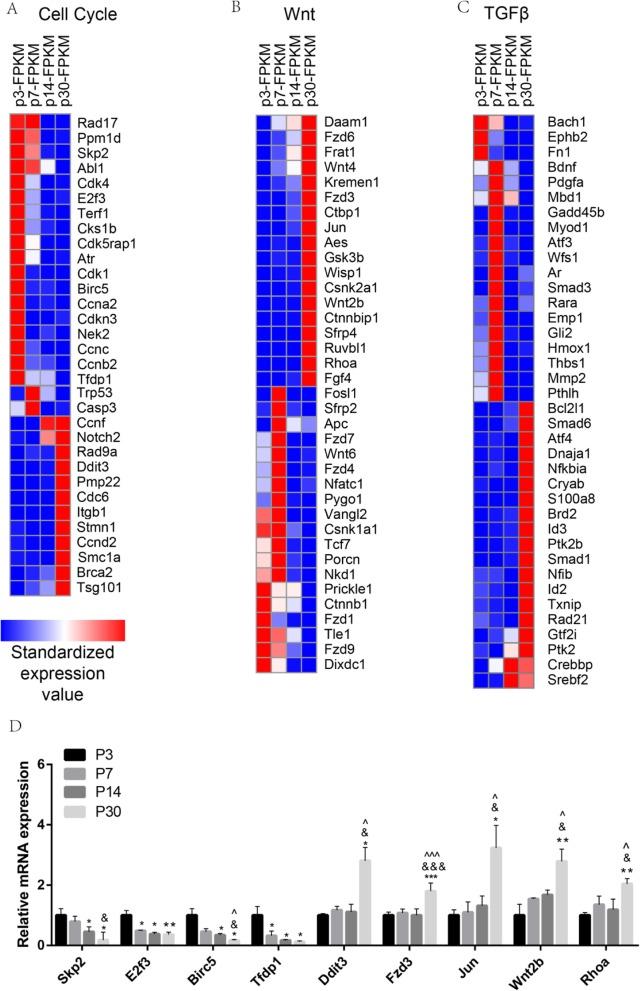
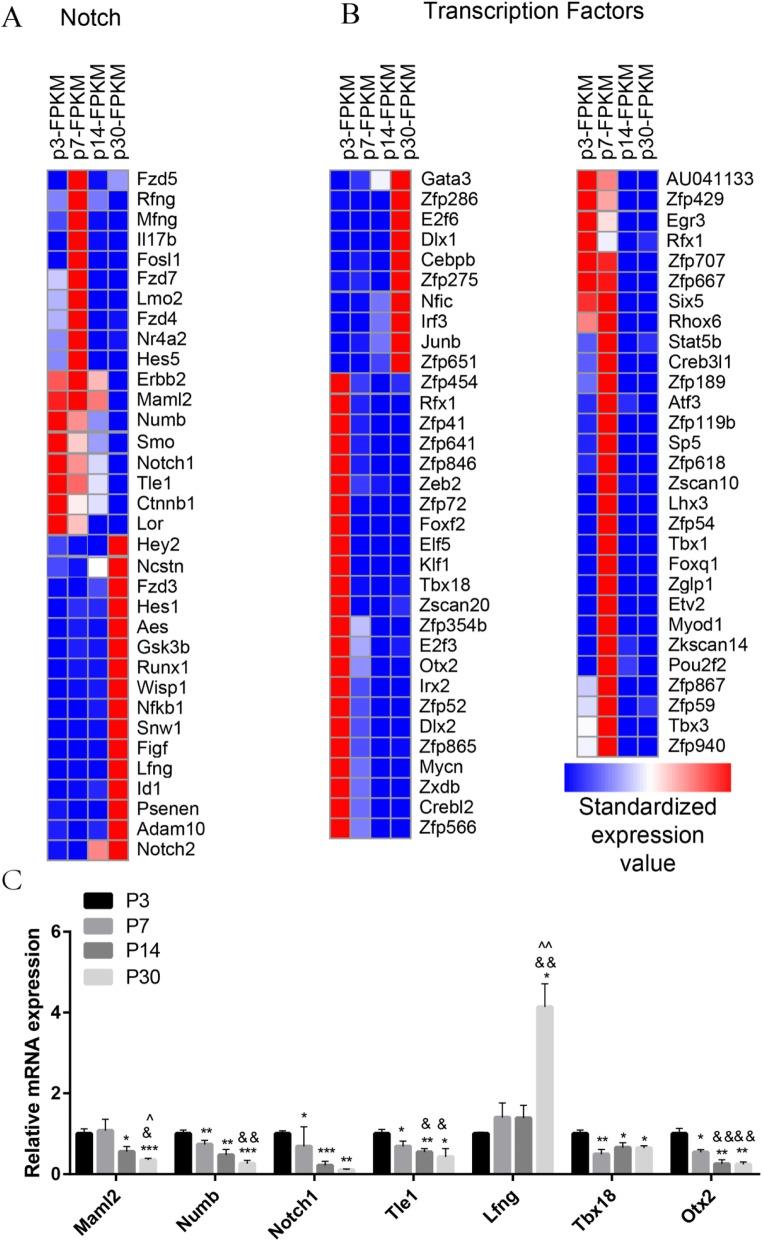
Consistent with previous reports, we also found that the proliferation and HC regeneration ability of isolated Sox2+ SCs significantly decreased as mice aged. We identified numerous genes that are enriched and differentially expressed in Sox2+ SCs at four different postnatal ages, including cell cycle genes, signaling pathway genes, and transcription factors that might be involved in regulating the proliferation and HC differentiation ability of SCs. We thus present a set of genes that might regulate the proliferation and HC regeneration ability of SCs, and these might serve as potential new therapeutic targets for HC regeneration.
CONCLUSIONS
In our research, we found several genes that might play an important role in regulating the proliferation and HC regeneration ability of SCs. These datasets are expected to serve as a resource to provide potential new therapeutic targets for regulating the ability of SCs to regenerate HCs in postnatal mammals.
背景
新生小鼠耳蜗中的内耳支持细胞 (SCs) 是毛细胞 (HC) 再生的潜在来源,但多项研究表明,随着年龄的增长,SCs 的再生能力会显著下降,成年小鼠的 HC 无法再生。为了更好地理解如何更好地利用 SC 来再生 HC,了解不同年龄 SC 中的基因表达谱如何变化非常重要。
方法
在这里,我们使用 Sox2 小鼠通过流式细胞术在出生后第 3、7、14 和 30 天 (P) 分离 Sox2+SCs。接下来,我们使用 RNA-seq 确定 P3、P7、P14 和 P30 SCs 的转录组表达谱。为了进一步分析 Sox2+SCs 中这些与年龄相关的差异表达基因之间的关系,我们进行了基因本体 (GO) 分析。
结果
与之前的报告一致,我们还发现分离的 Sox2+SCs 的增殖和 HC 再生能力随着小鼠年龄的增长而显著下降。我们鉴定了许多在四个不同出生后年龄的 Sox2+SCs 中丰富和差异表达的基因,包括细胞周期基因、信号通路基因和转录因子,这些基因可能参与调节 SC 的增殖和 HC 分化能力。因此,我们提出了一组可能调节 SC 的增殖和 HC 再生能力的基因,这些基因可能成为 HC 再生的潜在新治疗靶点。
结论
在我们的研究中,我们发现了几个可能在调节 SC 的增殖和 HC 再生能力方面发挥重要作用的基因。这些数据集有望成为资源,为调节后生哺乳动物 SC 再生 HC 的能力提供潜在的新治疗靶点。



 Zotero 插件