
血液铅水平与颈动脉粥样硬化风险:来自瑞典队列的研究结果。
Blood Lead Levels and Risk of Atherosclerosis in the Carotid Artery: Results from a Swedish Cohort.
机构信息
Occupational and Environmental Medicine, Sahlgrenska University Hospital and University of Gothenburg, Gothenburg, Sweden.
Department of Clinical Sciences in Malmö, CRC, Lund University and Skåne University Hospital, Malmö, Sweden.
出版信息
Environ Health Perspect. 2019 Dec;127(12):127002. doi: 10.1289/EHP5057. Epub 2019 Dec 6.
BACKGROUND
Lead exposure has been associated with increased incidence of adverse clinical cardiovascular outcomes. Atherosclerosis has been suggested as one of the underlying mechanisms, and findings from experimental studies support this, but human data are scarce.
OBJECTIVES
Our objective was to determine the association between environmental lead exposure based on blood lead (B-Pb) concentrations and the prevalence of atherosclerotic plaque in the carotid artery.
METHODS
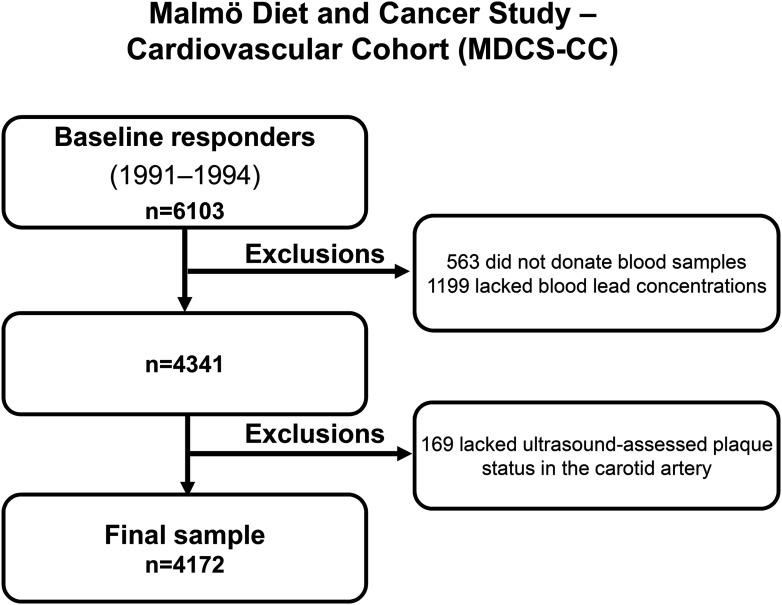
We used cross-sectional data from the Malmö Diet and Cancer Study cardiovascular cohort (MDCS-CC; recruitment in 1991-1994) covering 4,172 middle-aged men and women. B-Pb at baseline, measured by inductively coupled plasma mass spectrometry, was used as the exposure biomarker. The presence of atherosclerotic plaque in the carotid artery was determined by B-mode ultrasonography. We used logistic regression to estimate odds ratios (ORs) for prevalence of plaque in the carotid artery according to B-Pb quartiles.
RESULTS
The median B-Pb was (range: 1.5-258), and 36% of the cohort had any atherosclerotic plaque. After controlling for confounders and known cardiovascular risk factors, the OR for prevalence of plaque in the highest quartile (Q4) of B-Pb compared with the lowest quartile (Q1) was 1.35 (95% CI: 1.09, 1.66) in the total group, 1.58 (95% CI: 1.20, 2.08) among women, and 1.18 (95% CI: 0.83, 1.69) among men. Among women, associations were limited to those who were postmenopausal [OR for Q4 vs. 1.72 (95% CI: 1.26, 2.34) vs. 0.96 (95% CI: 0.49, 1.89 in premenopausal women)]. Associations were weak and nonsignificant in never-smokers [OR for Q4 vs. 1.14 (95% CI: 0.81, 1.61)].
DISCUSSION
Our study shows an association between B-Pb concentrations and occurrence of atherosclerotic plaque in the carotid artery, adding evidence for an underlying pro-atherogenic role of lead in cardiovascular disease. Associations appeared to be limited to postmenopausal (vs. premenopausal) women. https://doi.org/10.1289/EHP5057.
背景
铅暴露与不良临床心血管结局的发生率增加有关。动脉粥样硬化被认为是其中的一个潜在机制,实验研究的结果支持这一点,但人体数据却很少。
目的
我们的目的是确定基于血铅(B-Pb)浓度的环境铅暴露与颈动脉粥样硬化斑块的患病率之间的关联。
方法
我们使用了 1991-1994 年招募的马尔默饮食与癌症研究心血管队列(MDCS-CC)的横断面数据,该队列涵盖了 4172 名中年男女。基线时通过电感耦合等离子体质谱法测量 B-Pb,作为暴露生物标志物。颈动脉粥样硬化斑块的存在通过 B 型超声检查确定。我们使用逻辑回归估计 B-Pb 四分位数(Q)与颈动脉斑块患病率之间的比值比(OR)。
结果
B-Pb 的中位数为 (范围:1.5-258),队列中有 36%的人有任何程度的动脉粥样硬化斑块。在控制了混杂因素和已知的心血管危险因素后,与最低四分位(Q1)相比,B-Pb 最高四分位(Q4)的斑块患病率的 OR 为 1.35(95%CI:1.09,1.66)在总人群中,1.58(95%CI:1.20,2.08)在女性中,1.18(95%CI:0.83,1.69)在男性中。在女性中,这种关联仅限于绝经后女性[Q4 与 Q4 的比值比(OR)为 1.72(95%CI:1.26,2.34)vs. 0.96(95%CI:0.49,1.89)在绝经前女性中]。在从不吸烟的人群中,关联较弱且无统计学意义[Q4 与 Q4 的比值比(OR)为 1.14(95%CI:0.81,1.61)]。
讨论
我们的研究表明,B-Pb 浓度与颈动脉粥样硬化斑块的发生之间存在关联,为铅在心血管疾病中潜在的促动脉粥样硬化作用提供了证据。这种关联似乎仅限于绝经后(与绝经前)女性。https://doi.org/10.1289/EHP5057.


 Zotero 插件