
肽酰基精氨酸脱亚氨酶自身免疫与类风湿关节炎中抗瓜氨酸化蛋白抗体的发展:半抗原-载体模型。
Peptidylarginine Deiminase Autoimmunity and the Development of Anti-Citrullinated Protein Antibody in Rheumatoid Arthritis: The Hapten-Carrier Model.
机构信息
INSERM UMRs 1097 and Aix-Marseille University, Marseille, France.
INSERM UMRs 1097, Aix-Marseille University, and Assistance Publique-Hôpitaux de Marseille, Marseille, France.
出版信息
Arthritis Rheumatol. 2020 Jun;72(6):903-911. doi: 10.1002/art.41189. Epub 2020 Apr 26.
OBJECTIVE
The presence of autoantibodies to citrullinated proteins (ACPAs) often precedes the development of rheumatoid arthritis (RA). Citrullines are arginine residues that have been modified by peptidylarginine deiminases (PADs). PAD4 is the target of autoantibodies in RA. ACPAs could arise because PAD4 is recognized by T cells, which facilitate the production of autoantibodies to proteins bound by PAD4. We previously found evidence for this hapten-carrier model in mice. This study was undertaken to investigate whether there is evidence for this model in humans.
METHODS
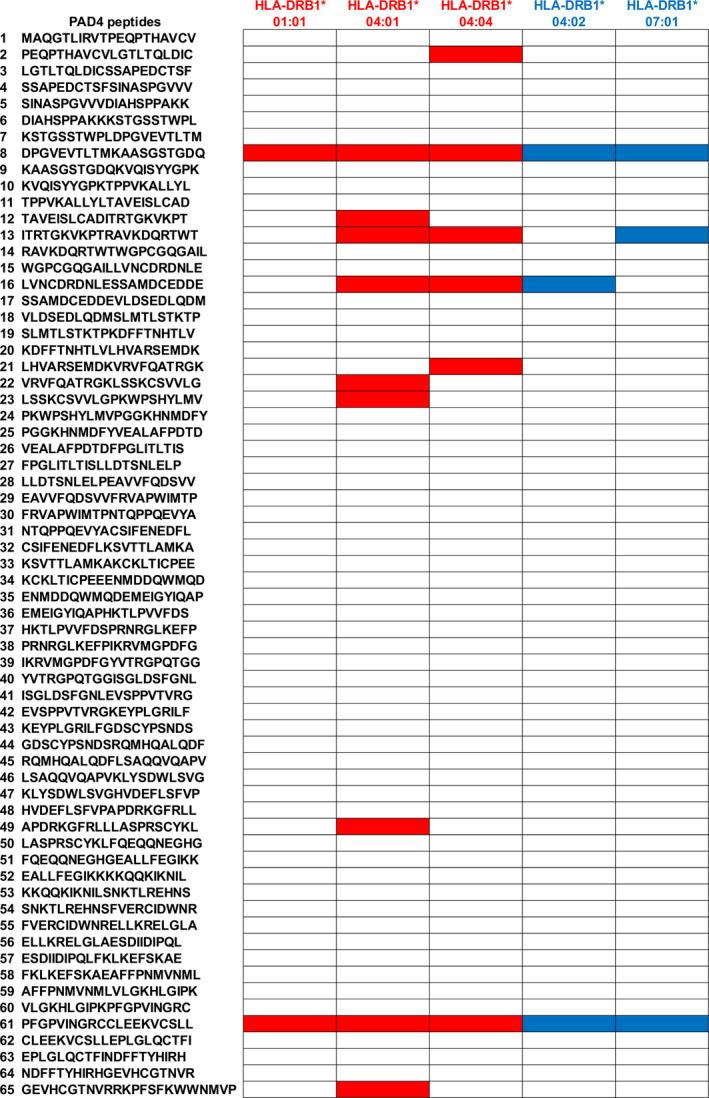
We analyzed antibody response to PAD4 and T cell proliferation in response to PAD4 in 41 RA patients and 36 controls. We tested binding of 65 PAD4 peptides to 5 HLA-DR alleles (DRB1*04:01, *04:02, *04:04, *01:01, and *07:01) and selected 11 PAD4 peptides for proliferation studies using samples from 22 RA patients and 27 controls. Peripheral blood lymphocytes from an additional 10 RA patients and 7 healthy controls were analyzed by flow cytometry for CD3, CD4, CD154, and tumor necrosis factor expression after PAD4 stimulation.
RESULTS
Only patients with RA had both antibodies and T cell responses to PAD4. T cell response to peptide 8, a PAD4 peptide, was associated with RA (P = 0.02), anti-PAD4 antibodies (P = 0.057), and the shared epitope (P = 0.05).
CONCLUSION
ACPA immunity is associated with antibodies to PAD4 and T cell responses to PAD4 and PAD4 peptides. These findings are consistent with a hapten-carrier model in which PAD4 is the carrier and citrullinated proteins are the haptens.
目的
抗瓜氨酸化蛋白自身抗体(ACPAs)的存在常常先于类风湿关节炎(RA)的发生。瓜氨酸是由肽基精氨酸脱亚氨酶(PADs)修饰的精氨酸残基。PAD4 是 RA 中自身抗体的靶标。ACPAs 的产生可能是因为 T 细胞识别 PAD4,从而促进了与 PAD4 结合的蛋白的自身抗体的产生。我们之前在小鼠中发现了这种半抗原-载体模型的证据。本研究旨在探讨该模型在人类中是否存在证据。
方法
我们分析了 41 例 RA 患者和 36 例对照者中 PAD4 抗体的应答以及 PAD4 刺激下的 T 细胞增殖反应。我们检测了 65 个 PAD4 肽与 5 个 HLA-DR 等位基因(DRB1*04:01、*04:02、*04:04、01:01 和07:01)的结合情况,并选择了 11 个 PAD4 肽用于增殖研究,使用了来自 22 例 RA 患者和 27 例对照者的样本。另外,对 10 例 RA 患者和 7 例健康对照者的外周血淋巴细胞进行了分析,通过流式细胞术检测 PAD4 刺激后 CD3、CD4、CD154 和肿瘤坏死因子的表达。
结果
只有 RA 患者对 PAD4 既有抗体应答又有 T 细胞应答。PAD4 肽 8 的 T 细胞应答与 RA(P=0.02)、抗 PAD4 抗体(P=0.057)和共享表位(P=0.05)相关。
结论
ACPAs 免疫与 PAD4 抗体和 PAD4 肽的 T 细胞应答有关。这些发现与 PAD4 作为载体和瓜氨酸化蛋白作为半抗原的半抗原-载体模型一致。



 Zotero 插件