
肠道微生物群与嵌合抗原受体T细胞(CAR-T)疗法
Gut microbiome and CAR-T therapy.
作者信息
Abid Muhammad Bilal, Shah Nirav N, Maatman Theresa C, Hari Parameswaran N
机构信息
1Division of Infectious Diseases, Medical College of Wisconsin (MCW), Hub for Collaborative Medicine, 8701 Watertown Plank Road, Milwaukee, WI 53226 USA.
2Division of Hematology/Oncology, Medical College of Wisconsin (MCW), Milwaukee, WI USA.
出版信息
Exp Hematol Oncol. 2019 Nov 19;8:31. doi: 10.1186/s40164-019-0155-8. eCollection 2019.
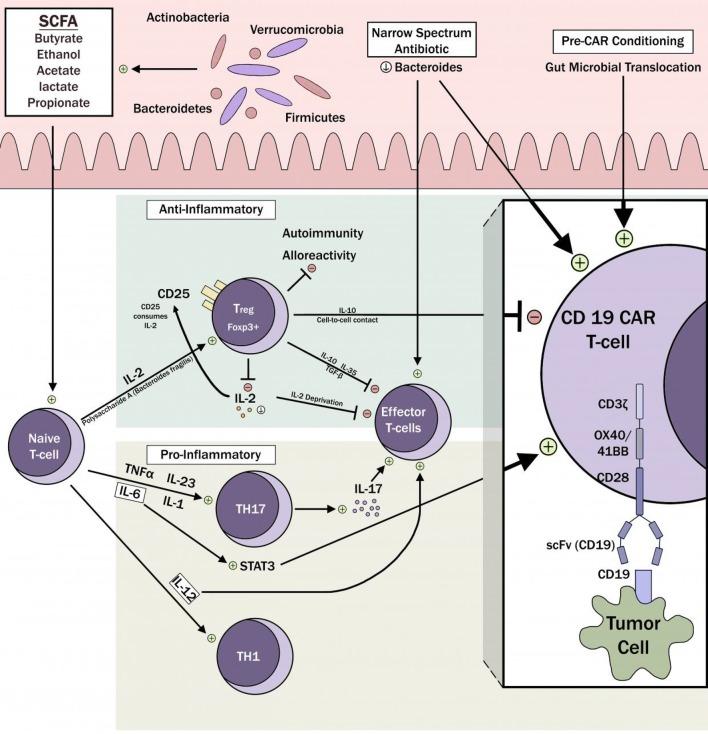
Considerable progress has been made in cancer therapeutics recently with targeted strategies that are efficacious and less toxic. Immunotherapy and chimeric antigen receptor (CAR) T-cells are increasingly being evaluated in a variety of tumors in the relapsed/refractory as well as frontline disease settings, predominantly in hematologic malignancies (HM). Despite impressive outcomes in select patients, there remains significant heterogeneity in clinical response to CAR T-cells. The gut microbiome has emerged as one of the key host factors that could potentially be modulated to enhance responses to immunotherapy. Several recent human studies receiving immunotherapy showed a significantly superior response and survival in patients with the more diverse gut microbiome. Currently, it is unknown if gut microbiota modulates anti-tumor responses to CAR T-cells. Based on molecular and immunological understanding, we hypothesize that strategically manipulating gut microbiota may enhance responses to CAR T-cells. In this review, we further discuss resistance mechanisms to CAR T-cells in HM, potential approaches to overcome resistance by harnessing gut microbiota and other related novel strategies.
近年来,癌症治疗领域取得了显著进展,出现了有效且毒性较小的靶向治疗策略。免疫疗法和嵌合抗原受体(CAR)T细胞正越来越多地在复发/难治性以及一线疾病环境中的各种肿瘤中进行评估,主要是在血液系统恶性肿瘤(HM)中。尽管在部分患者中取得了令人瞩目的疗效,但CAR T细胞的临床反应仍存在显著异质性。肠道微生物群已成为关键的宿主因素之一,有可能通过调节它来增强免疫治疗反应。最近几项接受免疫治疗的人体研究表明,肠道微生物群更多样化的患者反应和生存率明显更高。目前,尚不清楚肠道微生物群是否会调节对CAR T细胞的抗肿瘤反应。基于分子和免疫学的认识,我们假设通过策略性地操纵肠道微生物群可能会增强对CAR T细胞的反应。在这篇综述中,我们将进一步讨论HM中对CAR T细胞的耐药机制、利用肠道微生物群克服耐药性的潜在方法以及其他相关的新策略。

 Zotero 插件