
影响日间手术患者选择椎管内麻醉或全身麻醉的因素:一项多中心观察性研究的结果。
Factors Determining the Choice of Spinal Versus General Anesthesia in Patients Undergoing Ambulatory Surgery: Results of a Multicenter Observational Study.
机构信息
Department of Anesthesia and Intensive Care Medicine, Lapeyronie University Hospital and Inserm U1051, Montpellier NeuroSciences Institute, Montpellier, France.
Polyclinique, Cesson-Sévigné, France.
出版信息
Adv Ther. 2020 Jan;37(1):527-540. doi: 10.1007/s12325-019-01171-6. Epub 2019 Dec 11.
INTRODUCTION
Available short-acting intrathecal anesthetic agents (chloroprocaine and prilocaine) offer an alternative to general anesthesia for short-duration surgical procedures, especially ambulatory surgeries. Factors determining the choice of anesthesia for short-duration procedures have not been previously identified.
METHODS
This observational, prospective, multicenter, cohort study was conducted between July 2015 and July 2016, in 33 private or public hospitals performing ambulatory surgery. The primary objective was to determine the factors influencing the choice of anesthetic technique (spinal or general anesthesia). Secondary outcomes included efficacy of the anesthesia, time to hospital discharge, and patient satisfaction.
RESULTS
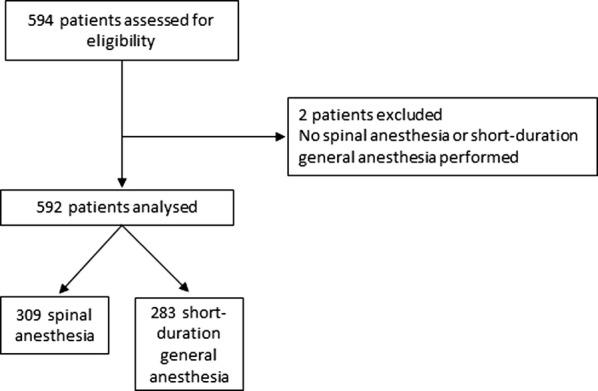
Among 592 patients enrolled, 309 received spinal anesthesia and 283 underwent general anesthesia. In both study arms, the most frequently performed surgical procedures were orthopedic and urologic (43.3% and 30.7%, respectively); 66.1% of patients were free to choose their type of anesthesia, 21.8% chose one of the techniques because they were afraid of the other, 16.8% based their choice on the expected ease of recovery, 19.2% considered their degree of anxiety/stress, and 16.9% chose the technique on the basis of its efficacy. The median times to micturition and to unassisted ambulation were significantly shorter in the general anesthesia arm compared with the spinal anesthesia arm (225.5 [98; 560] min vs. 259.0 [109; 789] min; p = 0.0011 and 215.0 [30; 545] min vs. 240.0 [40; 1420]; p = 0.0115, respectively). The median time to hospital discharge was equivalent in both study arms. In the spinal anesthesia arm, patients who received chloroprocaine and prilocaine recovered faster than patients who received bupivacaine. The time to ambulation and the time to hospital discharge were shorter (p < 0.001). The overall success rate of spinal anesthesia was 91.6%, and no significant difference was observed between chloroprocaine, prilocaine, and bupivacaine. The patients' global satisfaction with anesthesia and surgery was over 90% in both study arms.
CONCLUSIONS
Patient's choice, patient fear of the alternative technique, patient stress/anxiety, the expected ease of recovery, and the efficacy of the technique were identified as the main factors influencing patient choice of short-acting local anesthesia or general anesthesia. Spinal anesthesia with short-acting local anesthetics was preferred to general anesthesia in ambulatory surgeries and was associated with a high degree of patient satisfaction.
TRIAL REGISTRATION
ClinicalTrials.gov identifier NCT02529501. Registered on June 23, 2015. Date of enrollment of the first participant July 21, 2015.
简介
现有的短效鞘内麻醉剂(氯普鲁卡因和丙泊酚)可为短时间手术提供替代全身麻醉的选择,尤其是门诊手术。以前并未确定用于短时间手术的麻醉选择因素。
方法
这是一项在 2015 年 7 月至 2016 年 7 月间于 33 家开展门诊手术的私立或公立医院开展的观察性、前瞻性、多中心队列研究。主要目的是确定影响麻醉技术选择(脊髓或全身麻醉)的因素。次要结局包括麻醉效果、出院时间和患者满意度。
结果
592 例患者中,309 例接受了脊髓麻醉,283 例接受了全身麻醉。在两个研究组中,最常进行的手术为骨科和泌尿科手术(分别为 43.3%和 30.7%);66.1%的患者可以自由选择其麻醉方式,21.8%的患者因为害怕另一种麻醉方式而选择其中之一,16.8%的患者基于预期的恢复难易程度选择,19.2%的患者考虑其焦虑/压力程度,16.9%的患者基于其疗效选择。与脊髓麻醉组相比,全身麻醉组患者排尿和非辅助步行的中位时间明显缩短(225.5[98;560]min 与 259.0[109;789]min;p=0.0011 和 215.0[30;545]min 与 240.0[40;1420]min;p=0.0115)。两组患者的中位出院时间相当。在脊髓麻醉组中,接受氯普鲁卡因和丙泊酚的患者比接受布比卡因的患者恢复更快。步行和出院时间更短(p<0.001)。脊髓麻醉的整体成功率为 91.6%,氯普鲁卡因、丙泊酚和布比卡因之间未见显著差异。两组患者对麻醉和手术的总体满意度均超过 90%。
结论
患者选择、患者对替代技术的恐惧、患者的压力/焦虑、预期的恢复难易程度以及技术的疗效被确定为影响患者选择局部短效麻醉或全身麻醉的主要因素。在门诊手术中,使用短时效局部麻醉剂的脊髓麻醉优于全身麻醉,且患者满意度高。
试验注册
ClinicalTrials.gov 标识符 NCT02529501。于 2015 年 6 月 23 日注册。第一个参与者于 2015 年 7 月 21 日入组。
 Zotero 插件