
免疫疗法在任何治疗线均可改善晚期转移性非小细胞肺癌(NSCLC)患者的生存,优于化疗(Quijote-CLICaP)。
Immunotherapy at any line of treatment improves survival in patients with advanced metastatic non-small cell lung cancer (NSCLC) compared with chemotherapy (Quijote-CLICaP).
机构信息
Foundation for Clinical and Applied Cancer Research (FICMAC), Bogotá, Colombia.
Molecular Oncology and Biology Systems Research Group (FOX-G), Universidad el Bosque, Bogotá, Colombia.
出版信息
Thorac Cancer. 2020 Feb;11(2):353-361. doi: 10.1111/1759-7714.13272. Epub 2019 Dec 12.
BACKGROUND
To compare survival outcomes of patients with advanced or metastatic non-small cell lung cancer (NSCLC) who received immunotherapy as first-, second- or beyond line, versus matched patients receiving standard chemotherapy with special characterization of hyperprogressors.
METHODS
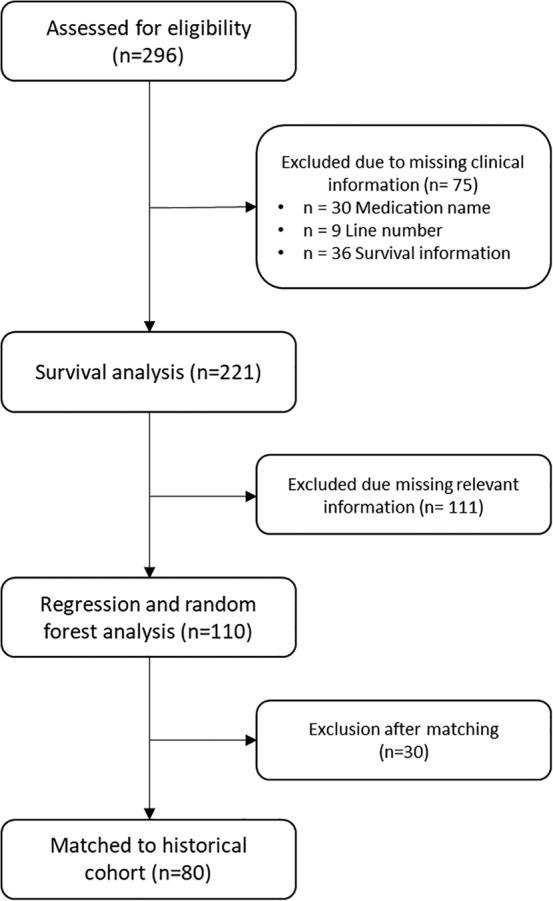
A retrospective cohort study of 296 patients with unresectable/metastatic NSCLC treated with either, first-, second-, third- or fourth-line of immunotherapy was conducted. A matched comparison with a historical cohort of first-line chemotherapy and a random forest tree analysis to characterize hyperprogressors was conducted.
RESULTS
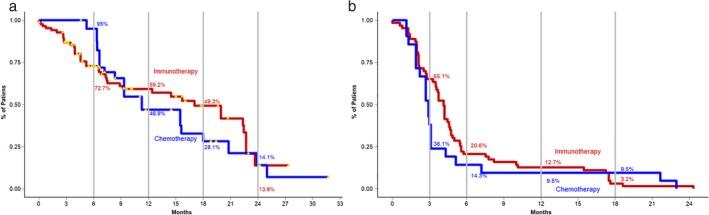
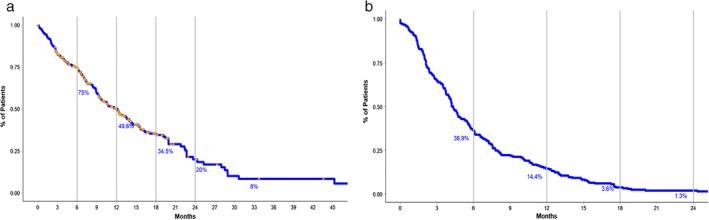
Median age was 64 years (range 34-90), 40.2% of patients were female. A total of 91.2% of patients had an Eastern Cooperative Oncology Group (ECOG) performance score ≤ 1. Immunotherapy as first-line was given to 39 patients (13.7%), second-line to 140 (48.8%), and as third-line and beyond to 108 (37.6%). Median overall survival was 12.7 months (95% CI 9.67-14 months) and progression-free survival (PFS) of 4.27 months (95% CI 3.97-5.0). Factors associated with increased survival included treatment with immunotherapy as first-line (P < 0.001), type of response (P < 0.001) and PD-L1 status (P = 0.0039). Compared with the historical cohort, immunotherapy proved to be superior in terms of OS (P = 0.05) but not PFS (P = 0.2). A total of 44 hyperprogressors were documented (19.8%, [95% CI 14.5-25.1%]). Leukocyte count over 5.300 cells/dL was present in both hyperprogressors and long-term responders.
CONCLUSIONS
Patients who receive immune-checkpoint inhibitors as part of their treatment for NSCLC have better overall survival (OS) compared with matched patients treated with standard chemotherapy, regardless of the line of treatment.
背景
比较接受免疫治疗的晚期或转移性非小细胞肺癌(NSCLC)患者的生存结果,这些患者接受免疫治疗作为一线、二线或以上治疗,与接受标准化疗的匹配患者相比,特别描述了超进展者。
方法
对 296 名接受免疫治疗的不可切除/转移性 NSCLC 患者进行了回顾性队列研究,这些患者接受了一线、二线、三线或四线免疫治疗。与一线化疗的历史队列进行匹配比较,并进行随机森林树分析以描述超进展者。
结果
中位年龄为 64 岁(范围 34-90),40.2%的患者为女性。共有 91.2%的患者的东部合作肿瘤学组(ECOG)表现评分≤1。一线免疫治疗给予 39 例(13.7%),二线治疗给予 140 例(48.8%),三线及以上治疗给予 108 例(37.6%)。中位总生存期为 12.7 个月(95%CI 9.67-14 个月),无进展生存期(PFS)为 4.27 个月(95%CI 3.97-5.0)。与生存增加相关的因素包括一线接受免疫治疗(P<0.001)、反应类型(P<0.001)和 PD-L1 状态(P=0.0039)。与历史队列相比,免疫治疗在 OS 方面表现出优越性(P=0.05),但在 PFS 方面没有优势(P=0.2)。共记录了 44 例超进展者(19.8%,[95%CI 14.5-25.1%])。白细胞计数超过 5300 个/μL 在超进展者和长期反应者中均存在。
结论
接受免疫检查点抑制剂治疗的 NSCLC 患者的总生存(OS)优于接受标准化疗的匹配患者,无论治疗线如何。

 Zotero 插件