
替代增塑聚氯乙烯输注管的材料对药物吸附和增塑剂释放的影响。
Impact of alternative materials to plasticized PVC infusion tubings on drug sorption and plasticizer release.
机构信息
Universite Clermont Auvergne, CHU Clermont-Ferrand, CNRS, SIGMA Clermont, ICCF, F-63000, Clermont-Ferrand, France.
Unité De Biostatistiques (Délégation à La Recherche Clinique Et à l'Innovation), CHU de Clermont-Ferrand, 63000, Clermont-Ferrand, France.
出版信息
Sci Rep. 2019 Dec 12;9(1):18917. doi: 10.1038/s41598-019-55113-x.
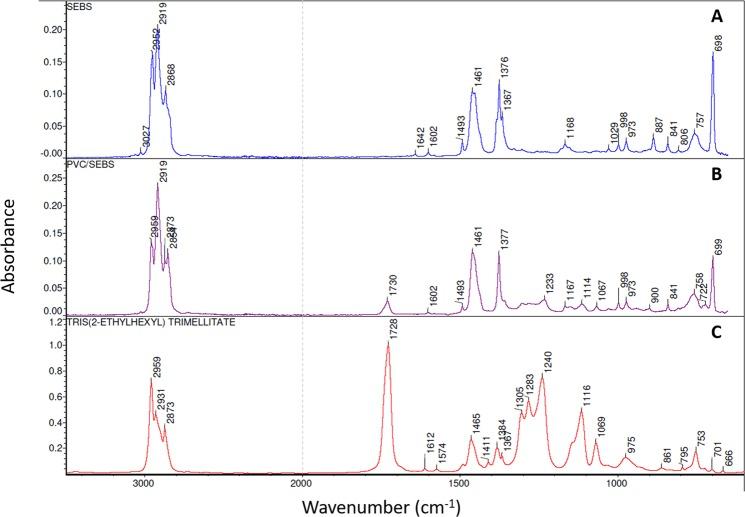
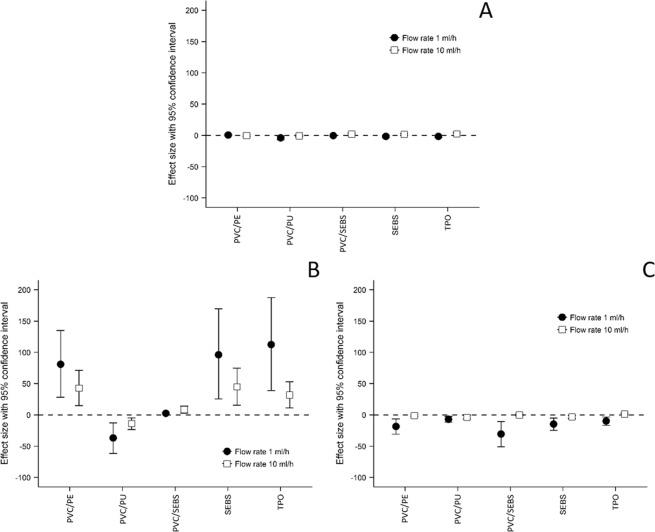
Medical tubings in plasticized polyvinylchloride (PVC) are widely used for the infusion of medications but are known in some cases to cause content-container interactions (drug sorption and plasticizer release). The aim of this study was to assess interactions between drugs and five alternative materials to a reference plasticized PVC intravenous (IV) infusion tubing: three were PVC coextruded with polyethylene (PE), polyurethane (PU) or a thermoplastic elastomer (Styrene-EthyleneButadiene-Styrene (SEBS)) and two were SEBS or thermoplastic olefin (TPO) monolayer tubings. Diazepam and insulin were chosen as respective reference of absorption and adsorption while paracetamol acted as a negative control. The concentration of each drug was quantified with liquid chromatography to evaluate a potential loss after a static contact condition and simulated infusion at 1 mL/h and 10 mL/h dynamic condition by an electric syringe pump. A characterization of each material's surface was performed by Fourier transform infrared spectroscopy in attenuated total reflection mode (ATR-FTIR) and by measurement of surface zeta potential. Plasticizer release was quantified by gas chromatography coupled with mass spectrometry (GC-MS). For all tubings except PVC/PU, no loss of paracetamol was observed in any condition. Diazepam sorption appeared to be less important with PVC/PE, PVC/SEBS, SEBS and TPO tubings than with PVC, but was more important when using PVC/PU tubings. PVC tubings induced the least loss of insulin amongst all the studied materials. Surface analysis by ATR-FTIR highlighted the presence of a plasticizer (that could be attributed to Tris (2-Ethylhexyl) Trimellitate (TOTM)) in the coextruded SEBS layer of PVC/SEBS, which could have influenced drug sorption, probably as a consequence of a migration from the PVC layer. Coextruded PVC/SEBS and PVC/PE presented the lowest zeta potential of all studied materials with respective values of -39 mV and -36 mV and were related to the highest sorption of insulin while PVC/PU with the highest zeta potential (about -9 mV) presented the highest absorption of diazepam. Coextruded layered materials appeared to have a lower plasticizer release than PVC alone. As a conclusion, PVC/PE and thermoplastic elastomers alone or coextruded with PVC could be interesting alternatives to PVC tubings with regards to sorption phenomena and plasticizer release.
聚氯乙烯(PVC)增塑医学管材广泛用于输注药物,但已知在某些情况下会引起药物与容器的相互作用(药物吸附和增塑剂释放)。本研究旨在评估五种替代参考增塑聚氯乙烯静脉(IV)输注管的材料与药物之间的相互作用:三种为共挤出的聚氯乙烯(PE)、聚氨酯(PU)或热塑性弹性体(苯乙烯-乙烯-丁二烯-苯乙烯(SEBS)),两种为 SEBS 或热塑性烯烃(TPO)单层管材。地西泮和胰岛素分别作为吸收和吸附的参考药物,而对乙酰氨基酚则作为阴性对照。采用液相色谱法定量检测每种药物的浓度,以评估在静态接触条件下和通过电动注射器泵以 1mL/h 和 10mL/h 动态条件下输注时潜在的损失。采用衰减全反射傅里叶变换红外光谱法(ATR-FTIR)和表面zeta 电位测量对每种材料的表面特性进行了表征。采用气相色谱-质谱联用(GC-MS)定量测定增塑剂的释放。除了 PVC/PU 之外,所有管材在任何条件下均未观察到对乙酰氨基酚的损失。与 PVC 相比,PVC/PE、PVC/SEBS、SEBS 和 TPO 管材的地西泮吸附似乎不那么重要,但当使用 PVC/PU 管材时,地西泮吸附则更为重要。在所有研究的材料中,PVC 管材对胰岛素的损失最小。ATR-FTIR 表面分析突出了增塑剂(可能是三(2-乙基己基)偏苯三甲酸酯(TOTM))在 PVC/SEBS 共挤出 SEBS 层中的存在,这可能影响了药物的吸附,可能是由于从 PVC 层迁移所致。共挤出的 PVC/SEBS 和 PVC/PE 具有所有研究材料中最低的zeta 电位,分别为-39mV 和-36mV,与胰岛素的最高吸附有关,而具有最高 zeta 电位(约-9mV)的 PVC/PU 则对最高的地西泮吸收。共挤出层状材料的增塑剂释放似乎低于单独的 PVC。因此,单独的 PVC/PE 和热塑性弹性体或与 PVC 共挤出的材料在药物吸附和增塑剂释放方面可能是 PVC 管材的替代品。


 Zotero 插件